

There are a total of seventeen cemeteries in Cypress Hills on either side of the Brooklyn-Queens border. It’s a hilly area, where thousands of years ago a glacier was stopped cold, depositing debris in its advance, accounting for the hills of Staten Island and the middle of Brooklyn, Queens and on into Long Island. I’ve chosen to feature National Cemetery at Jamaica Avenue and Hale Street on Memorial Day, since each and every one of its over 21,000 stones bears the cross that appears on the gravestone of a military veteran.
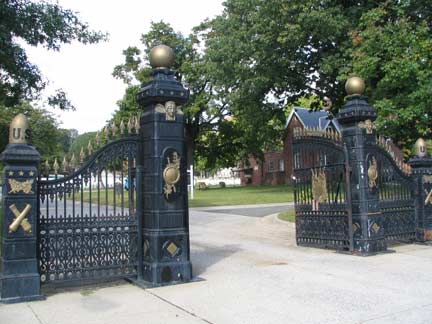
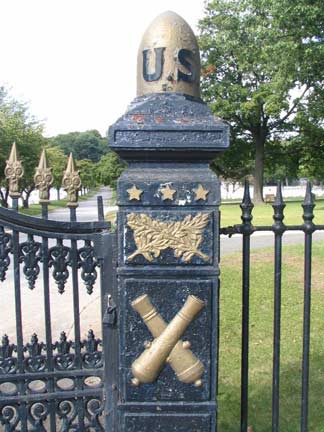
The National Cemetery network was established during the Civil War. On July 17, 1862, Congress enacted legislation that authorized the President to purchase “cemetery grounds” to be used as national cemeteries “for soldiers who shall have died in the service of the country.” The cemeteries were soon to do a good business. In that first year, a National Cemetery established in Sharpsburg, Maryland became the final resting place for 4, 476 Union soldiers killed at the Battle of Antietam, September 17, 1862, the bloodiest day in US history. Today the National Cemetery network consists of 136 cemeteries, 120 administered by the US Department of Veterans Affairs.
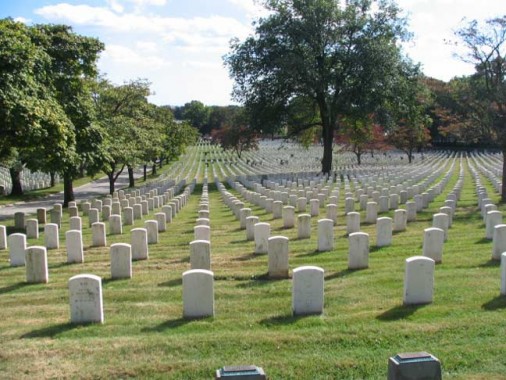
Cypress Hills National Cemetery is one of the original fourteen National Cemeteries. Its site had already been established before its national designation, as part of the larger Cypress Hills Cemetery. Additional land was acquired in 1882 with the aid of Secretary of War Robert Todd Lincoln (son of the President) as well as 1941, when its Mount of Victory and Union plots, in Cypress Hills Cemetery proper, north of National Cemetery, were donated by New York State. The Mount of Victory plot is the final resting place of the last surviving veteran of the war of 1812, Hiram Cronk, who died in 1905 at age 105.
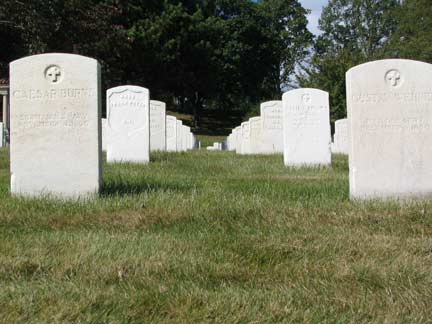
Over 7,000 Civil War veterans, Union and Confederate, are buried at Cypress Hills National. Only the Gettysburg and Arlington Cemeteries contain more Civil War veterans killed at Gettysburg than does Cypress Hills National. Private Alfred Mitchell was the first Union interment. 22 Medal of Honor awardees, marked by gold-lettered, marble headstones, are here. The Medal of Honor is the highest award for valor in action given to a member of the armed services; it is generally given personally by the President.
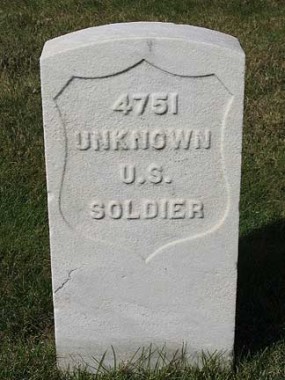
Three members of the 7th US Calvary who survived the battle of Little Big Horn, June 25, 1876, are interred at Cypress Hills National, including Italian-born bugler John Martin (Giovanni Martini) who had served in his youth under Giuseppe Garibaldi for Italian independence. Martin served in the miltary for 30 years, 1874-1904, and later served at the 103rd Street IRT subway station taking tickets in the days before tokens. He passed away in 1922.
Nine other countries, Argentina, Brazil, Canada, France, Italy, Poland, Russia, Spain and the U.K., claim interments in the Cemetery, including 25 French sailors who died while on duty in American waters in WWI, and British Revolutionary soldiers whose remains were transferred to Cypress Hills National in 1909, the earliest war dead in the Cemetery.
Cypress Hills National Cemetery [US Dept. of Veterans Affairs]
5/26/12
33 comments
May they all be at Fiddler’s Green
Are Confederate veterans actually buried within the confines of this National Cemetery, or rather in adjacent land? Confederates are generally excluded from National Cemeteries. Clarification?
There are plenty of Confederates in other NYC cemeteries — including my great-grandfather, over in St. Raymond’s. He was formerly a commandand of the NYC Camp of the United Confederate Veterans (and a salesman of gents’ hats, in real life), one of many ex-Rebs who figured out which side won, after the War.
Yes, there are many Confederate soldiers buried in Cypress Hills National Cemetery. These soldiers are buried in the section of the cemetery known as the “Union Grounds,” found in the public cemetery adjacent to that which is usually known as Cypress Hills National Cemetery. After Gettysburg itself, Cypress Hills has the greatest number of marked grave sites for soldiers, both Confederate and Union, who fought at Gettysburg. From what I know, most of the Gettysburg soldiers buried at Cypress Hills were wounded during the battle, sent to hospitals in the NY area, and did not survive their war wounds. Some soldiers previously buried elsewhere were relocated to the Cypress Hills “Union Grounds” from other sites after the war, but these were (as far as I know) Union soldiers. Other Civil War era soldiers who survived the war are buried in the main section of the cemetery. My Great Great Grandfather, Henry Wales Dennis, a Union soldier with roots in the South, is buried there, as are my grandparents (WWI,) a cousin of my grandmother’s (KIA WWI) and my parents (WWII.)
I must admit that at first I found it jarring to see the way in which Confederate soldiers are buried literally alongside U.S. Colored Troops in the Cypress Hills Union Grounds. There, the USCT graves are interspersed with Confederate graves on a hillside. Many of the USCT soldiers buried in the Union Grounds died of illness while in training, as the wounded of Gettsyburg were dying. I now find the Cypress Hills Union Grounds a remarkable and tragic testament to the Civil War. We all take away our own lessons and meaning from these hallowed grounds.
As we note the 150th anniversary of the battle at Gettysburg, I strongly encourage those who can, to go to Cypress Hills National, and to visit the grave sites of those who gave their last full measure of devotion so that we could be free. May our nation remain united, and may we continue to advance the cause of freedom for which our forefathers made such profound sacrifices.
Oops. I meant to write my Great Granduncle, Henry Wales Dennis. He was my Great Grandfather’s brother.
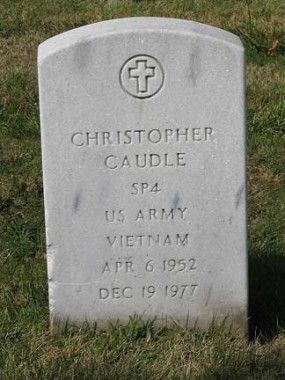
The headstone for Christopher Caudle baffles me. I can’t find any information about him from the war.
FYI the headstone lists the conflict during which the veteran served. Service in the theater or “in country” as we used to say is not required. For example one who served during WW2 is considered a veteran of that war but not a combat veteran unless the person was in theater. The person would still be entitled to WW2 on the headstone.
I didn’t know it was a national cemetery until now. By the way, why do people not in New York State know more about Arlington National and Gettysburg cemeteries than about Cypress Hills national cemetery?
Let’s do something about that. People in the New York metro area should know more about Cypress Hills National. It is very rich in history, and deserving of far more attention than it receives.
By the way, a wonderful time to visit Cypress Hills is on Memorial Day. I have met some wonderful folks there on Memorial Day. Folks come to pay tribute, and each grave site has been decorated with a flag by a local children’s group.
On Memorial Day, I always meet at least a few visitors currently serving in the Armed Forces. It is an honor to meet them. Some visitors are there to visit grave sites of relatives and friends. Last year I met the daughter of a Harlem Hellfighter – I hope you know of the fighting 369th from WWI ! – whose husband is a Korean War Vet. I often find very touching personal tributes to Vietnam era vets. For some of us at least, Cypress Hills is hallowed ground, with great personal significance.
I plan to be there on July 4th, which was my grandmother’s birthday. I visit the Union Grounds every few years; this Independence Day I plan to go there.
By the way, the public cemetery (in which the “Union Grounds” are located, is the final resting home of Jackie Robinson, Mae West and Eubie Blake, among others. There will be a “run through history” in and around the public cemetery this September 8th, in honor of an NYPD officer, Peter Figoski.
For those who wish to visit the grave sites of Medal of Honor recipients (including the very famous Dan Daly,) enter the main National Cemetery (est 1884.) You will find a cluster of MOH recipients about two thirds of the way up on the right side, near a beautiful large tree.
For those who want to pay tribute to the U.S. Colored Troops, just wander around! Their grave sites are labeled USCT.
Come to Cypress Hills and learn. History in our own back yard!
Fascinating, reading, Thank you. I came upon this researching “Gentleman Jim Corbett” who was my grandmother’s second cousin. That is how I got to this site, and find it fascinating to learn of it’s existence.
Reposted with typing corrections-apologies to the moderator
I drive by this cemetary every day on the Jackie Robinson Parkway and figured it was a Military cemetary from the way the headstones are arranged, much like Arlington and the ones I have seen in France.
I had family on both sides in the Civil War (or The War of Northern Agression as by Carolina/Tennessee cousins would say).
My wife remarked yesterday that between her family and mine, we have had folks in service in every US war/polital action except the Revolutionary War and Grenada plus my mother’s family’s service in the Royal Navy, Army and the RAF.
Two of my Nephews are presently serving in Afghanistan with the 82nd Airborne and the US Navy and the son of my wife’s boss just shipped out for his third tour with the Rangers (Iraq x2 and Afghanistan).
On my way back home on Friday I noticed a group placing flags at each headstone. I was unaware of the MOH recipients buried in Cypress Hill. Have to make a journey there to pay my respects to the fallen.
BTW-No one “wins” the Medal of Honor. It is awarded for “gallantry above and beyond the call of duty at greal peril to the recipient” and is the only decoration that requires a slaute be given to the recipient by ALL members of the military, no matter what the rank.
and deservedly so…
‘BTW-No one “wins” the Medal of Honor.’
I hate this language hairsplitting, but I changed it for you.
I wouldn’t call it hair splitting in this case. Saying somebody “wins” a Medal of Honor makes it sound like they won it by dumb luck in a raffle instead of paying for it with their life on the battlefield.
It DEFINITELY is hair-splitting, by reading too much into the word “win.” It only “sounds” like that because you are forcing it, contriving. People KNOW how the MOH is acquired. To “win” something is not just by virtue of “dumb luck” (check any authoritative dictionary). “Win” is both a more natural way of speaking AND, because it is used in the active voice, emphasizes the effort on the part of the recipient. To “be awarded” something is not only wordy, but also makes it sound like the recipient is the one being acted upon, not the doer of the action. The military is fussy about language usage, I understand; that does not mean it has to be imposed on the rest of us ordinary English speakers.
The official end of the Vietnam War is 30 April 1975, and the attack on and recapture of the freighter SS Mayaguez beginning 12 May 1975 caused an additional 17 U.S. deaths. Therefore SP4 Caudle (1952-1977) cannot be counted as a Vietnam War fatality.
Apologies if you felt offended by my correction. None of the MOH recipients I have met felt that they deserved the award. When I spoke with the second to last recipient, he said that he was just an average soldier compared to his squadmates. All the men I met were the same. Simple men who rose to the cal and did what they felt would make a difference.
Also buried in Cypress Hills National is M/Sgt. Dan Daly. He was twice awarded the Congressonal Medal of Honor.
Dan Daly, a man only 5’6” tall, and weighing about 135 lbs. stands tall in Marine Corps history and legend. He is probably the most famous enlisted Marine of all time. Chesty Puller and Smedley Butler were both officers. Dan Daly shares with Butler the honor of having won the Congressional Medal of honor twice. Smedley Butler might have won it three times, but it wasn’t given to Officers at the time when both he and Daly fought so bravely in Peking China defending the American legation during the Boxer Rebellion.
Private Dan Daly volunteered to single-handedly man the machine gun at the front while the other Marines were rebuilding the barricades. He held his position throughout a night in which the Boxers made repeated attacks. In the morning, over 200 Boxers were found dead in front of the position Dan Daly still held. For this gallant defensive action Daly was awarded his first Congressional Medal of Honor. Butler, still a young officer, also served very bravely as his small force held the legation against overwhelming numbers of opponents. He received the Marine Corps Brevet Medal which was then the highest honor a Marine Officer could be awarded for bravery under fire (Congress later changed the rules so that officers could win the Medal of Honor). If Butler had been eligible, he might have later become the only Marine in history to win three such medals.
Daly won his second Medal of Honor as a Gunnery Sergeant in Haiti fighting the Caco rebels. His unit was surrounded and badly outnumbered, and forced to cross a river to take up a new defensive position. The machine gun was lost on the bottom of the river. Sneaking out alone at night, Daly retrieved the machine gun, and set up a strong defensive position. The Marines then split into three fire teams, and maneuvered against the Cacos. By the end of the engagement, virtually all of their enemies lay dead, and the Marines had taken very few casualties. For his service, initiative, and bravery in Haiti, Daly won his second Medal of Honor.
Ads by Google
#1 U.S. Marine Educator 5,000 Marines Study Online at AMU. TA & GI Bill Benefits Available. http://www.AMU.APUS.edu/Marines
University of Phoenix® Official Site – Start Class Today. Online and Campus College Degrees. Phoenix.edu
Later, during WWI, in the battle of Belleau Woods Dan Daly again led his men to a hard fought victory, this time against the Germans. He is famously quoted for urging his men forward by saying “Do you sons of bitches want to live forever?” This became a legendary phrase in the Corps, and has a sort of dual meaning if you consider the way Daly himself lives on in memory and legend. Despite taking heavy casualties the Marines won this battle, and Daly survived. At one point he achieved the rank of Sergeant Major. There is only one higher enlisted rank possible, and that is Sergeant Major of the Marine Corps top enlisted advisor to the Commandant. Fighting bravely and surviving in so many tight places it is easy to see why Dan Daly epitomizes Marine enlisted men, and is a legend with few equals.
My own grandparents are buried there too. He was a Marine in the Spanish American War.
There are two double Medal of Honor recipients there. Here’s the other one:
Captain of the Hold Louis Williams (Interim), U.S. Navy. Awarded two Medals of Honor. On board the USS Lackawanna, March 16, 1883, and on board the USS Lackawanna, June 13, 1884 (Section 6, Grave 12616).
And from the US government:
Monuments and Memorials
The 12-foot granite French Cross monument was erected in memory of 25 French sailors who died while on duty in American waters during World War I. Of the sailors who died, 22 are buried in the cemetery and three were returned to France for burial.
The granite and bronze Second Division American Expeditionary Forces monument was erected near the cemetery’s rostrum.
The Eagle Monument was erected by laborers at Cypress Hill Cemetery about 1934. The stone eagle, with wings spread wide, was placed atop a stone pyramid erected by the Londino Construction Company, Bronx, N.Y., that same year.
The Ringgold Monument is a large obelisk that was erected by officers and soldiers who served under the command of Colonel Benjamin Ringgold.
The large, granite, British Navy Monument was erected in 1939 in memory of some British Revolutionary War soldiers whose remains were discovered in the 20th century and re-interred at Cypress Hills National Cemetery in 1909.
The 1881 Garfield memorial marks the former location of a commemorative oak tree that was planted in honor of President James A. Garfield, after he was assassinated. The James A. Garfield Oak Society, composed mostly of Germans residing in Eastern Brooklyn, sponsored the memorial tree.
I passed by the confederate graves on the way to visit Houdini’s grave a couple years ago. I was surprised to learn they were even there.
Hiram Cronk! Last vet of War of 1812, living until 1905. God, I love that kind of stuff!
Ralph Kramden is buried in the Raccoon National Cemetery in Bismarck, ND.
Alice too.
Back in civil war days the medal of honor didnt carry quite the weight it does now.The army gave out hundreds of them.After the war pawnshops were filled with them.Dudes down ontheir luck would try and buy a drink with one at a bar and get turned down by the bartender.
I know cuz I watched wagon train on tv
IMO, the only war should be the one against them.
WHY ARE THERE CONFEDERATE SOLDIERS BURIED IN OUR NATIONAL CEMETERIES? WHAT A DISGRACE.
CONFEDERATE SOLDIERS BURIED IN OUR NATIONAL CEMETERIES – WHAT A DISGRACE.
I would ask you to please try to recall that many of the young men who went away to war did so reluctantly. The same was true in the Vietnam conflict.
If you want to be indignant about something from the Civil War era, please direct your attention to Arlington House, which (much to my chagrin) still stands as a memorial to Robert E. Lee. If there is any public site that needs serious overhauling, it is that site, which actually pays tribute to Lee. To my mind, it is disgraceful that we have a memorial to Robert E. Lee on a hillside overlooking our nation’s capital. Let him be recognized elsewhere if necessary. Lee would have torn our nation apart to keep citizens enslaved. One consolation is that many formerly enslaved, and other Union, soldiers are buried not far from Arlington House – some are even buried in the former gardens of the grounds.
Arlington house doesn’t “pay tribute” to Robert E. Lee. It was his family home, taken from him in retribution for the war.
My great great grandfather, who I am very proud of, is buried at Cypress Hills National Cemetery in the War Between the States. He was a private in Co. G., 2nd Battalion, NC Troops, and is grave number 741. I was so happy to find out about this (thanks to Footnote records, now Fold3) before my father passed away. It is doubtful that my great great grandmother ever knew where her husband was buried, as the records in the south indicated that he was buried at Gettysburg. So many people assumed this, and as many are looking for their great plus grandfathers that served in the Confederacy but never found a grave, Cypress Hills is a great place to start. My grandfather was captured/wounded, and like many, was sent to David’s Island, and was cared for at the DeCamp Hospital until his death. His inscription on the stone is incorrect, although recognizable to family, so I believe many others may be hard to find. Another thing to note is many of the men sent north were not all captured at Gettysburg, but some actually were sent from the gulf area as well! Many were there during the Draft Riots, including my grandfather. Note that many of the prisoner’s buried there among the soldiers and sailors of the Union forces were also from other prisons in the area. I like to think they are keeping each other company.
On the prison, I have read accounts by chaplains and visitors, and it is apparent that the men were treated quite well at David’s Island. I believe the ladies of Brooklyn had sent bread pudding, and more to the prisoners. After all the difficulties and suffering, I can speak for my grandfather and others that their attentions were more than appreciated.
According to the research done by John F. Walter in his book “The Confederate Dead in Brooklyn” (Heritage Books, Bowie, Maryland, 2003), there were 513 Confederate prisoners interred at Cypress Hills. Of the Gettysburg group, and probably some others, other prisons, like the one on Hart Island and some as far away as New England, supplied the cemetery with Confederate dead. By the way, John F. Walter, the author of the above book, is a native New Yorker. I recommend it.
I need to add that, like many southerners, my surname grandfather buried at Cypress Hills was the grandson of immigrants from Maine, and his relatives (Moravians) were mostly from Pennsylvania. Of the many Quaker families that moved here, many thought to be only from Pa, my people came mostly from Essex County, New Jersey, and Long Island, most originally from the New England colonies. Some came by ship, and many walked or drove down the Great Wagon Road to points south.
Can I add that many of the men buried from the Snug Harbor (Staten Island) had their gravestones removed, and sent to North Carolina! I would like to know more about this. Veteran sailors from the Union were residents of that place, as well as some merchant seamen. Someday I hope to visit the Snug Harbor, which is near Beaufort, N.C. To me, it was important to honor and maintain the cemetery, and I am sure that others would feel the same way. How is it possible to move gravestones, and if so, why would they have done that?
I’m well-acquainted with this cemetery; my dad’s childhood home is directly across the street.
He was a World War II vet and is buried at the Long Island National Cemetery in Farmingdale.
One of the men buried there is a British soldier of the “Great War,” Pvt. Fred Wilshear, of the Labour Corps. He died on February 5, 1921, and he’s there because his mother was Mrs. E.V. Winshear, of 528 Linwood Street in Brooklyn.
He probably joined the British Army out of familial loyalty, and the Labour Corps did just what the word says: labored, often under very difficult conditions. His death date is puzzling, because the Great War was over, but he might have been killed in the Russian intervention, Iraq, Afghanistan, or died of his wounds once he came home, which I think is the most likely cause — possibly lingering effects of poison gas.
Here’s the Commonwealth War Graves Commission web page about him:
http://www.cwgc.org/find-war-dead/casualty/4010398/WILSHEAR,%20FRED
There’s a smattering of British and Commonwealth war dead buried around New York City, mostly World War I casualties, but a few from World War II.
Not all of the graves in a National Cem are marked with crosses—at least not today. When it was time to bury my father in law at the Gerald Solomon National Cemetery –a much newer one built on part of the Battle of Saratoga fields—we were given a choice of several religious or other symbols–Star of David; Russian Orthodox Cross etc.
Ironically many of the dead FROM the Battle Of Saratoga were not buried there; many were carried abut 30 miles to my little town of Salem NY where rumor had it they were buried in our very old Olde Burying Ground. Recently, led by the local Historian, they have been located in what we believe to be a mass grave to the East of the cemetery. As the land had been vacant–I don’t think any one ever did build on it!—it is now a Veterans Park adjoining the Olde grounds with a beautiful ancient stone wall and several very interesting Barrow Tombs–almost never seen in the USA (Very Lord of the Rings actually!)
You are very lucky to have the lovely Cypress Hills in as green and leafy a condition==the Solomon cemetery is a much newer one and great care is taken to keep it looking very nice and with beautiful trees; a Visitors Center; several Shelters where the Ceremonies take place and places for cremains and cenotaphs are on the grounds. When a relative was buried in a National Cemetery in South Jersey we were SHOCKED to see how awful the place was–poorly maintained; ugly in the extreme–not a tree to be seen-and an extremely run down (disgraceful) maintainance “shed” that served as the “Visitors Center” and really awful restrooms. The poor family of the deceased had been to the Solomon for this Vet’s brother burial and thought that ALL of these were similar. I am “happy” to report that the one in Boscawan NH is ALSO quite well cared for and green and leafy.
We ride with the Patriot Guard Riders to honor those Veterans and those KIA of todays Wars.
Many Civil War and of course other Vets are NOT buried in these cemeteries–you find them everywhere (Guess who spends a lot of time in old graveyards!) One of my familys plots turned up two Vets; the second husband of my Great Grandmother (In Queens) who was a Union Soldier and who was captured and imprisoned in Andersonville; his son was part of the American Expeditionary Force and was first gassed and then was given the job of “Prop spinner” ie the guy who got to try and get the airplanes propeller to spin long enough to have the engine catch; one day a prop spun the wrong way and his arm was paralyzed. That finally got him out of the Service! He bought a chicken farm in Bucks County and lived a long life.
A few years after I discovered this I was at a yard sale in Vermont and bought a large box of old aviation photos–some seriously early pre-Wright Bros “Flying Machines” and lots of American Expedtionary Forces items–these turned out to have belonged to Duncan Grant who was one of the first to volunteer in Service to Britain; and who was tragically killed over Britain. Funny how these things find you!
Love this Site—going to have to get the Queens book as numbers of my family were from there–several worked in the old Corona Tiffany Factory.
My grandfather Harry W. Blake was the superintendent of this cemetery and one down South after WWII.
I grew up on Jerome st. And Jamaica ave. In my grandparents house, and my grandmothers father Ernest Wagner enlisted in the union army-13th New Jersey volunteers (1862-1865)and is interred in the national cemetery in cypress hills. I know highland park and the whole area-and go there often.local
Long-gone places like the old waterworks,streets such as Miller hill and force tube ave. Are all of interest. Anyone originally from over there or interested in those places with some tall tales and true -send the good word. A. Kirmss. Also very interested in 1600s Dutch and early New York.