
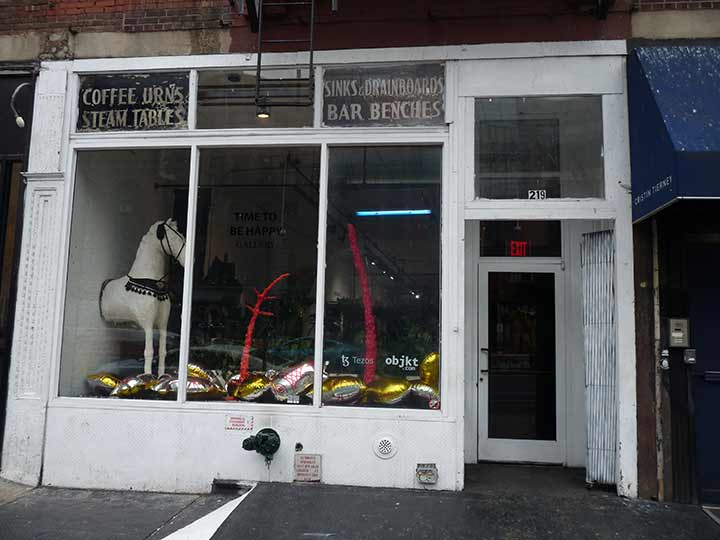

EARLIER this week I mentioned the presence of a small building from the 1820s, hidden in plain sight on the Bowery opposite Rivington Street. Today, here’s another Bowery relic, of somewhat recent vintage. Presently, #219 Bowery, north of Rivington, houses objkt.com, which sells art using blockchain. This variety of alternative money has always baffled me, and the objkt.com website is somewhat dense and also baffling; so I’ll just quote what it says:
objkt.com is the largest NFT marketplace on the Tezos blockchain; offering art, music, collectibles, gaming items and other virtual goods. We are on a mission to build the largest web3 creator platform, empowering creators, collectors and builders in a brand-new economy.
Creators can mint (publish) their creations as tokens with limited supply, each representing a piece of their work. Every token is minted into a collection, which is represented by a smart contract (FA2 standard) on the blockchain and is owned by the artist. For every token a creator can specify a royalty that is paid on each sale.
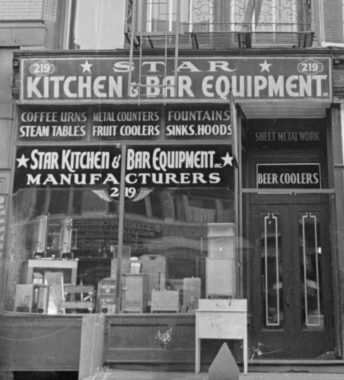
My attention to this storefront lies in what the etched glass at the top of the window says, “Coffee urns, steam tables” and “Sinks and drainboards, bar benches.” The owners of objkt.com chose to leave the etched glass in place from the storefront’s previous incarnation as one of the wholesale kitchen supplies companies that I mentioned at the above link.
However the wording on the right panel doesn’t match the 1940 photo, instead saying, “Fountains, sinks, hoods.” I believe that the etched glass sign was changed since 1940. Prior to 2021, Street View presents an image in which the central panel etching was preserved; but that has since been lost since objkt.com has occupied the space. If you play around with the Street View “time machine” the entire storefront was covered by a vinyl awning sign for Chair Up, a furniture store.
Check out the ForgottenBook, take a look at the gift shop. As always, “comment…as you see fit.” I earn a small payment when you click on any ad on the site.
8/13/25
1 comment
Actually the building is from 1889, designed by architect James E. Ware in an experimental for the time hybrid of Queen Anne and Renaissance Revival styles. called “The Alabama” it was considered to be a ‘model’ low income residential hotel, and then became a less ideal version of that for years. In the gritty punk rock era it was a supply service for restaurants. Some proposed Landmarking, but that seemed doubtful. It appears now to be stablized for commercial. The exterior could benefit from some TLC, but there is a great building beneath the signage.