
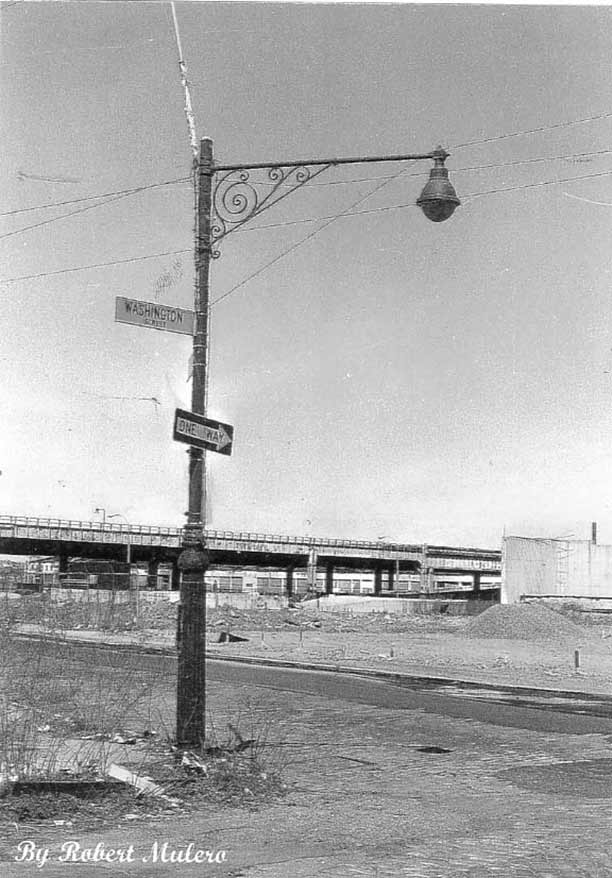

To my eternal regret I completely missed what was a lamppost graveyard in Tribeca, now one of NYC’s most expensive neighborhoods, for many years in the 1970s and into the 1980s as multiple blocks in what was then called the Lower West Side were razed, leaving empty lots. Manhattan also lagged behind other boroughs in eradicating older lampposts, so you were left to a spectacle of mostly empty lots with the streets running through them lit by antiques. I was in St. Francis College and the Brooklyn Business Library at this time with my nose to the grindstone and my head in books (I struggled mightily to graduate with 2.5 index, a C) and while I was a lamppost enthusiast, I wasn’t going all over town looking for them.

NYC’s King of Lampposts, Bob Mulero, was doing that, however and in 2017, Mulero published The History and Design of New York City Streetlights, Dorrance Publishing, the only volume I am aware of that deals exclusively with NYC lamppost design. He also graciously provided me with a few dozen black and white photographs of classic poles around town, many of which have been lost since then. I collected some of them on this FNY page.
Before Independence Plaza, the housing complex, was constructed in the former Washington Market area between West, Greenwich, Chambers and Hubert Streets in the early 1980s, there was an intermediary period of about a decade after the market’s buildings, as well as other local businesses and residences, were torn down and the streets were barren with empty, weedy lots punctuated by a few straggling structures. It’s hard to believe it these days when just about anywhere in Manhattan was prime real estate: but there were acres upon acres of empty territory just north of the USA’s financial capital. To get a good look at what this area used to look like, see Danny Lyon’s photo book called The Destruction of Lower Manhattan. It depicts these blocks just after they closed and just before they were demolished.
Until Independence Plaza was built, old species of streetlamps could still be found here and there. The lamp you see above at the former intersection of Washington and Chambers Streets was the last of its type remaining, a Type 6 Special Post. This is actually an altered version because these posts were usually crowned by a bishop crook lamp and they were used at elevated trains, with the lower shaft lighting under the el and the bishop crook the intersecting street. The post was demolished about 1982, and to my knowledge, wasn’t preserved and so became scrap metal.
In this case the “crook” had been lopped off and the lower shaft retained as seen in the plate shown above. Washington Market buildings often had protective sheds extending over the sidewalk; perhaps this mast, at a 90″ angle from the shaft, extended underneath one of those awnings.
Check out the ForgottenBook, take a look at the gift shop. As always, “comment…as you see fit.” I earn a small payment when you click on any ad on the site.
9/3/25
2 comments
Is that wall to the right the southern flank of the one old building they let stand, on West Street, and which lasted until after 9/11? It’s hard to tell. I’m sure you already have a page on that building.
I recall that I first saw this area in early 1974. For someone like me interested in streetlighting, it was like walking into the twilight zone. It was not only that the lights had not been replaced by mercury vapor lights, it was that this area was exclusively incandescent bulbs. I would assume Mr. Mulero has the photo of the Desky pole that had apparently replaced a cast iron knockdown. It was equipped with an incandescent luminaire, most unusual.
I always wondered why this area retained these original street lights. I assumed that plans had been made for the urban renewal of this area, and the City didn’t want the expense of installing new lights if they were going to be removed shortly after. When exactly was the urban renewal plan announced? If the buildings, residential and business, had been still occupied in the early 1960’s, they surely would have been included in the mercury vapor relighting program. The relighting program was essentially complete by 1966(except for the several hundred incandescents scattered around the City that you mention), and the mid-block lighting program was about to begin. Any thought of replacing the old lights in the 1970’s ended with the fiscal crisis and the complete collapse of street light maintenance during 1976.