

I have not done enough pieces about Queens, my adopted borough, lately. Some pages are in the offing. In September I walked in eastern Flushing and Auburndale, getting some photos from Flushing Cemetery and environs. To get there, I took the LIRR from Little Neck to Broadway. Broadway, the Long Island RR station, that is, not Broadway the street, which is miles away in the west. Queens has a Broadway, which runs from Vernon Boulevard at the East River to Queens Boulevard in the heart of what was once Newtown but is now Elmhurst. However, Queens formerly had two Broadways.
Until about 1920, all of Northern Boulevard from the Flushing River to the city line in Little Neck was named Broadway. West of the Flushing River, Northern Boulevard was known as Jackson Avenue, because it was built as a toll road by John Jackson in the 1850s from the waterfront through Astoria, Woodside and the Trains Meadow area now called Jackson Heights. East of the Flushing River there was an already-existing trail that had likely been used by Native Americans for centuries prior to the incursion of Europeans. The road connected Flushing as well as the farms and fields east of it as far as Roslyn, and sometime in the 19th Century, it acquired the name “Broadway.” East of what would become the Queens-Nassau county line in 1898, it was called North Hempstead Turnpike, which made sense, since it ran through the town of North Hempstead, originally in Queens, later in Nassau. By 1920, the whole road from LIC to the city line in Little Neck was called Northern Boulevard, and North Hempstead Turnpike east of that; motorists know it by Route 25A. But “Northern Boulevard” was proven popular and now, 25A is called Northern Boulevard almost all the way to the Suffolk line in Cold Spring. (There are still two Broadways in Queens; I’ll get to the other one presently.)
I have discussed the Broadway LIRR station often. Its name is left over from when Northern Blvd. was called Broadway, but now the general area east of Murray Hill is called Broadway-Flushing. I lived on 43rd Avenue and 159th Street for 14 years from 1993-2007 and Broadway was my LIRR station. Throughout my tenure the station was crumbling and falling apart, with a pair of passenger rain sheds that were mostly employed as urinals. As soon as I moved to Little Neck in 2007, the MTA improved all the stations on the Port Washington line, rebuilding them in some cases; Broadway was one of those.
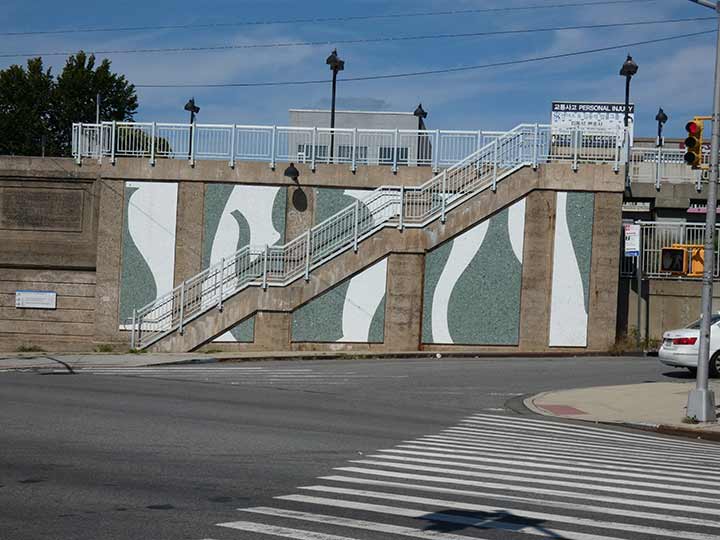
As part of the Arts for Transit project, artist Jean Shin was chosen to decorate the station. “Caledon Remnants”appears on the stationhouse as well as sprucing up the old concrete entrance stairs, here at Northern Blvd. and 163rd Street, first installed after the grade cross elimination in 1913:
Fragments of traditional Korean ceramics are arranged into mosaic murals of vase silhouettes on the façade of the Broadway Long Island Railroad station in Flushing, Queens. Located in the heart of a vibrant Korean-American community, the abstract, green-blue silhouettes enhance the beauty of the Celadon itself, while the overall piece speaks to the rich, yet fractured, cultural history of the Korean diaspora. The pottery remnants were imported from Icheon, Korea as part of a cultural exchange. —Jean Shin
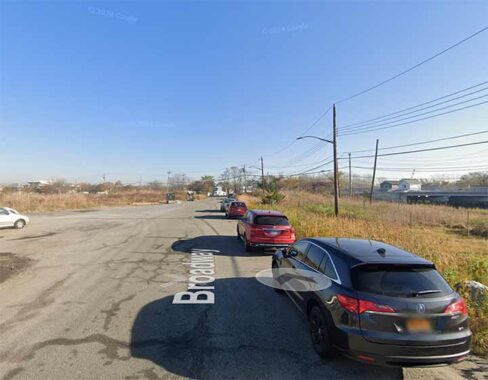
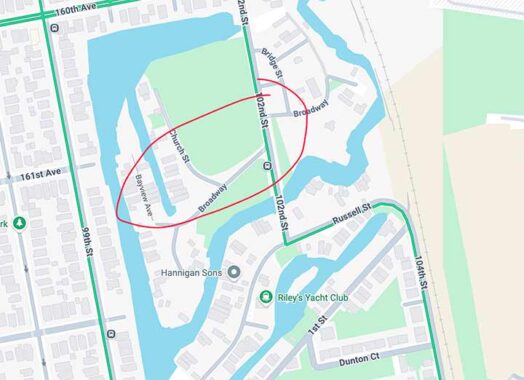
Meanwhile, way, way south in Hamilton Beach, the semi-private enclave south of Howard Beach previously called Ramblersville, one of the winding paths that edge around Hawtree Creek is Queens’ second Broadway.
Check out the ForgottenBook, take a look at the gift shop. As always, “comment…as you see fit.” I earn a small payment when you click on any ad on the site.
11/25/25
11 comments
When the roadway crossed over to the east side of the Flushing River, it was Bridge Street, not Broadway. That is where the LIRR’s Whitestone Branch crossed it and the station there was named Flushing Bridge Street. Broadway began slightly east at either Prince Street or Main Street.
That has been my understanding as well. Additionally, I note that there existed only a narrow street the entire distance between the river and Main Street, and that east of Main Street there was a large plaza, where civil war monument rises. Thus, it makes sense that narrow Bridge Street would become the broad Broadway at Main Street. Although Northern Boulevard west of Main Street is presently as wide as it is east of Main Street, the southern boundary of former Bridge Street had been shaved back to create the present-day width. Old Sanborn maps show the much larger lots that used to exist on the south side of Bridge Street; that 135-22 Northern Boulevard comes to narrow point on its Main Street side is a consequence of the street widening.
The current bridge over the Flushing River is a fixed bridge, and touches ground at Prince Street. Previous bridges were draw bridges and were lower to grade, touching down much closer to the River. For a reference, look to tiny King Road. It is the former right-of–way of the Whitestone Branch of the LIRR, which crossed Bridge Street as a grade crossing. On the south side of Northern Boulevard, starting at Prince Street, and going east, is a very large building with retail storefronts. Built in the neo-colonial style that was popular following the Great War, it was the first view of Flushing after you came over the Flushing River drawbridge. Keeping to that low-rise residential community feeling, many more such neo-colonial buildings were erected on Northern Boulevard going east for several blocks.
Wasn’t Booth Memorial Ave previously named North Hempstead Tpke or a similar name prior to the early 70’s?
Yes, Booth Memorial Ave was previously named North Hempstead Tpke. The Booth Memorial name was adapted in 1957, when Booth Memorial Hospital on Main Street was opened. That hospital is now known as New York-Presbyterian Queens. More information is on Wikipedia:
https://en.wikipedia.org/wiki/Booth_Memorial_Hospital
The roadway was named for William Booth, founder of the Salvation Army. It was that organization which requested changing the numbered avenue to his name when they opened the hospital. After they sold it to New York Hospital they requested the name be removed, but that request was not honored, so it remains Booth Memorial Avenue.
I like North Hempstead Turnpike, but returning to it would be confusing as it does not reach North Hempstead and never did. As with Flushing Avenue, it went to other routes that did.
“Flushing River”
Rolling my eyes.
It’s on the map.
159th and 43rd?
Ever drink at the old Hummel’s?
Yes. the waterway is on a map, and it is called Flushing Creek.
Calling it a ‘River” is a subterfuge by developers to sell their coops and condos.