
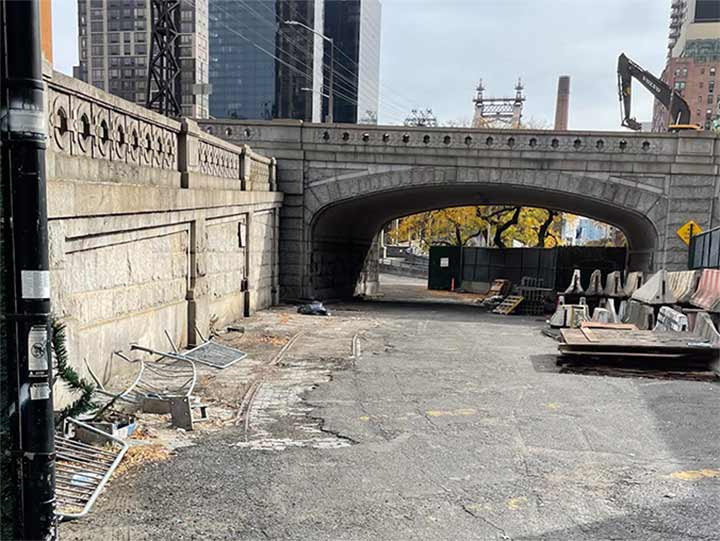

FORGOTTEN FAN Jonathan Rickard passes along what appear to be exposed trolley tracks, and a bit of Belgian block paving, in a storage area at the remaining 1909 vintage lamppost on East 59th Street just east of 2nd Avenue. The ornate fencing and arch seen in the background carries one of the bridge’s approach ramps. I really should make a trip there as there are some interesting vintage structures to be found in the area, but the impossible traffic always puts me off.
My guess is that this is the eastern end of the Third Avenue Railway 59th Street crosstown line that ran between 10th and 1st Avenues. Like many of NYC’s railroads and trolleys, the line went through a number of operators. According to wikipedia, it was built by the Central Park, North and East River Railroad sometime in the mid-1800s, and then leased to the Houston, West Street and Pavonia Ferry Railroad in 1892 and the Metropolitan Crosstown Railway in 1893, and then purchased by the Third Avenue in 1918. It was finally replaced by buses in 1946 and most of the tracks pulled up or paved over. The storage area is usually closed off to the public, but the gate was briefly open, vouchsafing this view.
Check out the ForgottenBook, take a look at the gift shop. As always, “comment…as you see fit.” I earn a small payment when you click on any ad on the site.
11/11/25
3 comments
Great urban architecture. It should be turned into some sort of a public use. Thoughts?
A few weeks ago Streetsblog had several FNY-style comments on this. I know you’re not crazy about them. I wish they were more pro-pedestrian and less pro-cyclist, pro-“micromobility.” They also lead the charge in introducing new unnecessary substitution terms such as “unhoused” for “homeless,” and “car storage” for “parking.”
https://nyc.streetsblog.org/2025/10/14/parking-lots-but-manhattanites-want-to-unlock-space-by-queensboro-bridge
Funny coincidence here. The posting is dated November 11, 2025. Indeed, these old tracks are part of the Third Avenue Railway’s 59th St. Crosstown route, which stopped running on November 9, 1946 and was replaced by buses the next day. This route, and all other Manhattan-based streetcars, used an underground conduit system to provide electric power for the cars, as opposed to the more common overhead wires used in the other four boroughs and with one exception, every other North American city. The exception was Washington DC, where the system lasted until 1962,