
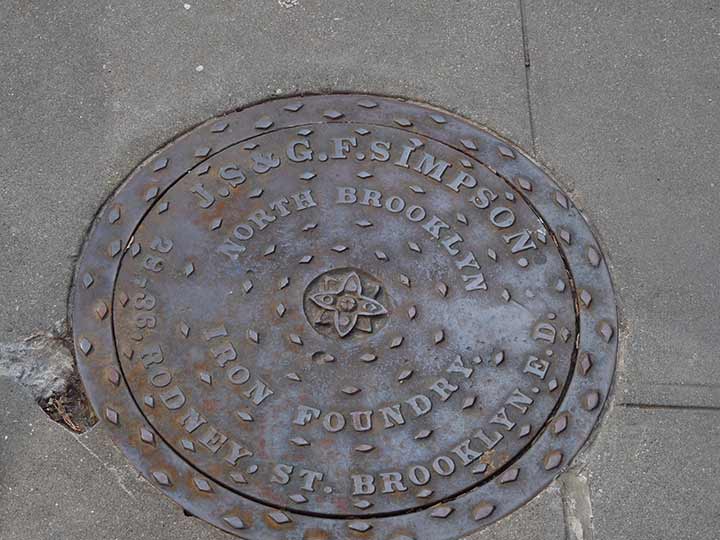

KEEP looking down…you may see a piece of New York City forgotten history. A few years ago I was ambling east on East 95th Street near Hunter College High School and Park Avenue in the Upper East Side, a beautiful residential area (if you have the 4-5 K monthly scratch for an apartment) when I spotted this round metal coal chute in the sidewalk. Coal trucks, and before them coal carts pulled by Dobbins, would unload the black gold directly to the coal burners in home basements. Most NYC schools ane residences are of course no longer heated by coal, but the chutes and covers remain.
Forgive me. My slight case of OCD often compels me to try as much as possible to center my subject in the shot but for some reason I couldn’t do it this time. Nevertheless you can make out that the coal chute cover was made by the J.S. and G.F. Simpson North Brooklyn Iron Foundry, 28-36 Rodney Street in Williamsburg, Brooklyn, between Wythe and Kent Avenues.

As it happens 1940s.nyc has a photo of what was the Simpson foundry, which by that time already looked abandoned. Next door is the Maujer Garage; there must have been some Maujers in Williamsburg, but this is some distance from Maujer Street. I am still mystified how the name is pronounced, but I’d guess at this late date it’s MAW-jer.

Heavily industrial in the early 20th Century, the region declined as the old factories and foundries moved out, and western Willieburg became ripe for urban renewal. Much of Rodney Street and surrounding streets were demapped for the nearby Bedford Gardens houses, but this block of Rodney Street remained. The old garages and foundries were replaced in the Super Seventies by these 2-story brick dwellings, with terraces and driveways, a far cry from the Simpson Foundry days of old.
Check out the ForgottenBook, take a look at the gift shop. As always, “comment…as you see fit.” I earn a small payment when you click on any ad on the site.
11/12/25
6 comments
I like the ghost signs in the 1940 photo.
“Maujer” is French and would be “mo-zhair” or something like that, you would figure, but in NY with its Huguenot settlers, it may have been something like “Moyer,” i.e., a Dutchified pronunciation. There is a British variation, also from Huguenot descendants, pronounced “Major.” In any case, ask the people who live on that street, and see if there’s a consensus.pronunciation.
Could the “j” be silent (Mau-wer)?
They used to have a foundry class at Brooklyn Tech but it was
stopped in ’92 because it was dangerous and hurtful.They had
only been teaching it since 1922.
Tech Class of ’78 and was Aero. I remember foundry class and woodworking where we made wood molds of items we drew in Technical Drawing class. BTW,Lee McCaskill, who was responsible for getting rid of all of the shop classes, was the worst principal in Tech’s history. He and his wife were charged with lying and fraud about their residential status. They lived in NJ and used a phony Brooklyn address so their daughter could attend NYC public schools.
https://qns.com/2006/02/doe-axing-wife-of-former-brooklyn-tech-principal/
There’s a chain of superstores (akin to Walmart) in the Mid-West (Illinois, Indiana & Ohio) called Meijer and pronounced as Myer with the “J” silent. I’m sure Maujer also has a silent J and pronounced as Johnny B wrote: Mauwer