
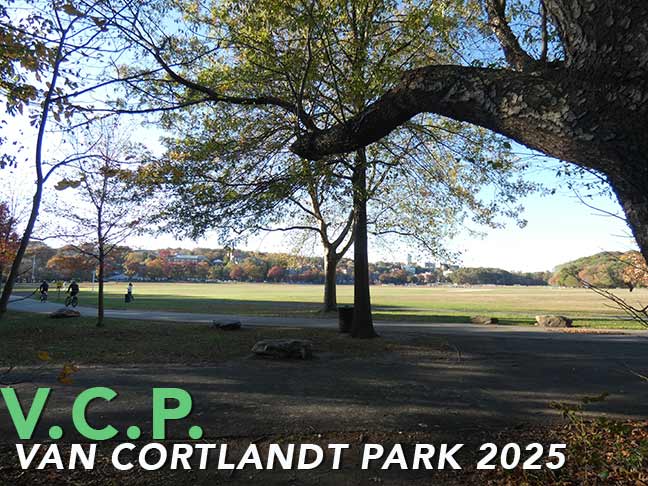

PHOTOGRAPHERS talk about the “golden hour” before sunset when, in pleasant weather, the light seems suffused with a golden aura. For me the first week of November is the “golden week” or “golden days” as the leaf colors are just right, the temperature is just right, and things are primed for excellent pictures. My most memorable experience of this came in early November 2020 in Spuyten Duyvil and Riverdale, so I thought I would replicate conditions by going to the same area in early November 2025. My stamina has deteriorated since 2020 with various conditions, so hiking the steep hills of Spuyten Duyvil wasn’t optimum: thus, I entered the somewhat flatter Van Cortlandt Park, staying away from its own hills for the most part. I was in search of a specific quarry but I’ll get back to that later. Well worn territory for me, but I did hit some parts of the park I hadn’t seen before.
I took the IRT Broadway (#1) to the end of the line at 242nd-Van Cortlandt. The IRT got this far north in August 1908 then stopped. The station platform is unusual, in that its crosstimbered canopy supports give it something of a rustic look, and a walkway spans the wide east side of Broadway with a pair of steep staircases to the park below. I did not see an elevator option.


There are parts of the station, as well as the south end of the side platform (not in public use) that still have original platform lamps. These are seen better on this NYC Subway image. They have been outfitted with new LED lamps…
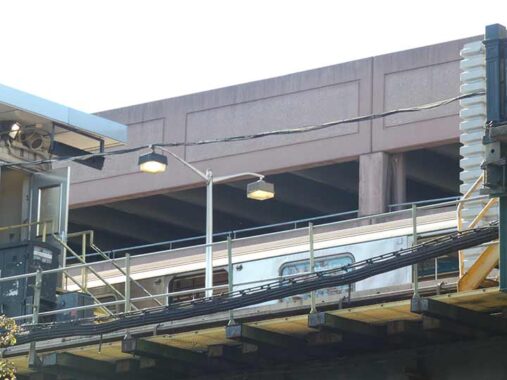
…Additionally there is a twin 1960s-era platform lamp that also has modern LED lamps.
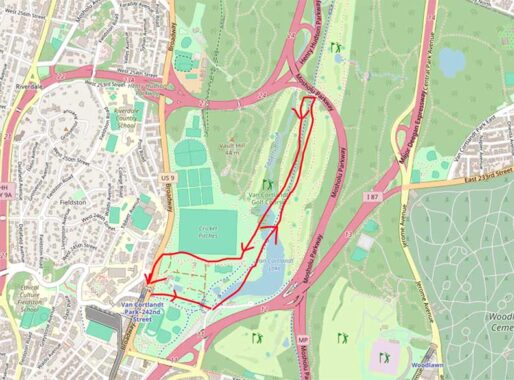
On this walk I used the old Putnam Greenway, one of a number of Van Cortlandt Park hiking trails, as far north as the Mosholu Parkway overpass. I would have preferred to press further north but there are no intersecting trails and I would have had to go almost all the way to Yonkers to find a turnoff; Street View hasn’t photographed the trail, so I was unable to scout it online.
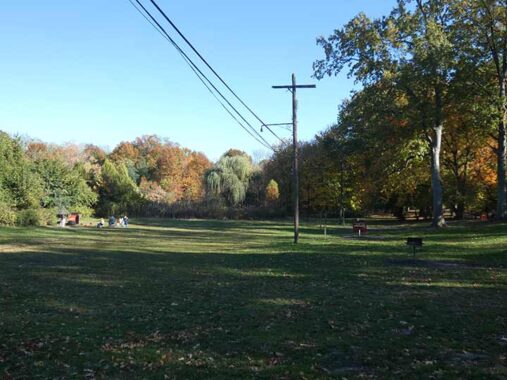


If you think seen this path featured before in FNY, you’re right, but I check on it periodically. It’s the remnants of a walkway or roadway that once connected Broadway through Van Cortlandt Park to the VCP station on the old Putnam RR (see below). Telephone poles still carry wiring along the path and on them, there are some rusted masts that once carried incandescent lamps, most of them Wheeler “crescent moons.” By 2025, only two of them still carried reflector shields.
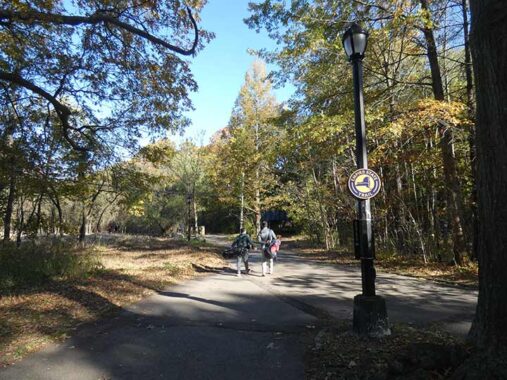
The old trail is muddy as a rule, so most use the parallel paved path. On it you will find a sign marking the Empire State Trail, a 750-mile series of trails that extend north to Lake Champlain near the Canadian border, and west generally along the Erie Canal to Buffalo. There’s an online map, but the more detailed print version has to be ordered by mail.


The walkway runs beneath an embankment, over which the Putnam Trail is carried on a blue-painted iron trestle stamped with the date 1904, the date it was installed. The trestle carried the New York and Putnam RR that was built in 1881. “The Old Put” as it’s called, originally ran from Sedgwick Avenue in the Bronx north to Brewster, New York on the NY Central commuter line, now called the Metro-North. It diverged from the Hudson Line just south of West Kingsbridge Road. Passenger service ended on the line in 1958, and the last fright train rumbled on the now-missing tracks in 1980.


I’m fascinated by this old skeleton, the remains of the Van Cortlandt Park station on the Putnam, the northernmost station in the Bronx. I am unsure if it was used all the way to the end of passenger service in 1958. It throws shadows on the trail reminiscent of train tracks. The Putnam once let passengers out in the middle of the park, which was quite a convenience in the good weather months.


Just north of the old station the trail bridges over Van Cortlandt Lake, the largest freshwater lake in the Bronx. The trail continues through the park and north into Yonkers. It will surprise you to read, if you are already unaware, that Can Cortlandt Lake is not a nautral lake but the result of the damming of Tibbett’s Brook in the 1690s to create a grist mill. NYC Parks has redesignated the Lake west of the Putnam trail as Hester and Piero’s Mill Pond to commemorate two of the enslaved people who worked at the Van Cortlandt Mansion, which will be seen a bit later:
Enslaved people also inhabited what is probably the oldest house in The Bronx–the Van Cortlandt Mansion in today’s Van Cortlandt Park. Jacobus Van Cortlandt (1638-1739) purchased the property in the late 1600’s. A 1698 census of “Fordham and Adjacent Places” listed the people held in slavery by Jacobus’ Van Cortlandt as: “hetter, tonne, marce, and hester.” By the time of Jacobus’ death, he had more enslaved workers, which he willed to his son, Frederick. According to Jacobus’ will of May 12, 1739 Frederick Van Cortlandt was to receive Jacobus’ “Indian Man Slave named Pompey [his] three Negro men Slaves called Piero John and Frank and [his] two Negro Women Hester & Hannah togr. with all the Children that are already or hereafter shall be born of the Body of the said Negro Woman named Hester (except such of the said Children as I may think fit in my life time to dispose of by Deed or Gift or otherwise).” In 1748, Frederick began work on the Van Cortlandt Mansion. [Kingsbridge Historical Society]


The Putnam Greenway bridge over the lake once had a washboard-like consistency and hadn’t been repaired since the tracks were taken up in the 1980s. That changed a short time ago when the path, at lest as far north as Yonkers and possibly beyond, was completely rapaved and is now smooth as a [insert your favorite metaphor]. It is now ideal for bicyclists and delivery scooters, which is bad news for walkers. (When walking I find bikes and scooters nuisances and possible dangers, and vice versa.)


More relics, as you proceed north along the Greenway. In the 1910s, before the Grand Central Terminal was built from 1905-1913, it was decided to test different varieties of stone to see what could stand up to the weather the best. These pillars were placed along the NY Central right of way in the park and were used to make the decision. The second pillar as you walk north, made of Indiana limestone, contains the stone selected…not for its durability, but because it was cheapest!


South of the Van Cortlandt Park Golf Course, the Greenway is bridged again over the curving VCP Lake, which provides interesting photo ops.


South of the Mosholu Parkway overpass, some relics of the old New York and Putnam RR appear in the form of wooden rail ties by the side of the path, as well as a pair of iron poles that one carried overhead catenary wire supplying electric power.
I can reveal now what I hoped to find. There is a 6 mile marker along the Greenway marking 6 miles north of the railroad’s south end at Sedgwick Avenue. I had hoped to show it on a screen capture. But the web page that had a photo of it was apparently taken down because I can no longer find it. The marker itself is further north on the trail, near the Yonkers city line. If you find that image…Comments are open.
With no available cross trails, I retraced my steps south on the Putnam Greenway until I found a short trail that got me to…
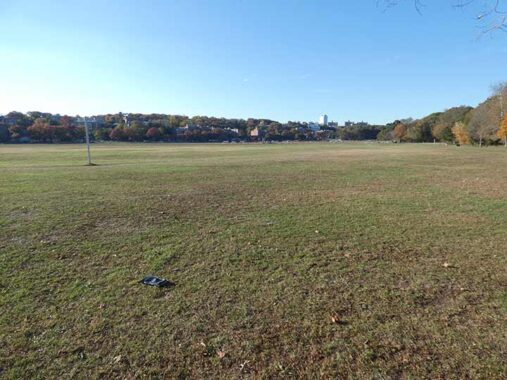
…the Van Cortlandt Park parade ground formerly used for military drills. Such grounds, scattered around the city, make for the largest “plains” in NYC parks. Van Cortlandt Park’s is truly vast.
This is one of NYC’s rare prairie lands, with little bluestem and panic grass that provide habitat for over 130 species of butterflies, either native to NYC or migrating. Speaking of wildlife, don’t be surprised to find foxes, coyotes and wild turkeys roaming around, especially in the park’s wilder northern tracts.
The story goes that as buffalo (properly called bison) were overhunted in western states in the frontier era, putting them in danger of extinction, Dr. William Hornaday of the Bronx Zoo (he has a street named for him) acquired a few buffalo and bred them on the zoo grounds. By 1907 the Bronx herd outstripped the Zoo’s resources, so a few bulls and cows were transferred to Van Cortlandt Park. Later that year, they were sent to Oklahoma, where some of the buffalo are still descended from the Bronx specimens.


I had thought that Vault Hill was Van Cortlandt Park’s only cemetery. Not true. On the southeast end of the VCP parade ground, northeast of the Mansion (see below) you find the burial ground of several colonial-era families in the Kiingsbridge and Riverdale regions including the Tippetts, Berrians and Bettses. The latter two also had holdings across the East River in northwest Queens. There were headstones here, but as the cemetery was forgotten for a log time, most had vanished or had been removed by the 1970s and 1980s. There were also unmarked graves of the enslaved people “belonging” to these families. and they are now commemorated by a NYC Parks sign.


East of the Van Cortlandt mansion, there’s an interesting terrace and locked iron gate, installed in 1916, that face a park path that may have once been a carriage road to the mansion. The gate and brick posts resemble those at Vault Hill, linked above.


Not many NYC Parks have mansions as centerpieces. King Park in Jamaica is one. Van Cortlandt Park is another.
This Georgian-style country house made in the fieldstone style was built in 1748 for Frederick Van Cortlandt, the scion of a prominent family in the area. The Van Cortlandts had been in New Amsterdam since brewer Oloff immigrated from Holland in the mid-1600s, and had acquired much of the land that was to become the park by the turn of the 18th Century. The vast athletic field north of the mansion was at one time the Van Cortlandt farm, and had large planting fields, livestock, and a grist mill. The Van Cortlandts did employ slave labor in the colonial period.
George Washington used Van Cortlandt Mansion as a headquarters during the Revolution (as he had in the Morris-Jumel Mansion in Washington Heights). It is maintained by the National Society of Colonial Dames as a museum appointed with period Colonial and Federal collections. The Van Cortlandt family granted the house and grounds to New York City in 1889. The estate became Van Cortlandt Park, which at over 1100 acres is NYC’s largest save Pelham Bay Park.


William Clark Noble’s 1902 bronze of General Josiah Porter (1830-1894) sits on the mansion’s north side. General Porter was the first Harvard College graduate to enlist in the Union army during the Civil War. As a captain he commanded the 22nd Regiment of the NY State National Guard in the war. He rose to adjutant general in 1886.


In the Mansion’s back yard is a prison window. Sugar refineries, called sugar houses, were built in lower Manhattan during the mid to late 1700s to alleviate the need to import refined sugar from Europe. The sugar houses, with their small windows and low ceilings, were considered ideal by the British as prisons, and as on the prison ships in Wallabout Bay, conditions were notoriously inhumane, and may patriots died in captivity.
This sugar house stood at what is now Duane and Rose Streets; its window was later incorporated in the Rhinelander Building, itself torn down in 1968 to make way for One Police Plaza. The window was rescued and now now stands behind the Mansion. As many as 800 Americans were crammed in a typical sugar house, suffering a tremendous amount of abuse and left with the choice of either starving or freezing to death. Conditions were so bad that many inmates carved messages and their names on the beams and walls. For years afterward these ‘last wills’ remained.


I had also been unaware of the presence of VCP’s Memorial Grove along Broadway south of the parade ground. It was founded in 1949 to memorialize the region’s 21 World War II casualties with bronze plaques and newly planted oak trees, and updated later with Korean and Vietnam War honorees. The grove was rehabilitated in 2012 after a period of neglect.
Will there be any Gulf or Afghanistan War memorials? If so, where?
Check out the ForgottenBook, take a look at the gift shop. As always, “comment…as you see fit.” I earn a small payment when you click on any ad on the site.
12/14/25
3 comments
The oddest war memorial I saw was on the lawn of the Allamakee County courthouse in Waukon, Iowa, honoring a county resident who died in the 1983 invasion of Grenada. I’d say the odds were pretty slim that one of the 19 US deaths in that action came from a county with a population of less than 15,000. But, then, the casualties had to come from somewhere,
Note: this visit was on my 2016 pilgrimage to the passenger pigeon memorial. Though it’s in Wisconsin I drove into Iowa and Minnesota just to say I’ve been in those states.
An elevator is being installed on the west side of the #1 subway station. It’ll allow travelers to bypass climbing the stairs up to the platform.
I believe the Putman RR station in the park was operational up until the end of passenger service in 1958. My family moved into an apartment building in the neighborhood in 1957 or 1958. I was told that there was to woman in the building who would take the Put from the park station on her way to work.
I suspect that most of the boardings and alightings at the VCP station were people using the golf course. Probably zero passengers on rainy or snowy days except for those Parks Dept employees who weren’t commuting by the Broadway-7th Av line or the streetcars.