
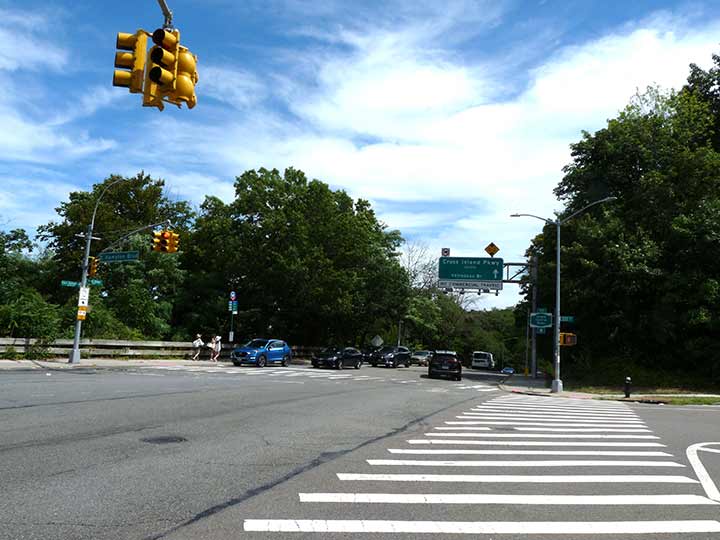

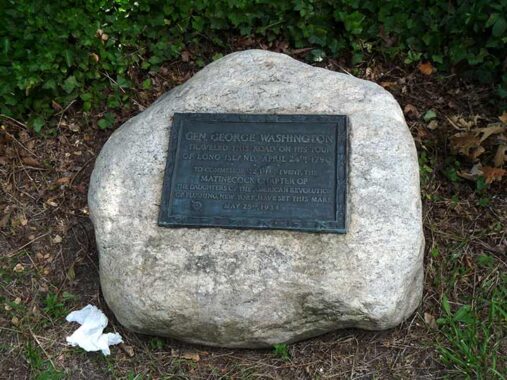
At the corner of West Alley Road and 233rd Street, at the spaghetti ramp interchange of the Horace Harding Expressway (LIE) and Cross Island Parkway, you’ll see a small, unobtrusive boulder with a verdigris’ed marker on it. The marker reads:
“George Washington traveled this road on his tour of Long Island, April 24, 1790. Commemorating this event, the Matinecock Chapter, Daughters of the American Revolution, Flushing, New York have set this mark.
May 25, l934.”
In 1790, and even well into the 20th century, there were few good roads in eastern Queens. What is now West Alley Road runs through a valley between two hilly areas left by a retreating glacier 150 centuries ago, and the lone road through was called “the alley” on early maps. A number of roads through the area took its name. In the early 19th Century, Alley Road became Douglaston Parkway and East Alley Road became 61st Avenue; only West Alley Road retains its old name.
President Washington visited the plant nurseries of Flushing in 1789 and made a return visit to Queens and the rest of Long Island on a five-day swing the following year. Beginning April 20, he made a 165-mile round-robin journey from Brooklyn to Jamaica, Long Island’s South Shore, Patchogue, north to Setauket, Smithtown, Huntington, Oyster Bay, Roslyn, and Flushing, returning home to his Manhattan mansion on April 24. Washington was on his final leg of the tour when passing Alley Road.
Washington’s principal concern on the trip was the condition of the soil; the USA in the pre-Industrial Revolution era was mostly farmland. The use of fertilizers and techniques like crop rotation were yet untried in Long Island at the time. The President also wanted to personally thank patriots in Long Island who had risked their lives as spies during the Revolutionary War. In Roslyn, Washington visited the home of grist mill owner Henrick Onderdonk; the house, built in 1740, survives today as the restaurant Hendrick’s Tavern. He also paid a call on Setauket tavern keeper Austin Roe, who had helped transport messages to him during the war; and visited several widows of patriots killed in the conflict.
Washington was a New Yorker while the federal government was located in NYC for about a year from 1789-1790, and lived in a mansion on 3 Cherry Street, a location currently underneath the Brooklyn Bridge.
Behind the marker on 233rd Street, you’ll find an entrance into Alley Pond Park. Indulge your inner Walden with a walk along the blazed paths, some of which go past the park’s kettle ponds. When Washington passed by here, Alley Road threaded through woods that looked like this.
Check out the ForgottenBook, take a look at the gift shop. As always, “comment…as you see fit.” I earn a small payment when you click on any ad on the site.
12/19/25
6 comments
Not to mention Washington Walk at the top of University Ave, across from the reservoir in the Bx
Washington’s concern of the soil was also that of the Yale president Timothy Dwight, who wrote THE travel book on New England and New York State in 1818, describing his annual travels since 1797, which I’m reading right now. Dwight describes the agriculture and soil in every township and hamlet he passes through. He calls soil cold or warm. Not sure what he means by that. If it’s loam, it would be warm because the leaves and such are rotting, but he separates loam from soil, so I still don’t what know he means or why it would matter.
The entire region near Ally Pond Park is a well kept secret & defiinitely worthy of your thorough exploration (click the link I’ve included):
https://www.nycgovparks.org/parks/alley-pond-park/highlights/12634
Legend has it that Hendrick Onderdonk was taken to be a loyalist during the Revolution, but was actually part of the spy ring. The names of those spy ring members was neve divulged, even by George Washington. However, that Washington stopped for a breakfast of oysters at Onderdonk’s home was taken as a silent signal that Onderdonk had undertaken the dangerous work of helping the Revolutionaries. The President would not have stopped to visit someone who had been a supporter of the Crown.
Onderdonk’s mill, just down Old Northern Boulevard from his home in Roslyn Village, has survived, and is currently undergoing a massive restoration project.
Here’s more about the Culper Spy Ring (I also suggest Brian Kilmeade’s excellent book on the topic “George Washington’s Secret Six”),
I just realized that I forgot to include this:
https://historychronicler.com/george-washingtons-secret-weapon-the-culper-spy-ring/
Sorry about that.