
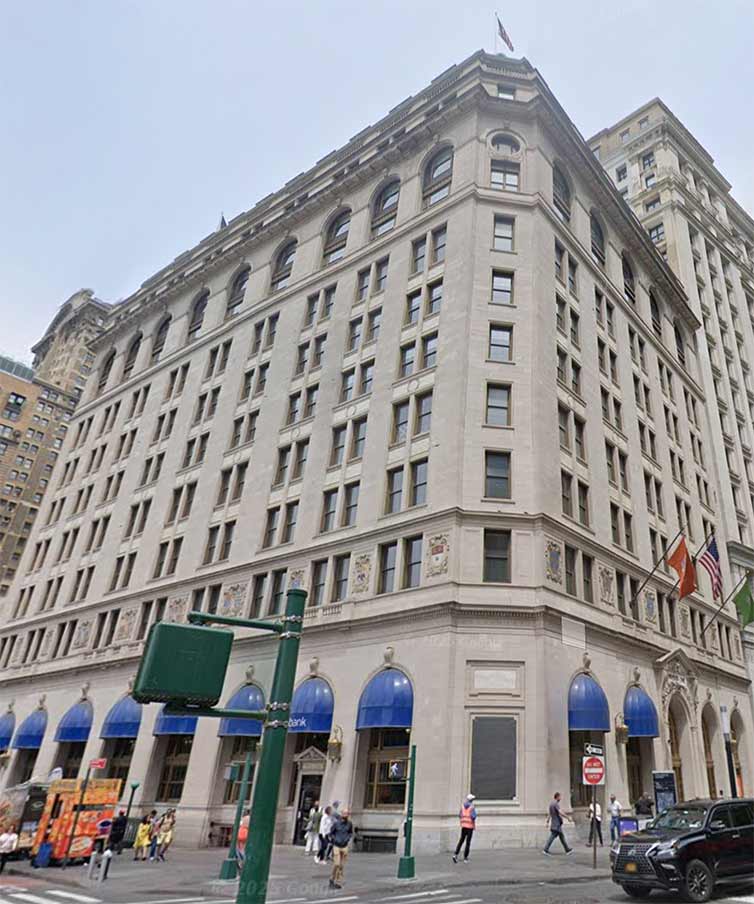

BROADWAY begins at Battery Place and Bowling Green and runs as a continuous road, much of it NY State Route #9, almost all the way to the Canadian border. In Manhattan, a number of different roads were consolidated under one name, Broadway, in 1899. It managed to survive as one of the few diagonal roads on the island after the grid system was drawn up in 1811 and built over the next century; now much of it between Central Park and Union Square has been pedestrianized.
#1 Broadway is the International Mercantile Marine Building, built in 1884 and refaced in limestone in 1922. General Washington’s revolutionary headquarters was an even earlier occupant of the site. The owners, known eventually as the United States Line, incorporated many marine symbols in a 1921 facade update, just as their competitor the Cunard Line had done two years earlier. The grand entryway is surrounded by shells and sea icons, and the second floor windows alternate with colorful Venetian mosaic shields featuring the coats of armsof great port cities. Inside, two gigantic murals depict shipping lanes and a compass dominates the marble floor. The booking room is modelled after an 18th century ballroom. It is a regal setting with columns and fanciful iron mezzanine railings at either end and four impressive chandeliers. Two side doors depict First Class and Cabin Class entrances.
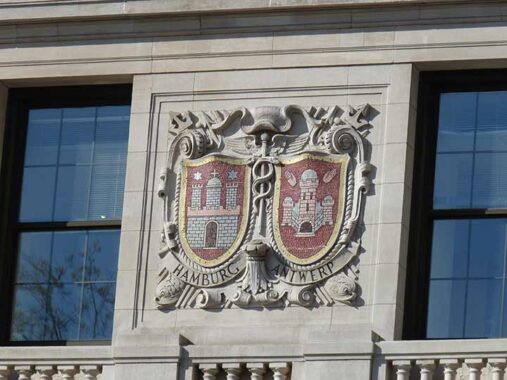
I could do an entire feature on the Merchant Marine Building’s mosaic panels of the world’s great port cities. On this one, we see Hamburg, Germany, located on the River Elbe a short distance from the North Sea. I know little about European cities, and as I age, I realize, sadly, I will probably never see much of the world beyond the US Northeast. The money barrier…the stamina barrier…the language barrier. I digress. What I know of Hamburg is that it’s the city where the Beatles and other British beat bands cut their teeth in the early 1960s, and that the city gave its name to the hamburger, the popular ground beef patty in the bun. The most popular story has Jewish immigrants traveling to the States on the Hamburg America Steamship Line eating the lunch treat, but there are so many stories the origin of the name is murky at best.
Hamburg is Germany’s second biggest city, only Berlin is more populous. Its coat of arms consists of a red (or gules) field, showing a castle with three towers, a cross and two stars. The cross and stars hark back Hamburg’s history of the seat of Germany’s Catholic archbishop, as the stars represent Mary, Mother of Jesus, in her role as guide and protector of seafarers (e.g. Stella Maris.)
Antwerp is also its country’s second biggest city: in Belgium, only Brussels claims more residents. It is Europe’s busiest port except for Rotterdam, Netherlands. Antwerp is located on the river Scheldt, a similar distance from the North Sea as Hamburg. Its coat of arms is similarly red, with a three towered castle. The difference is the presence of two hands above the castle. Those refer to a very old folkloric story of the giant, Druon Antigonus, who charged a toll to cross the Scheldt. The penalty for not paying the toll was the dismemberment of one of the traveler’s hands. This went on until a Roman soldier ended Antigonus’ terrorism by severing both the giant’s hands. Part of the myth is that “Antwerp” is derived from the Dutch words hand werpen, “to throw hands,” even though the Romans called the city Andoverpis, a name of ultimately Celtic origin.
See how much information can be obtained from a bit of research on two mosaics?
Check out the ForgottenBook, take a look at the gift shop. As always, “comment…as you see fit.” I earn a small payment when you click on any ad on the site.
3 comments
Right there at that corner I got sideswiped in my van
by a tour bus going right.Dude didnt stop,kept going
(I think the name is actually International *Mercantile* Marine, not Merchant Marine. IMM was the firm that J.P. Morgan, Sr. helped form to take over, among other firms, White Star, the firm that owned the RMS Titanic. IMM bought the building in 1919 to serve as its HQ, and United States Lines was the successor to IMM.)
I would love to see you do an article about the mosaic panels