

RESIDING just within the borough of Queens at Bushwick and Onderdonk Avenues you can find one of the oldest houses in Queens: probably only the Quaker Meeting House and Bowne House in Flushing are older. The van Der Ende-Onderdonk House is divided into two sections; the dormered part closer to Onderdonk Avenue has been dated to about 1710, with the smaller western section being added many decades later. It was likely built by Paulus van Der Ende and was owned by a succession of heirs until 1831, when it was purchased by Adrian Onderdonck; Onderdoncks occupied the house for over 100 years after that. According to the Greater Ridgewood Historical Society, whose archives and offices are located here, the house has been used as a scrap glass factory, speakeasy, livery stable, greenhouse manufacturer, and most fascinatingly, a factory for spare parts of the Apollo space program. Old Paulus would have been flabbergasted if he could have known that.
The Onderdonk House (The “c” in the name has been dropped along the way) nearly burned down in 1975, and didn’t have heat until 1991. The Ridgewood Historical Society, established in 1975, brought the house back from probable demolition, and in 1977, the house and property were listed on the National Register of Historic Places and in 1978 was granted landmark status by the State of New York. Today, the Society offers guided house tours, history slide lectures, videotaped history programs, genealogy workshops, craft classes and special events, such as St. Nicholas Day and other Dutch celebrations. There is also a voluminous library with historical publications dealing with all of Queens, and preserved copies of newspapers dating from the mid-1800s to the present. While poking around in its quiet attic in March 2004 I found some logbooks from a local police precinct, likely untouched and unread since they were written in.
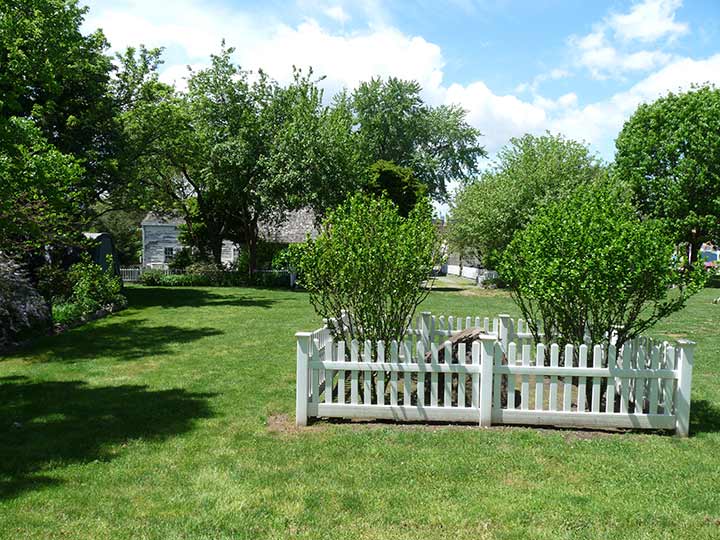
The house once was the seat of a working farm, and now has a big back yard. In the middle of the yard, you’ll find a big, unevenly shaped boulder, with a white picket fence surrounding it that has gotten bigger over the years. I have featured it before in FNY but it’s certainly worth a revisit, as it’s a fascinating story whose resolution may still be in doubt.
Natural elements, like trees, rivers and mountains, were and are still used to delineate political boundaries. In the case of Kings and Queens Counties, rocks and boulders left by the passing of a glacier 100 centuries in the past were used–and astoundingly, three such boulders are still in existence. In the back yard of the Onderdonk House is a large rock surrounded by a picket fence. It is the official position of the Greater Ridgewood Historical Society that this is the historic “Arbitration Rock” used to delineate the border, along the Brooklyn-Newtown Turnpike, of the borders of the towns of Bushwick and Newtown, or today’s Brooklyn-Queens line. In 1769 a large stone was used by surveyor Peter Marschalk to designate the boundary, which had been in dispute. The story goes that the rock had been left underground when Onderdonk Avenue was extended in 1930, and when the avenue was re-graded in 2000 the rock was exposed. It was moved to the backyard of the Onderdonk House the following year. The GRHS has yet to provide documentation in proof.
For centuries the Brooklyn-Queens county border ran on a diagonal straight line cutting through Bushwick and Ridgewood. In 1925, after both neighborhoods were well built up and the line was cutting across properties, it was redrawn to zig and zag along a number of streets; the border today runs mainly along Cypress and Wyckoff Avenues.
There are two other rocks in the vicinity that may have figured in the Queens-Brooklyn borderline. One is at Varick Avenue and Randolph Street, and Bob Singleton, executive director of the Greater Astoria Historical Society, claims that that is the true Arbitration Rock. I propose a duel to decide the question. Pistols at dawn, gentlemen!
A third could be seen a half mile southwest at Morgan Avenue and Rock Street (since removed). Rock Street may or may not have been named for this rock, or Arbitration Rock.
Check out the ForgottenBook, take a look at the gift shop. As always, “comment…as you see fit.” I earn a small payment when you click on any ad on the site.
1/13/26
4 comments
I was married at St. Aloysius on Onderdonk Ave. Never visited this house, but looks interesting.
I descend from a long line of farmers and florists from the Newtown area. When I was a kid, my dad would take me to the American Moninger company, which at the time occupied Onderdonk, to purchase parts for his greenhouses. The workers there let me run all around the place including the attic/dormer, a great place for a kid to explore. In the winter they always had logs burning in the fireplace.
Wow! (felt compelled to say it)
A survey marker ruined my first day at YMCA day camp just after I had turned seven. I looked down from the window of the camp bus on the way there and saw a small square roadside marker reading “Bound.” As I thought it was the grave of a dog named Bound I was very sad all day during what should have been a fun day.
That evening my father had the unenviable task of trying to explain land surveying in terms a child could understand.