
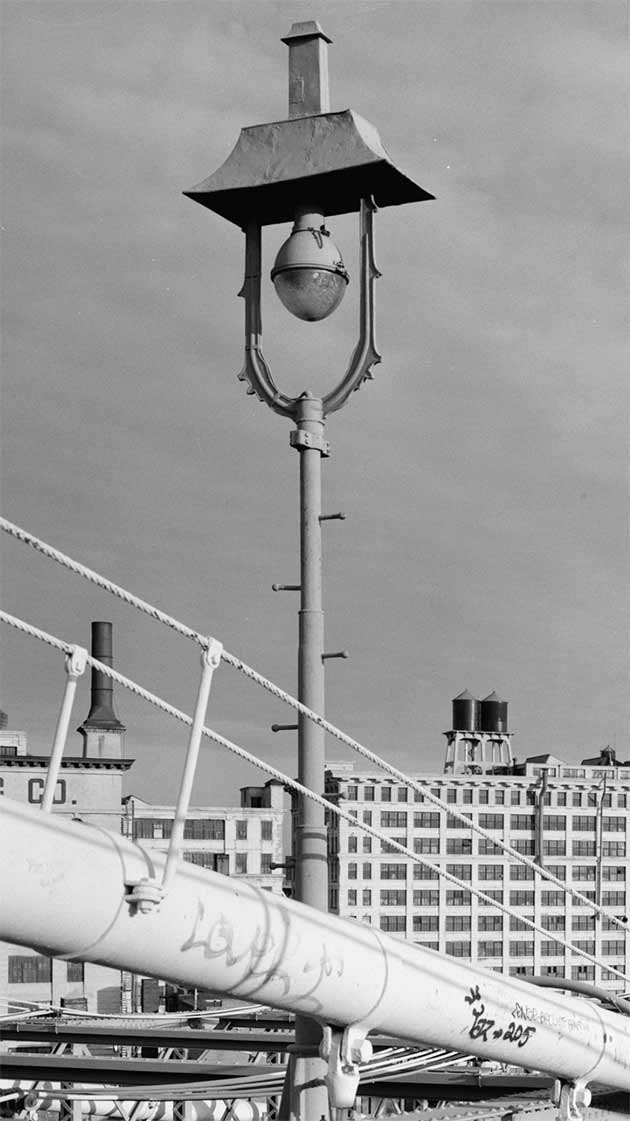

THROUGHOUT its 142-year (and counting) history, the Brooklyn Bridge has featured unique road and walkway lighting. I thought I’d show some historic black and white photos illustrating this, courtesy the Facebook group Old NYC Photo Dump, as well as contemporary scenes from Google Street View. The Brooklyn Bridge, constructed between 1870 and 1883 by John Roebling (who perished from tetanus during the construction) and his son, Washington Roebling (who suffered from the bends and supervised construction from his home in Brooklyn Heights, relaying commands via his wife) is perhaps the most storied and most famous bridge in the world. I won’t recount the details of its construction here — I’ll let Steve Anderson do it in NYCRoads; Ken Burns on PBS, or David McCullough in The Great Bridge.
The Brooklyn Bridge connects the boroughs of Manhattan and Brooklyn by spanning the East River. With a main span of 1,595.5 feet, it was the longest suspension bridge in the world from its opening until 1903, and the first steel-wire suspension bridge.
The lampposts on the walkway have had basically the same design seen above, at least the hooded apices, since the bridge opened in 1883. In those days, Mr. Edison’s harnessing of electricity was not as pervasive as it would soon become and the lamps were gaslit. There are ladder rests on the shafts to accommodate the lamplighters. I’m not sure when the switch was made, but the poles were electrified (some years ago, their photocells activated them automatically at dusk). When I first encountered them in the 1960s, the poles held incandescent “gumball” fixtures. However: the bases were not nearly as ornate as you see here.
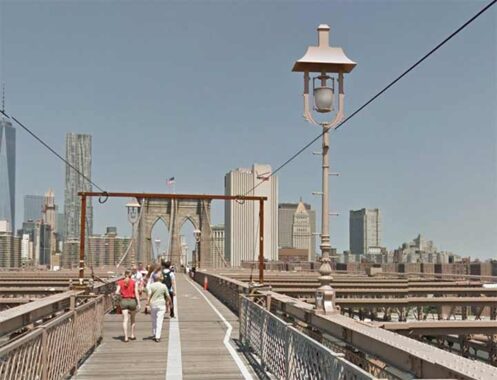
The more elaborate bases came along when the lamps were replaced in the 1980s and the lamp fixtures became yellow sodium, which themselves have been replaced now by bright white LEDs. I wish I knew more about Brooklyn Bridge lighting; it’s an aspect I haven’t seen touched upon by anyone but me.
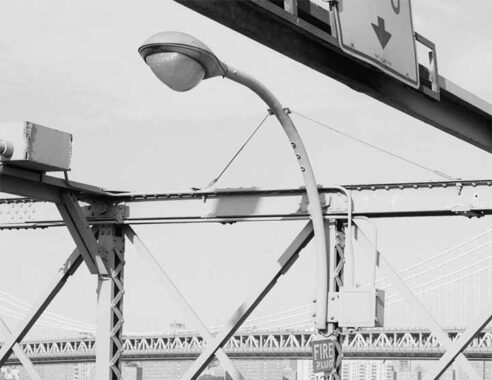
By the 1960s the Brooklyn Bridge roadway was lit by cobra neck masts carrying GE M400 lights, the same ones used to light NYC streets (along with Westinghouse OV-25s, see below). Earlier, these masts carried incandescent “gumballs”, the same seen above on the walkway lamps.
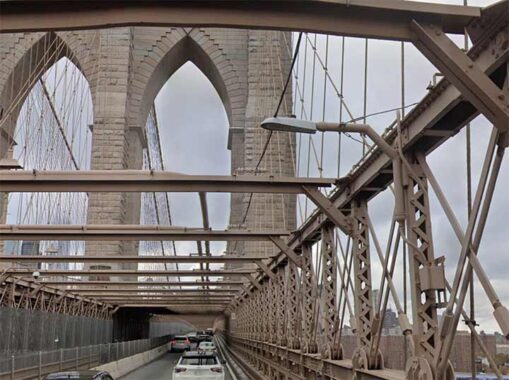
The new century has seen those masts replaced with angular masts seen here, as well as now-ubiquitous bright white LED lamp fixtures.
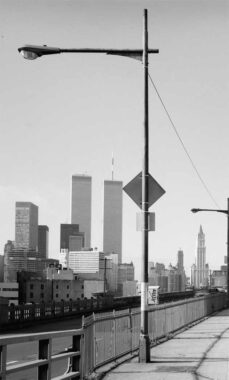
The approach roadways on both the Brooklyn and Manhattan ends of the bridge employed these 1930s-era finned “Whitestone” lamps, originally carrying SLECO AK-10 incandescent maps, and latterly Westinghouse OV-25s, seen here.
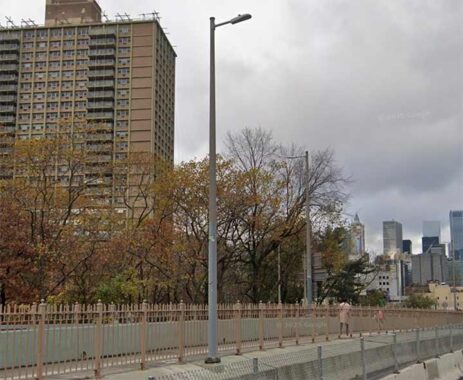
In the 1980s, the Whitestones were mostly replaced with these cylindrical poles with short masts. They carried yellow sodium fixtures that were switched out for LEDs.
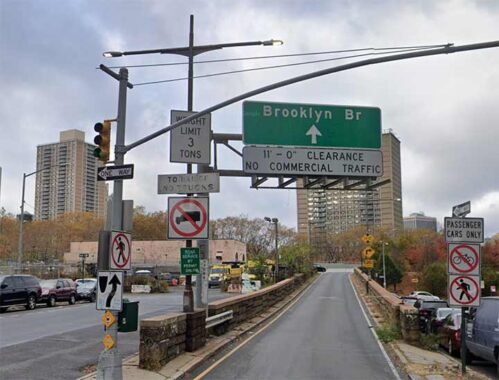
The Whitestones aren’t completely gone, though. Three remain, two Twins and a single, on the Sands Street westbound bridge entrance ramp. They have carried many lamp fixtures, with the latest modern LEDs.
Check out the ForgottenBook, take a look at the gift shop. As always, “comment…as you see fit.” I earn a small payment when you click on any ad on the site.
3/2/26