
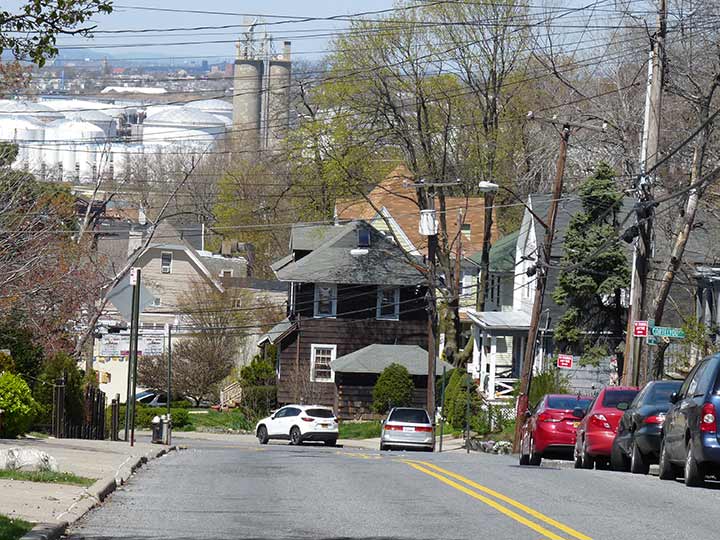

SEEN here is a scene I snapped in April 2016 — fully ten years ago! — on Lafayette Avenue and Cortelyou Place in Staten Island. Many sections of Staten Island are very hilly and the neighborhood I was in, Randall Manor, is located on a hill that slopes down to Richmond Terrace, the road that runs along the Kill Van Kull separating Staten Island from New Jersey. I hope 2026 is a year I’ll visit NYC locales I haven’t been for awhile, of which this is one.
Randall Manor is named for Robert Richard Randall (1750-1801), founder of nearby Sailor’s Snug Harbor. He specified that his fortune be left to the care of retired seamen without other means of support. Randall was the bachelor son of a privateer and knew well the toll a life at sea can take on the body and psyche. After Randall’s death in 1801, over twenty years was spent in adjudicating claims to Randall’s fortune, and by 1821, lower Manhattan had grown considerably and land for the sort of retreat Randall had had in mind was unavailable. Snug Harbor trustees purchased Isaac Housman’s farm in then-rural Richmond County in the 1830s. Architect Minard Lefever was commissioned to build Snug Harbor’s magnificent Greek Revival edifices, only some of which remain today. At its peak Snug Harbor was home to over 1000 seamen; by 1976 operations had relocated to North Carolina. The buildings were allowed to deteriorate for awhile, and some were demolished, but seven have been landmarked and Snug Harbor is in the process of becoming a premier cultural center in NYC. The institute includes Staten Island Botanical Garden and Children’s Museum, which all occupy the same space. Call (718) 448-2500 or consult snug-harbor.org for hours.
Walking through Snug Harbor is a strange yet calming experience; a trip through an old folks home, where all the old folks were Popeye.
In this photo we see the contrast between tranquil, residential Randall Manor (the western end of New Brighton) in the foreground and the east end of Bayonne, NJ in the background, which is completely given over to manufacturing and warehousing. We see the white containers of Gordon Terminal Services and 200-foot tall silos manufactured by Atlantic Cement in the Bayonne Cement Terminal, owned by Lafarge North America. I’ve been to Bayonne a few times, but obviously not this section which is closed to the public.
Check out the ForgottenBook, take a look at the gift shop. As always, “comment…as you see fit.” I earn a small payment when you click on any ad on the site.
3/10/26