
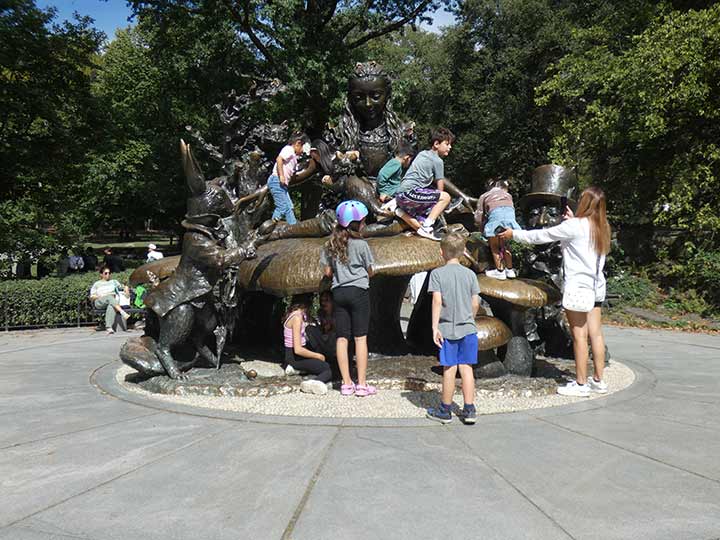

If you haven’t read Lewis Carroll’s two books featuring his heroine Alice Liddell, “Adventures in Wonderland” and “Through the Looking Glass” (I admit I haven’t since I was a kid, but they can be enjoyed equally by adults), they’re decidedly bizarre and imaginative; like H.P. Lovecraft, Carroll had an uncanny ability to remember dreams and write them down. The books are chockfull of strange creatures and mostly insane personalities. Sir John Tenniel’s illustrations are almost as famed as the text.
I usually holster the camera when the kiddies are around, but I couldn’t resist snapping a photo of the Central Park Alice in Wonderland bronze, and the kids can’t resist it either. George T. Delacorte (1893-1991) made his fortune publishing everything from penny-a-word mysteries and romances to comic books —Mickey Mouse, Woody Woodpecker and Bugs Bunny — to the novels of Kurt Vonnegut, James Clavell, James Jones and Irwin Shaw. But his name became chiseled into the consciousness of New Yorkers as the man who gave them the Delacorte Clock, Delacorte Fountain and Delacorte Amphitheater in Central Park and, at Columbia University, the Delacorte Professorship in the Humanities and the Delacorte Center for Magazine Journalism.
His most popular contribution may be the enchanting Alice in Wonderland statue that he placed in what he called “the finest spot in Central Park” in 1959 as a memorial for his recently deceased wife Margarita (1891–1956), a voracious reader and linguist. Spanish-American sculptor José de Creeft based the bronze on Sir John Tenniel’s illustrations. The surrounding landscaping was executed by the Japanese firm Hideo Sasaki & Associates.
Check out the ForgottenBook, take a look at the gift shop. As always, “comment…as you see fit.” I earn a small payment when you click on any ad on the site.
2/2/26
5 comments
Alice in Wonderland and the Diary of Anne Frank may be the top examples of book titles that don’t actually exist.
Gulliver’s Travels, too.
I’m amazed that in these lawsuit-crazy times, the Parks Department hasn’t fenced the whole thing off. The bronze is often too hot for kids to climb on during the summer. It’s also slippery. In fact, the 8 year-old version of me once took an unscheduled nose dive off the main mushroom. My skull — as well as the stonework surrounding the sculpture — fortunately survived.
I love Alice in Wonderland! My favorite! My sweet Dad read it aloud to me when I was 7 years old, acting out the characters. My favorite is the Jabberwocky. Thank you for sharing this picture!
Location of a photo shoot with the Jimi Hendrix Experience circa 1967-68