
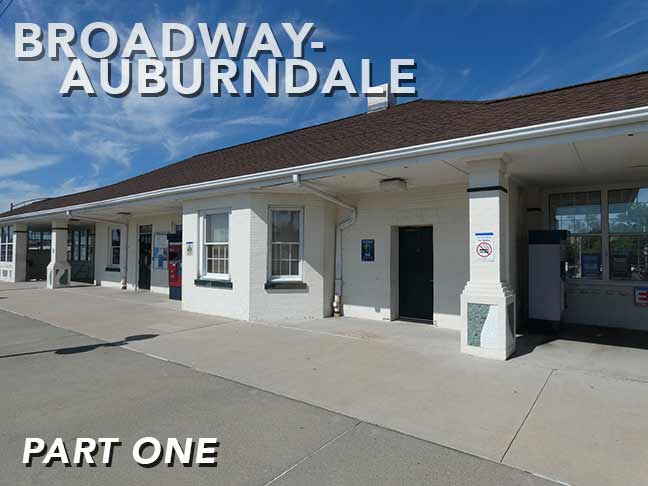

I have not really been able to do a lengthy walk with the camera since around Thanksgiving 2025, for a variety of reasons that include increasing sensitivity to wind and cold, and also a desire to not risk my back slipping on ice (which is only now beginning to melt after a 1/25/26 snowstorm). Fortunately, from July-November I was quite active indeed and have a backlog of photos that I nevertheless need to parcel out slowly before I am back in business once again. In September, I took a relatively quick walk from the Broadway LIRR station to the Auburndale-Bayside border. Very little of this area is thoroughly documented as little of it has Landmarks protection, but there are some interesting items to see and document.
GOOGLE MAP: BROADWAY-AUBURNDALE


I really like the stationhouse at LIRR Broadway. It’s a ranch house built in 1913, when the only ranch houses could be found on actual ranches. In 2014, I took a thorough look at the Broadway station and showed photos of it under construction in 1913 as well as its extensive renovation in 2006-2007. This was my home LIRR station from 1993-2007 and the platform had deteriorated to the point where it was crumbling onto the tracks, and there were two “rain sheds” that were used mainly as urinals; both have been razed.
The Broadway station achieved its present condition in 1913 when the grade crossings on 22nd Street (now 162nd Street) and Broadway (Northern Boulevard) were both eliminated. It was quite an involved operation. To do this, the tracks had to be placed on an embankment and, east of about 165th Street, an open cut, an elevated bridge in Auburndale and another open cut in Bayside, as the contours of the territory differed greatly. That wasn’t the only thing that had to be done, though. Both 162nd Street and Northern Boulevard had to be extensively excavated and an artificial slope constructed so that traffic had at least 1 ten-foot height to pass under the embankment, which was placed on a concrete and iron trestle.
In 1906 the Rickert-Finlay Realty Company set about building up vast swaths of northeast Queens, from Flushing to Little Neck, as the former farmland became residential property. The anticipated opening of the Queensboro Bridge (1909) made the heretofore sleepy county ripe for new residents. The immediate area became known as Broadway-Flushing, and the region north of the railroad that was developed by Rickert-Finlay remains some of the most exclusive and beautiful neighborhoods in New York City. Longtime area residents, whose houses still adhere to the Rickert-Finlay Covenant of 1906 restricting what types of houses can be built in the area, have battled tooth and nail with new residents and immigrants, who want to build their preference of houses. Who comes out on top will determine whether Broadway-Flushing retains its century-old flavor.
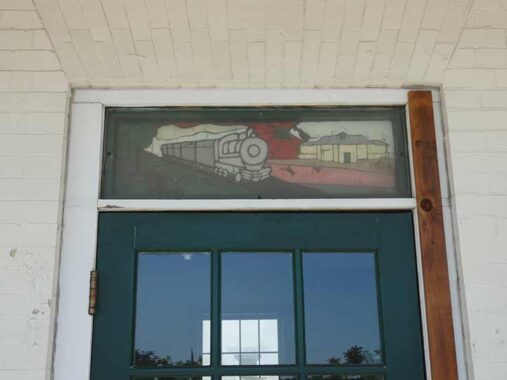
There has been a railroad running through Flushing since the 1860s, ran by several railroad companies before being consolidated under the Long Island Rail Road banner. The painted glass on the transom above the station entrance harks back to the era when steam trains plied the route before its electrification. It’s a bit anachronistic, depicting the current stationhouse, which was built in 1913.
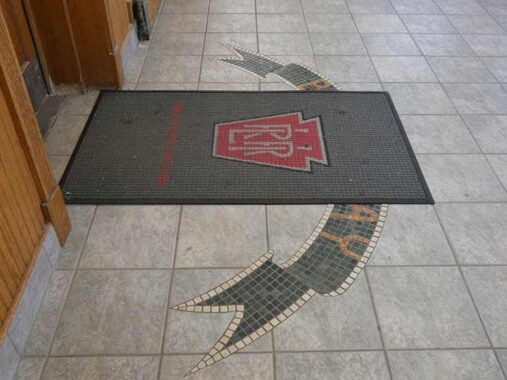
The rug just inside the entrance is one of the last representations of the LIRR-Pennsylvania Railroad alliance, other than the name of Pennsylvania Station itself. The LIRR was run under the auspices of the Pennsylvania Railroad from 1900 to 1949, and in those years, the LIRR signage adopted the “Pennsy” keystone symbol, since Pennsylvania is called the Keystone State. Until 1955, the LIRR’s chuffing steam engines all carried a keystone plate on their noses, when the last steam engine was retired from active service. One of their complement, Steam Engine #39, is exhibited, Pennsy plate included, at the Railroad Museum of Long Island in Riverhead. The rug obscures most of the tiled ribbon graphic.


In my previous examination of the Broadway station, I didn’t show the interior. From 1993-2007 when getting the train here, I would arrive shortly before the train arrived and didn’t go inside. In any case, station houses on the Port Washington branch close around 2 PM and so I could not enter the station when exiting the train, as a rule. The interior is pretty basic, as is the station at Bayside (which I have used more frequently while traveling before 2 PM during the winter). I have yet to check out the interior at Douglaston, Manhasset or Plandome. Port Washington’s used to have a newsstand, in the era of newspapers which ended just a few years ago.


The Broadway remake was the best, and longest-lasting, of the station remakes executed by the MTA in the 2000s. Already, Bayside’s are deteriorating and need an upgrade, and the elevator at Auburndale is being replaced, a proposition that in MTA-land takes several months and requires a steep set of stairs to access.
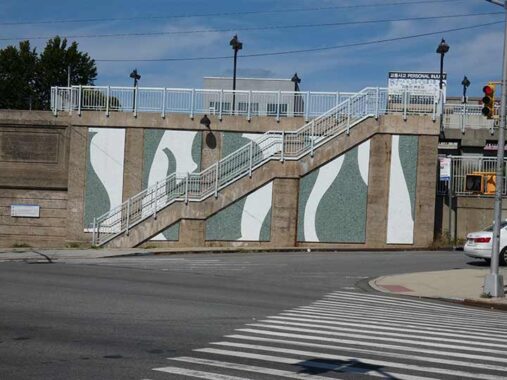
Broadway also participated in the MTA’s Arts for Transit program, with the installation of Jean Shin‘s “Caledon Remnants” which appears on the stationhouse as well as sprucing up the old concrete entrance stairs first installed after the grade cross elimination in 1913. the largest sampling can be seen on the staircase to the eastbound platform on Northern Boulevard.
Fragments of traditional Korean ceramics are arranged into mosaic murals of vase silhouettes on the façade of the Broadway Long Island Railroad station in Flushing, Queens. Located in the heart of a vibrant Korean-American community, the abstract, green-blue silhouettes enhance the beauty of the Celadon itself, while the overall piece speaks to the rich, yet fractured, cultural history of the Korean diaspora. The pottery remnants were imported from Icheon, Korea as part of a cultural exchange. Jean Shin
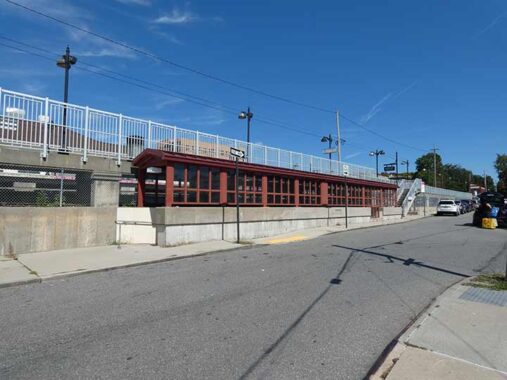
After extensive renovations completed in 2007, the station crossunder looks like this. The red windows shelter a wheelchair ramp that connects to the crossunder.
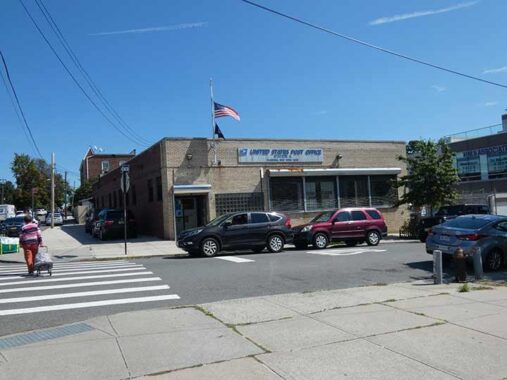
At Station Road and 163rd Street, across from the railroad, stands what was my post office while I lived in the area. Like the post office on Prince street that has since become an Apple store, this PO was never given a proper name and is called “Station A.”
Old Towne of Flushing Burial Ground
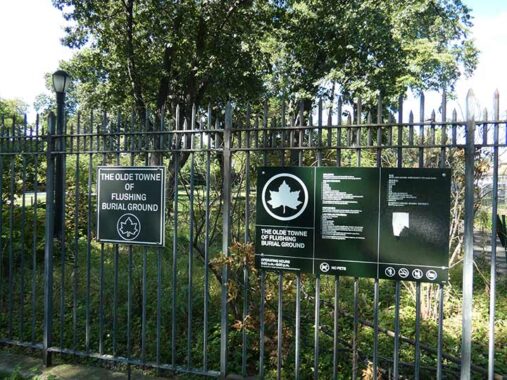
Between 164th and 165th Streets across from Flushing Cemetery, a clump of green marks a very unusual small cemetery. For decades this was a public park with a playground fronted by a concrete sitting area with park benches called Martin’s Field. The area had been a park since 1914, and was named for conservationist Everett P. Martin in 1931, with the playground built in 1936 under the auspices of the Works Progress Administration.
However: for decades prior to that the field had been used a a burial ground for African and Native Americans as well as some white area settlers — it had been established as a cemetery as long ago as 1822:
The land was initially a burial site for victims of plagues such as smallpox, cholera and yellow fever. From 1822 until the 1870s neighborhoods in Queens were greatly affected by these illnesses until a centralized water system was introduced. Purchased by the Town of Flushing in 1840, the site is home to approximately 800 to 1,000 individuals buried over several decades, the majority of whom were African-Americans and Native Americans. There were also a number of poor whites who, along with wealthier residents, died during the cholera and smallpox epidemics in 1840, 1844, 1857 and 1867, buried as well. Their bodies were considered too contaminated for a proper churchyard burial. Half of those buried are children five years old or younger.
According to [the late activist Mandingo] Tshaka, the plots were indiscriminately arranged, often, unmarked and as shallow as six inches below the surface. The last burial was in 1898, the year of the city’s consolidation. Queens Gazette


This peaceful expanse, now returned to its 19th Century purpose as a memorial grounds, was once a concrete kiddie playground with swings. A stone wall that marks the eastern boundary of the original cemetery has four names embedded within, representing tombstones that were discovered in 1919, belonging to Alfred, George and James Bunn and Willie Curry. Alfred Bunn and Willie Curry died in childhood. The playground was relocated further north on 159th Street.


A new element was added since my last visit, a commemorative wall inscribed with the names of the 320 people buried on the property.


Lastly, names of Native American tribes are embossed in the Times Roman font around a circular garden.
In Part 2, in and out of Flushing Cemetery
Check out the ForgottenBook, take a look at the gift shop. As always, “comment…as you see fit.” I earn a small payment when you click on any ad on the site.
2/12/26
4 comments
You are correct that the LIRR operated as a direct subsidiary of the Pennsylvania Railroad (PRR) until 1949, but the actual years of PRR ownership continued until 1966. Let me take the liberty to add a few bullet points:
• March 1949: LIRR enters bankruptcy and is managed by trustees appointed by the bankruptcy court.
• February and November, 1950: Two terrible accidents kill 112 people and lead New York State to create a public agency (Long Island Transit Authority) to oversee its operations. LIRR remains under federal bankruptcy protection until August 1954.
• August 1954: LIRR emerges from bankruptcy as special 12-year Railroad Redevelopment Corporation under NY State law. Property taxes are forgiven and PRR pledges to invest monies to improve LIRR. Redevelopment Law protection set to expire August 1966.
• December 1965: NY State purchases LIRR from PRR for $65 million.
• January 1966: LIRR officially becomes NY State property under the Metropolitan Commuter Transportation Authority (MCTA), a new public agency that owns and operates the LIRR. The MCTA morphed into the larger MTA in March 1968.
There used to be two nice Irish saloons right by the station. One was on Northern’s south side next to the Paint store. The other was on Depot Road right off of Northern. They have been gone for over a decade, replaced by two Asian establishments, and I cannot remember the name of either.
@Philipe: The bar next to the paint store was Bridie’s Pub. They had a second location on Woodhaven Blvd. that recently moved to Dry Harbor Road and 64th Road in Middle Village, so you can still get a stout at Bridie’s!
I remember Bridie’s when I moved to Flushing in 1993. They were succeeded by some Korean bars but now thew space is two Asian restaurants.