

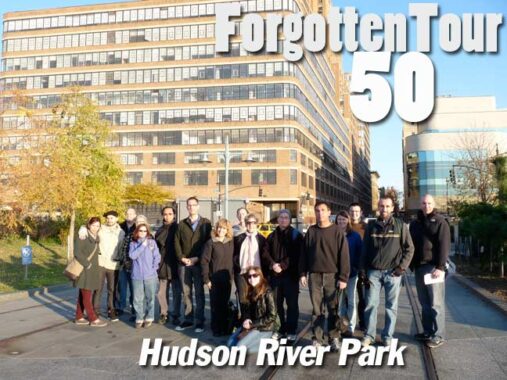
It has been awhile since I did a long form page on Hudson River Park. I have not visited often: In 2011, ForgottenTour #50 walked it from the Battery all the way to the Intrepid aircraft carrier, a distance of several miles. That was 15 years ago when all of us (I think) were in better shape. I put myself, and tourgoers, through their cardio paces for most of the 154 outdoors tours, some of which ran to six hours long. It’s still paying off but I have a couple of health issues that prevent me from really walking long distance now. In 2020, I wandered Hudson River Park as far north as Hudson Yards at the west end of 34th Street. I stood “wrong” and wrecked my lower back and had to gingerly limp over to the #7. This time, I walked HRP on a mild October 2025 day up to Christopher and had no mishaps. But they’re always around the corner.
I got 161 photos from HRP alone, more on Christopher, so this will have to be broken up to several posts.


I took the #4 train south to Bowling Green. I always check on this station when I’m around here, just to see how it’s holding up. This subway station house serves the IRT 4 and 5 lines and was constructed by early subway architects Heins and LaFarge in 1905. Other extant Heins & LaFarge stationhouses include ones at 72nd Street and Amsterdam Avenue and at the Atlantic-Barclays station in downtown Brooklyn. Of course, there are also BMT stationhouses in Brooklyn constructed in the 1910s under the supervision of designer/architect Squire Vickers. Sadly, indoors here, there’s not much to see except what could be some decades-old staircase railings. When built, fares were by ticket and the interior wasn’t cramped with turnstiles.


Walk south a bit on State Street from the stationhouse and you’ll see this small cannon by the curbline. It’ll be hard to get to if street vendors have set up there.
Both Battery Park and Battery Place take their name from a battery of guns the British kept trained toward the harbor between 1683 and 1687 to dissuade invaders from the Hudson River. The park itself stands on landfill created when Fort George was dismantled after the Revolutionary War. The cannon was discovered in 1892 for excavations for a building at Broadway and Exchange Alley. It was donated to the city of New York by William Henry Mairs and the City History Club and placed in Battery Park in 1914. The cannon was used in a British Revolutionary-era fortification called “Oyster Pasty” until the empire’s evacuation in 1783.
A common British delicacy is the “pasty,” an empañada-like treat that featured a pastry crust with various meat, cheese or vegetable filling. The fort must have had the rough shape of an oyster pasty. In fact, Exchange Alley was long ago called Oyster Pasty Alley, a name I wish it could have kept.


Continuing south on State Street, we come to sculptor Jonathan Scott Hartley’s 1903 bronze depiction of Swedish-born engineer John Ericsson (1803-1889) who designed the Monitor, the USA’s first ironclad vessel, at Greenpoint’s Continental Iron Works in 1861, and engaged the Confederate States’ Merrimac at Hampton Roads in 1862. It depicts the bearded Ericsson holding a boat model in his hand. The pedestal features inset bronze bas-reliefs, which illustrate significant naval battles involving the Monitor and Princeton, as well as an array of Ericsson’s mechanical inventions. A second Ericsson memorial can be found in McGolrick Park in Greenpoint, where there is also a Monitor Street.
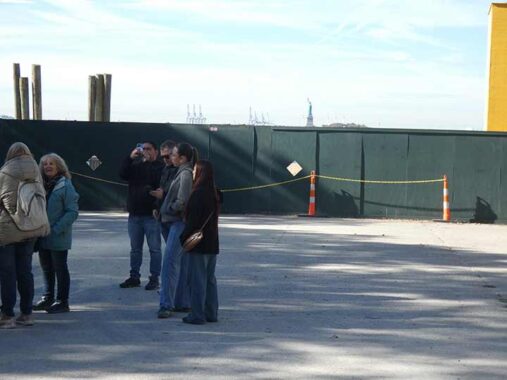
I also got several images from the Battery Park perimeter at State Street and the waterfront, but I believe I’ll present them individually and not part of this particular walk. A major problem I have with Battery Park is that over the past 10-15 years, much of it has been under major construction or repair, necessary I suppose, but frustrating, and I found a large part of the park simply not navigable on foot. I don’t recommend a visit unless you’re from out of town until all of it is finished, and who knows when that will be.
The current construction is due to the Battery Coastal Resilience Project, expected to conclude in 2027. We shall see. Right now, I go year by year.
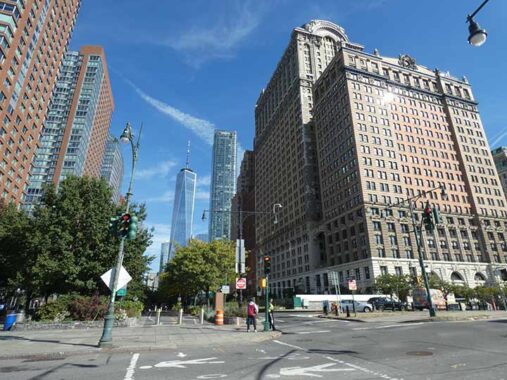
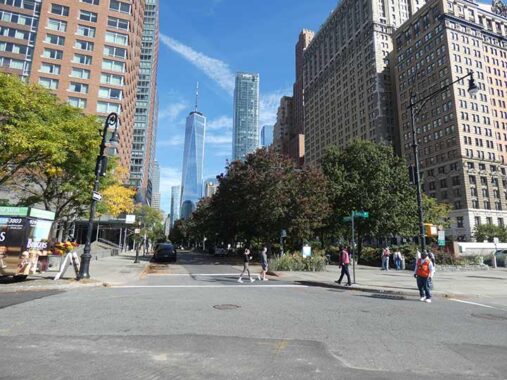
Standing now at Battery Place and Greenwich Street, with a view of One World Trade Center. On the right is an iconic lower Manhattan building, #17 Battery Place, constructed from 1902-1904 as the Whitehall Building (arch. Henry Hardenburgh). For years it hosted the Moran tugboat dispatcher, and a watchman in one of the upper floors would keep watch for incoming ships using a spyglass and used a megaphone to dispatch tugs to assist them. In the rear is the Greater Whitehall annex, completed in 1910. It was at one time the biggest office building in NYC. Both have been converted to residences.
I vaguely remember a job interview at #17 Battery years ago, but like most of my job interviews, nothing came of it.
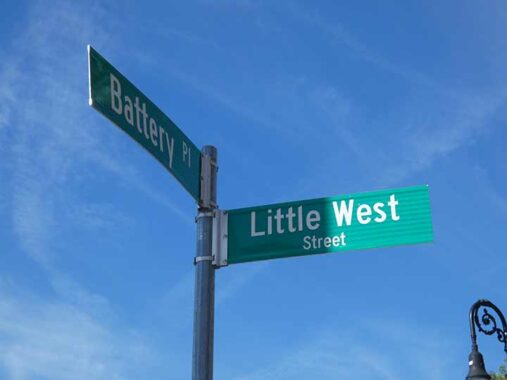
I skirted Battery Park City, where I have shot occasionally, but the sameness of its architecture frustrates me as far as doing infrastructure posts. One interesting element is Little West Street, which accompanies West Street for a few blocks between Battery Place and 3rd Place. It was built along with the rest of Battery Park City in the 1980s. There are a number of “Little” streets scattered around town. I do like Battery Park City, especially its corner windows, which provide two separate views.
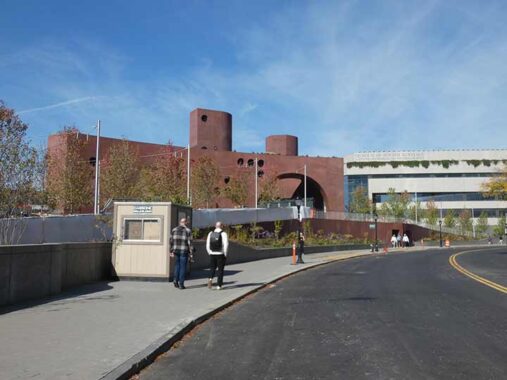
When Battery Park City was built, Battery Place was extended to take a northerly turn. Robert F. Wagner Jr. Park was opened in 1996 at the Hudson River edge from here north to Chambers Street at Stuyvesant High School. The park’s massive pavilion, containing event spaces, a restaurant and classrooms, was designed by Thomas Phifer. The park is named for the three-term mayor of NYC from 1954 to 1965.
It was fortunate I happened by in 2025 as RFW Park was wrapping up its own Battery Coastal Resilience Project initiated in 2023, an effort to contain flooding from storms such as Hurricane Sandy, the risks of which rise by climate change, say environmental experts.
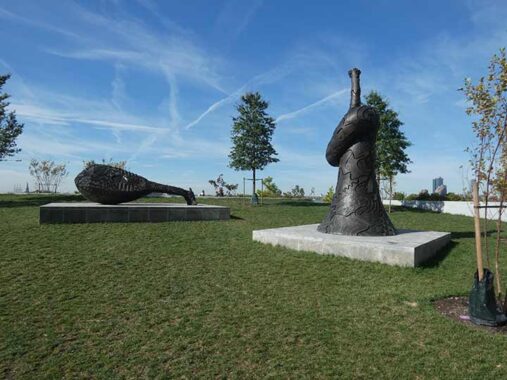
“Wagner Park will continue to be a vibrant public gathering space, featuring world-class public art and free community programming for residents and visitors of all ages. In addition to hosting temporary artworks, each of which will introduce a new perspective and experience for visitors, Wagner will be the permanent home for three major sculptures. Resonating Bodies [pictured here] by Tony Cragg, invites visitors to run their hands over monumental and highly textured bronze instruments. Louise Bourgeois’s Eyes look towards the Statue of Liberty, gazing with the public at New York City’s storied past.” [Battery Park City Authority]
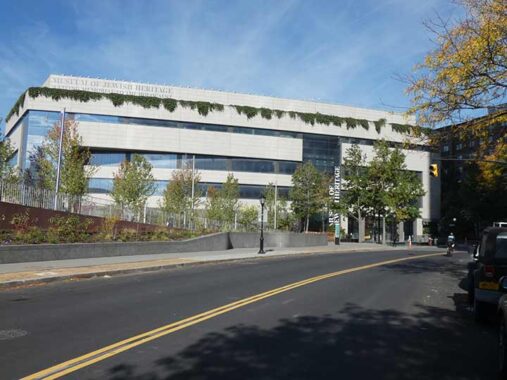
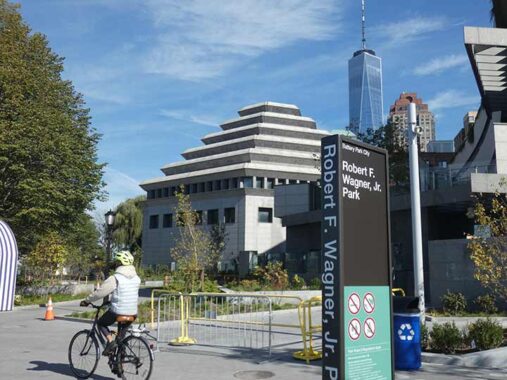
You will also find the Museum of Jewish Heritage in Wagner Park. Opened in 1997, it serves as both a museum and a monument to the millions of Jews killed in Nazi Germany during the Holocaust. It is open on Sunday and Wednesday through Friday, excepting Jewish holidays.
The museum’s building includes two wings: a six-sided building with a pyramid-shaped roof designed to evoke the memory of the six million Jews killed in the Holocaust, and the Robert M. Morgenthau Wing. The six-sided building, opened in 1997, contains the museum’s core exhibition galleries. The Morgenthau Wing, opened in 2003, contains the museum’s offices, theater, and classrooms, as well as the Irving Schneider and Family exhibition gallery. Both wings were designed by Roche-Dinkeloo. [wikipedia]
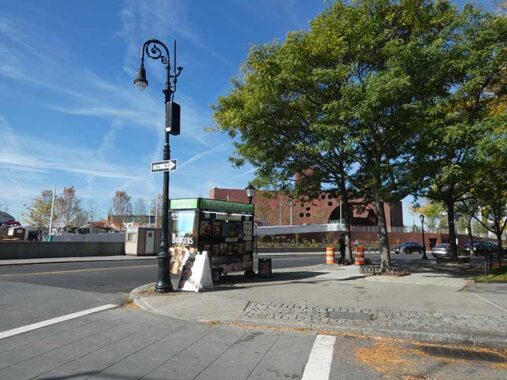
Battery Park City has had Bishop Crook poles as well as the longer-armed Corvingtons since the outset. This one on Battery Place goes all the way back to when BPC was under construction in the 1980s, as its streets and lighting where built first on landfill. This one is despoiled by the presence of cell phone transmitter. The short J-shaped arm near the top once held a fire alarm indicator lamp.
The reason I took the photo wasn’t the lamppost, though. On the burger cart, I noticed the word “Burgers” is spelled in The Beatles’ distinctive font, seen prominently on Ringo’s drumheads as well as promotional materials.
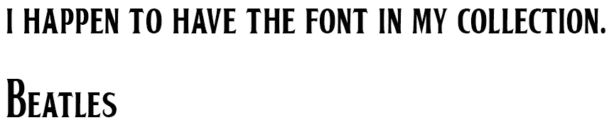
The Beatles logo is known as the “drop-T” logo, which was hastily drawn by Ivor Arbiter when the Beatles bought a drum kit in the shop he owned and asked for the name of the band to appear on it. Though it is a customized design, a font was created to imitate the lettering style of the Beatles logo. This font called Bootle was designed by Northern Fonts and it is free for both personal and commercial use. You can download the font here. [Fontmeme]
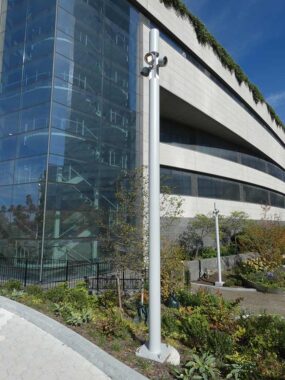
In many of NYC’s newer parks, such as Wagner Park, minimalism is the trend for park lighting. This is a simple metal cylinder with lighting fixtures at the apex. Brooklyn Bridge Park employs tall, cylindrical wood telephone poles with floodlights. Classic Type B park lamps, though, are found elsewhere in Wagner Park.
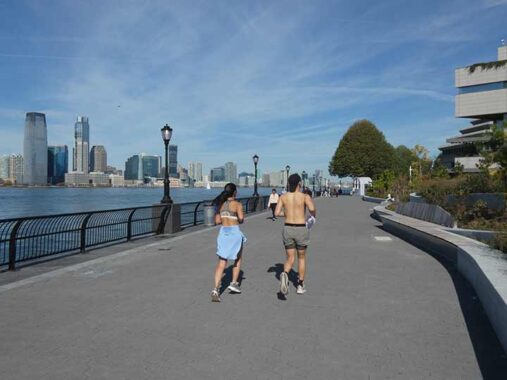


Whenever I am by the water, I always silently thank providence I live in a city with ready access to it. It wasn’t always the case; NYC’s waterfront was once semiprivate and where thousands worked, loading and unloading ships. Railroads were built to transport goods from the waterfront to separate handling facilities. During this time, NYC and its traffic czar Robert Moses thought it’d be a dandy idea to locate parkways and expressways along the water. (Moses wasn’t alone; cities as diverse as Philadelphia, San Francisco and Boston also built elevated highways along their water frontage.) It’s only been in the last few decades that cities have decided to make their waterfronts available to all and built parkland.
Speaking of Type B park posts, here are specialized “dwarf” versions of them on the railings in Wagner Park, looking toward Ellis and Liberty Islands as well as Jersey City.
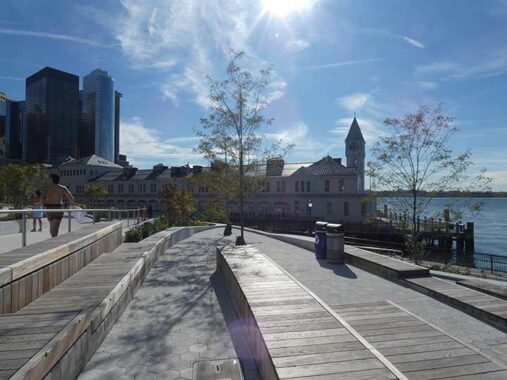
On this day in October 2025, because of Battery Park construction I didn’t walk past the Pier A building, so I shot through the sun glare to get this photo of the building, currently home to Pier A Harbor House. Pier A is the oldest extant pier in NYC and the only one identified by a letter. All piers north of here and on the east side of the island are identified by number. It was built in 1886 for NYC’s Department of Docks and Harbor Police. In the past it has been used as the HQ for the FDNY Marine Division. The distinctive tower clock, added in 1919, was the nation’s first World War I memorial. The building was used as a fireboat station from 1960 to 1992, but it fell into disrepair after that. Renovations began in 2009 and continued for several years.


I haven’t been to Ellis Island since I met Elliott Gould there about 20 years ago (he had narrated the film “Forgotten Ellis Island,” whose debut I was attending). Not going into lengthy descriptions of Ellis or Liberty Islands, though there may be “forgotten” aspects of each I could look into. I just wanted to test the quality limits on my zoom lens.
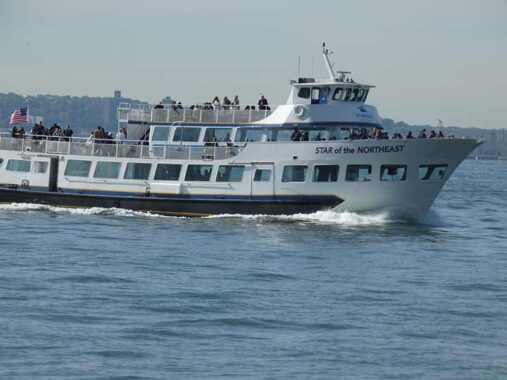
The Star of the Northeast event yacht sailed past. Maybe “Below Deck” could do a NYC version on it.
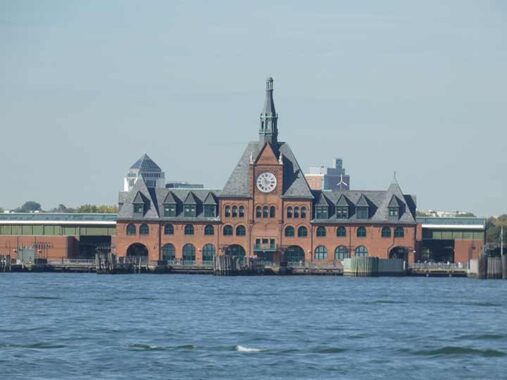
It’s also been a long, long time since I was in Liberty State Park. I can get there fairly easily with Hudson-Bergen Light Rail from Hoboken, so 2026 may be the year I return. Located on the park waterfront is the station terminal building of the Central Railroad of New Jersey, constructed in 1889 by Peabody and Stearns. Thousands of immigrants processed on Ellis Island made their way by boat here, and the CRRNJ and connecting railroads then took them to points all over America. The station served train traffic until 1967.


As I walked along the riverside path I noticed some of the Type B dwarf poles were painted light blue to various heights, some all the way up. Signs explain that the blue paint represents the level water would attain during “100-years storms” (of which Sandy was one), and was a prime reason for shoring up the seawall as is being done during the Battery Coastal Resilience Project.
Mother Cabrini


Frances Xavier Cabrini (1850-1917), the Catholic saint, was born in Lodi on the Italian peninsula (then a part of the Austrian empire) and became a nun at age 27 after the deaths of her parents. Born Francesca Saverio Cabrini, she added “Xavier” to her name to honor patron saint Francis Xavier. Interested in founding missionaries, she helped found the Institute of the Missionary Sisters of the Sacred Heart of Jesus in 1880, and she traveled to the USA in 1889 and organized catechism and schooling for Italian immigrants, using great powers of persuasion to accrue donations, eventually founding Italian Hospital, later the Cabrini Medical Center, which remained open until 2008.
The tireless Cabrini founded over 60 schools and orphanages throughout the United States, South America and Europe. She became a United States citizen in 1909, eight years before her death. She was beatified in 1938 (the first step in becoming a saint) and finally canonized in 1946. She was the first naturalized US citizen to become a saint; Elizabeth Bayley Seton was the first native-born US citizen to do so. There are three shrines to her honor in the USA, in Chicago; Golden, Colorado; and Washington Heights, New York, several miles south of her original burial plot in West Park in Ulster County.
When Chirlane McCray, Mayor Bill DeBlasio’s wife, founded the initiative “She Built NYC,” part of it was a nonbinding public vote for the initial stature proposals; while Cabrini came in first, an uproar erupted when McCray announced that Cabrini would not be among the first batch of sculptures to appear. On Columbus Day 2019, Governor Andrew Cuomo announced that the state would fund a Cabrini statue, prompting DeBlasio to accuse him of politicizing the affair.
The Cabrini memorial was sculpted by the artist team of Jill and Giancarlo Biagi and dedicated October 12, 2020. The saint and two children are depicted in a paper boat, many of which the saint produced as a girl, saying the boats acted as her “missionaries” spreading the gospels of Christ.
More: Cabrini Boulevard, Washington Heights


Along the waterfront at Wagner Park there are two man-made Hudson River inlets, South and North Cove. South Cove Park, opened in 1987, features two wooden boardwalks lit with lamps echoic of the Robert Moses parkways’ old “Woodie” lamps, but featuring blue glass. Also featured is a pergola and plantings that include beach grass, beach rose, bayberry and beach plum. The park’s design was by artist Mary Miss, landscape architect Susan Childs, and architect Stanton Eckstut. It is directly opposite Jersey City’s financial district, with its rather meh skyscrapers. The photo features the two tallest buildings in New Jersey, the Goldman Sachs Tower (30 Hudson Street) on the left and 99 Hudson Street, 79 stories and 900 feet in height, to its right; it took the title from 30 Hudson in 2019. Not to be outshone, New Jersey’s 4th tallest building, URBY Harborside Tower I, is off to the right.
See South Cove Park while you can: in 2026-2027, it will be under repairs by Northwest Battery Park Resiliency Project.
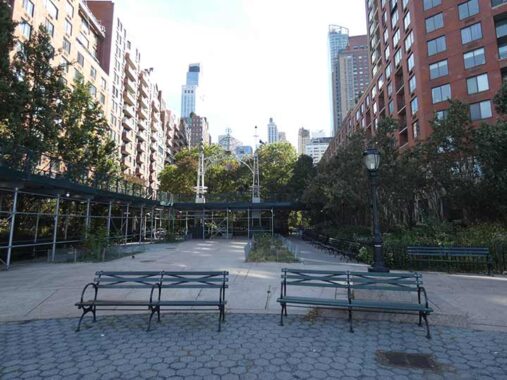
Among Battery Park City’s highlights are its numerous parks, along with a magnificent waterside promenade. Rector Park and its sculpture, Rector Gate, opened in 1988.
Colgate Clock
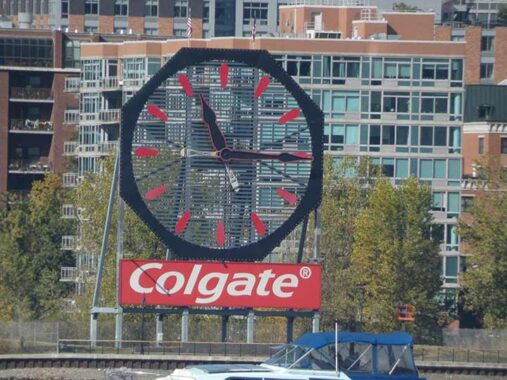
Glancing across the Hudson again, the familiar octagonal Colgate clock, facing Manhattan and visible from the Wagner Park riverside walk in Battery Park City, dates back to 1924 when it was set in motion on December 1 by Jersey City’s Mayor Frank Hague. Located on the former site of Colgate-Palmolive & Company, it is a reminder of the time when factories dominated the Jersey City’s waterfront. The clock’s design was inspired by the shape of a bar of Octagon Soap, first manufactured by Colgate as a laundry cleanser.
The Colgate‘s Soap and Perfumery Works, later Colgate-Palmolive Peet, was founded by William Colgate in 1806. He began as a manufacturer of starch, soap and candles with a shop on John and Dutch Streets in New York City. When he moved his company to Paulus Hook (Jersey City) in 1820 to produce starch, it was referred to as “Colgate’s Folly.” The company instead flourished and had a sizable complex in Jersey City by 1847. It made chemically produced soap and perfume but eventually gave up perfume production. Upon the death of William Colgate in 1857, his son Samuel reorganized the company as the Colgate Company. It took on brand products such as Cashmere Bouquet, perhaps the first milled perfumed soap, and revolutionized dental care with toothpaste sold in jars in 1873. It also packaged toothpaste in a “collapsible” tube in 1896.
Overlooking the Hudson River, the octagonal Colgate clock and signage perched on a company structure remained unaltered until 1983. The signage “Soaps-Perfumes” was removed and a toothpaste tube, advertising one of Colgate’s best selling products, took its place. Two years later and after 141 years in Jersey City, Colgate decided to move out, citing the need for improved facilities that its original manufacturing complex could not provide. The entire complex was razed, and the clock, without the toothpaste tube, was lowered to ground level as a freestanding icon on the future Goldman Sachs property, where it stood for fifteen years. The 24-acre site became part of the redevelopment of the Jersey City waterfront at Exchange Place that began in the early 1990s.
The clock was dismantled in June 2013 and refitted with LED lights, and then reinstalled on the waterfront near the Goldman-Sachs Building.


The Battery Park City Association has designed proprietary directional signs and maps.


It was a good thing I photographed the artwork “Upper Room” by Ned Smyth, installed in 1987 at the west end of Albany Street, because by the next month, November 2025, it had been dismantled and removed as part of the project I have been mentioning, the Battery Coastal Resilience Project.
“Designed by Ned Smyth, ‘Upper Room’ is a handsome colonnaded court marking the entrance to the Esplanade at Albany Street. At once dignified and playful, reverent and inviting, this self-contained sculptural environment suggests a contemporary reimagining of an ancient Egyptian temple offering stylized sanctuary from the surrounding city even as it formally echoes the rhythms of its urban environment.
“On its sides the work is girded by ruddy red pillars made of gravelly concrete aggregate recalling a fusion of decorative palm trees and Near Eastern architecture. . . . Designed to be both functional and symbolic, ‘Upper Room’ lends an appealing air of ceremony, harmony, and mystery to its site overlooking the waterfront.” [Our Town]
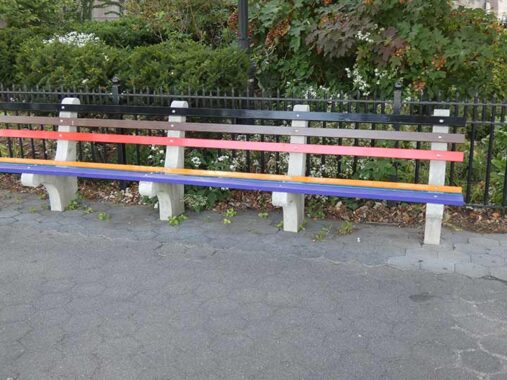
This is the standard design for NYC park benches (though there are other designs). The rainbow colors may be left over from June gay pride observations.


I had thought for a long time that the climate controlled atrium in the World Financial Center (officially called Brookfield Place) in Battery Park City was the only place outside of the New York Botanical Garden in the Bronx that you could find palm trees in NYC, but I discovered other palms in another atrium at #60 Wall Street, as seen on this FNY page. Every year, a contest called Canstruction challenges teams of architects, engineers and contractors to build sculptures made entirely out of unopened cans of food. The large-scale sculptures are placed on display and later donated to City Harvest to help provide families with a holiday meal.


Before skirting the North Cove area of Wagner Park, there are a couple of exhibits and memorials to check out. Artist James “Yaya” Hough served 27 years in prison, where he taught himself and other prisoners art manufacture and portraiture techniques. His glass and steel medallions triptych, “Justice Reflected,” was originally supposed to be on view for only a year, but remained in late 2025.
Police Memorial
[T]he triptych of five-foot circular pieces integrates specific references to the United States’s history of injustice through imagery of chains and hooded Klansmen, and more universal iconography of freedom and justice rendered in an Art Deco style. [Hyperallergic]


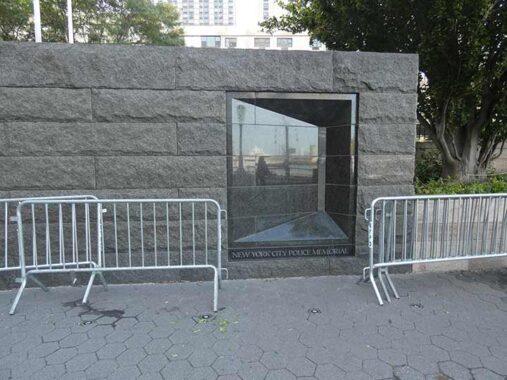
Close by the Yaya Hough artwork sits the NYPD Memorial Wall located within yards of the World Trade Center, founded in 1997, which has the names of over 500 members of the NYPD killed in the line of duty. Many were added after 9/11/01.
One of the names is that of Lieutenant Joseph Petrosino.
When he joined the Police Department in 1883, Petrosino was the city’s shortest officer, at five feet and three inches tall. Police Commissioner Theodore Roosevelt personally promoted him to Sergeant of Detectives in 1895. While investigating anarchists in the United States, Petrosino warned President McKinley of threats against his life; however, the warning was not heeded and the President was assassinated in 1901.
Within ten years, Petrosino was named lieutenant and given command of the new Italian Squad, a unit created to combat the crime organization known as the Black Hand. Under his leadership, several thousand arrests were made, and more than 500 offenders were sent to prison. Crimes against Italian-Americans dropped by fifty percent. Petrosino was killed while on assignment to Palermo, Sicily.
When his body was returned to New York, thousands of mourners formed a funeral procession which marched from Little Italy to Calvary Cemetery in Queens. Lt. Petrosino was the only New York police officer who had died in the line of duty outside the United States.


The North Cove at Wagner Park, directly west of the World Trade Center, is famed for its marina, believed to be the first European-style mega-yacht harbor in the continental United States when it opened in 1989. Many working in lower Manhattan debarked here in the aftermath of the terrorist attack on 9/11/01. The expansive waterfront plaza with seating was designed by architects Siah Armajani and Scott Burton and landscape architect M. Paul Friedberg.
Check out the ForgottenBook, take a look at the gift shop. As always, “comment…as you see fit.” I earn a small payment when you click on any ad on the site.
2/22/26
3 comments
Liberty Mutual Insurance features parks on both sides of NY harbor in their amusing ad campaign:
https://www.bing.com/videos/riverview/relatedvideo?q=this+could+be+the+last+time+youtube&refig=699c56e811194a3c8b9d7bf70aa9ffc1&pc=DCTS&pq=youtube%2fthis+could+be+the+last+time&pqlth=35&assgl=35&sgcn=this+could+be+the+last+time+youtube&qs=RI&sgtpv=RI&smvpcn=0&swbcn=10&sctcn=0&sc=10-35&sp=1&ghc=0&cvid=699c56e811194a3c8b9d7bf70aa9ffc1&clckatsg=1&hsmssg=0&ru=%2fsearch%3fq%3dthis%2bcould%2bbe%2bthe%2blast%2btime%2byoutube%26form%3dANSPH1%26refig%3d699c56e811194a3c8b9d7bf70aa9ffc1%26pc%3dDCTS%26pq%3dyoutube%252Fthis%2bcould%2bbe%2bthe%2blast%2btime%26pqlth%3d35%26assgl%3d35%26sgcn%3dthis%2bcould%2bbe%2bthe%2blast%2btime%2byoutube%26qs%3dRI%26sgtpv%3dRI%26smvpcn%3d0%26swbcn%3d10%26sctcn%3d0%26sc%3d10-35%26sp%3d1%26ghc%3d0%26cvid%3d699c56e811194a3c8b9d7bf70aa9ffc1%26clckatsg%3d1%26hsmssg%3d0&mmscn=vwrc&mid=42E4A9C21996ABD0FBE442E4A9C21996ABD0FBE4&FORM=WRVORC&ntb=1&msockid=ae9dfcb410c911f1b1f8e9e0bf16b546
Thanks, Kevin, for this comprehensive and delightful account of a place that was part of my youth.
I apologize for transmitting the wrong video. I meant to forward this one:
https://www.bing.com/videos/riverview/relatedvideo?q=Liberty+Mutual+ad+with+seagulls&mid=803507F711A1E3689DF9803507F711A1E3689DF9&FORM=VIRE
Sorry, but that “…could be the las time.