
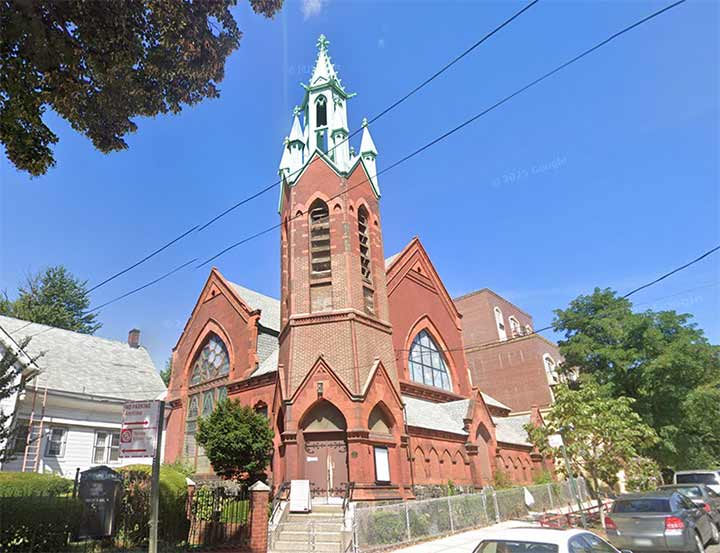

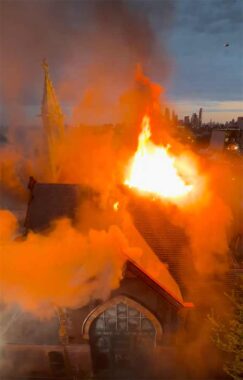
THE Reformed Dutch Church of Hallets Cove (later Good Church of Deliverance) at 27-26 12th Street in Astoria Village was built in 1888; its verdigris’ed steeple replaced the original in 1900. The parsonage, which may date as early as the 1850s, is just to its south. Nothing in Astoria Village has Landmarks protection, and many of its historic buildings have been lost over the last thirty years. One more can be added to the list, as the church suffered a devastating 5-alarm fire on April 23, 2026 and could be a total loss.
The church had been abandoned in recent years.
Interior photos [UrbanFlocca]
The First Reformed Church of Astoria was organized in 1835 when a group of Christians composed principally of those with membership in the Dutch Reformed and Presbyterian denominations met at the Schoolhouse of Hallet’s Cove on October 12, 1835 to determine if it was feasible to form a church. For a year this small group continued to gather for worship and to raise funds to construct a suitable House of Worship. On October 6, 1836, the cornerstone of a white frame church building of colonial architecture was laid. Services of worship were conducted each Sunday afternoon on an alternating basis by the Rev. John Goldsmith, pastor of the Presbyterian Church of Newtown and the Rev. Garret J. Garretson, pastor of the Reformed Dutch Church of Newtown. This group petitioned the Presbyterian and the Dutch Reformed denominations to assist them with their building indebtedness of $3,000.00. The Collegiate Dutch Reformed Church of New York responded with a gift of $1,500.00. Based on that financial assistance, The Classis of Long Island was petitioned to organize the Reformed Protestant Dutch Church of the Village of Astoria. The church was officially organized at a service on July 14, 1839.
|
On November 28, 1880 the “new Chapel” — now called the Church Hall — was dedicated and was widely acclaimed as the best accommodation for any Sunday School in Astoria. On Saturday, January 14, 1888, a fire of unknown origin broke out in the church, damaging the floor, some of the pews and slightly damaging the organ. The organ, pews, pulpit furniture, clock and bell were removed and stored in the chapel, and the 1837 church building was razed.
|
The cornerstone of the present church was laid on October 6, 1888, fifty-two years to the day after the laying of the cornerstone of the first church building. The brick Victorian Gothic building had terra cotta and copper details, and an octagonal tower and steeple. The original steeple was destroyed by lightning and was rebuilt.
|
Behind the church are gravestones from its lost cemetery bearing inscriptions for Stephen Halsey, the founder of Astoria Village, and Grant Thorburn, its first postmaster. [New York City American Guild of Organists]
Update: the brick tower survived (don’t know about the steeple yet); parsonage destroyed
Links via DeeAnne Gorman, Greater Astoria Historical Society
Check out the ForgottenBook, take a look at the gift shop. As always, “comment…as you see fit.” I earn a small payment when you click on any ad on the site.
4/23/26
4 comments
Thank you for telling its history. Hopefully something can be done to save what’s left and rebuild.
The Reformed Church is one of those mainline Protestant denominations that’s been sinking like a stone in recent years. Just like the Episcopal Church.
I did view the Church from the street. The steeple appears undamaged. The wood frame rectory is heavly damaged. The beautiful stained glass windows have been heavily damaged.
I believe a certain political dynasty in Astoria prevented the landmarking of Astoria Village and other streets not to mention blocking the extension of the N/W past Ditmars. So sad when you see 19th Century photos or those NYPL tax photos from the 1930s.