
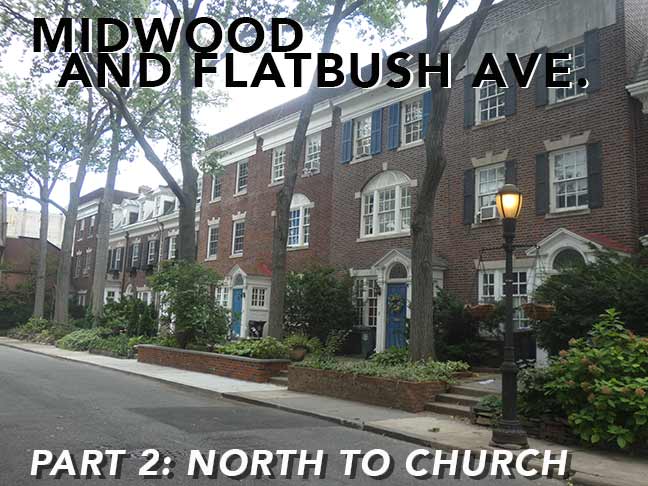

EVEN though I’m having a busy year with photography, having added over 4000 photos to my archive this year alone up to August, I’ve decided to use the most recent set from late August 2026 since I found the area compelling and also it was fresh in my mind since I hadn’t visited the area in nearly a decade if not longer. Beginning in the landmarked Fiske Terrace area in Brooklyn, I went past Brooklyn College and up Flatbush Avenue, wrapping up at the Church Avenue BMT subway. As I see it I have plenty of time to address earlier shoots! Since I got 129 photos, this record of my walk will again be split into two parts, this being the second part…
GOOGLE MAP: MIDWOOD TO FLATBUSH
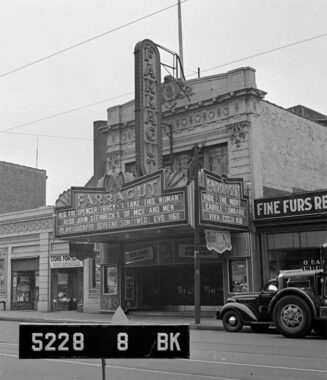


I continued north on Flatbush Avenue from Farragut Road. Just enough remains of the old Farragut There to remind you that it was a theater at one time. Built as a vaudeville house with live performances that also showed silent films in 1919, it survived as part of the Century and Springer Theaters circuit until 1959. It then became a bowling alley and then a YMCA, which remains today.
In 1940, Spencer Tracy and Hedy Lamarr in “I Take This Woman,” Burgess Meredith and Lon Chaney Jr. in “Of Mice and Men,” and Carole Lombard in “Vigil in the Night” were playing.


At Flatbush and Farragut is this old school hand lettered sign for the Mei Jung Mei Chinese restaurant in traditional red and gold. See Comments for a translation of the Chinese characters.
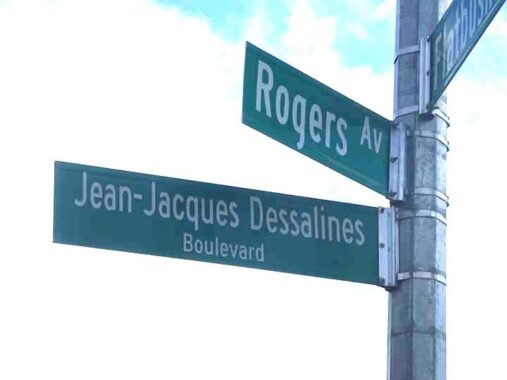
Rogers Avenue is lengthy, paralleling Bedford Avenue from Grant Square (with a striking horseback bronze portrait of President U.S. Grant) south to Flatbush Avenue and Farragut Road. Rogers Avenue from Farragut Road to Eastern Parkway was co-named Jean-Jacques Dessalines Boulevard in 2018 for the first leader of the independent Haiti (1758-1806), as it runs through section of Flatbush called Little Haiti.
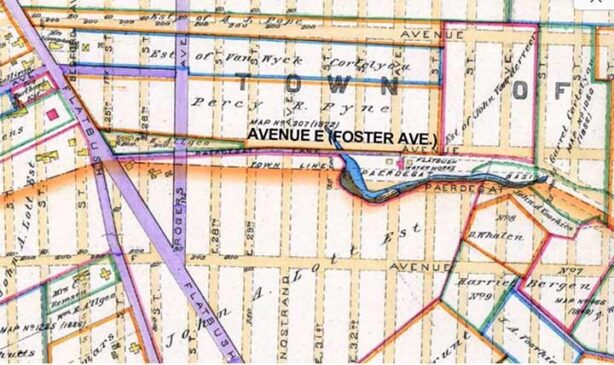
If we look at an 1890 Kings County map (when Flatbush was still a separate town) showing property lines, we can see that Rogers Avenue was actually one of the few paved routes at that time, as it is shown in purple. Note also that Amersfort Place, itself a remnant of Old Flatbush Road, was also paved. However, what became Bedford Avenue was not yet in existence!
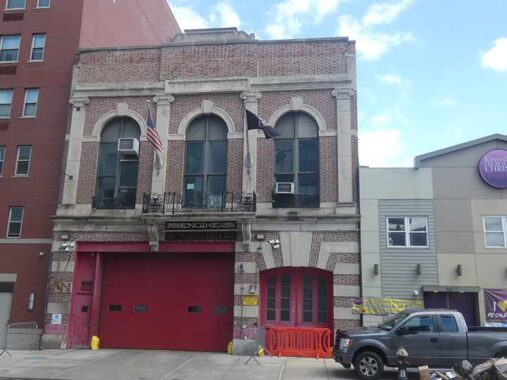
I’m surprised Engine 255, #1365 Rogers just north of Farragut, isn’t a NYC Landmark (look at those Ionic pilasters), but the Landmarks Preservation Commission is nothing if not fickle and choosy. The firehouse was established as Engine 55 of the Brooklyn Fire Department in 1897; firehouses taken over by Greater New York generally receive a digit before their old name and so in 1898, 17 days after it was founded, it became Engine 255. “The two-story structure features a classic brick and limestone three-bay facade, originally designed to stable horses and house a steam engine, hose wagon, and ladder truck. It was designed by noted early-career architect Frank J. Hemle” and “the Jolly Rogers” is considered one of the busiest firehouses in the borough.
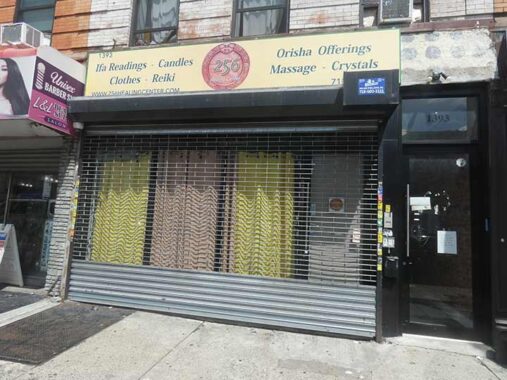
I walked on Flatbush Avenue, with a couple of detours, from Farragut north to Church Avenue, taking note not only of architecture but of signage. 256 Healing Center in Brooklyn, NY “offers a variety of holistic services designed to promote well-being.” I do not know the significance of the number 256 (it’s 16 squared and 4 to the 4th power). The words “ifa” and “orisha” refer to the belief systems of the Yoruba, a major West African ethnic group and language community numbering over 50 million people, primarily living in southwestern Nigeria, Benin, and Togo, who number many immigrants in the heart of Flatbush.
Before I forget, here’s a very informative site focusing on Flatbush, I either discovered just recently, or did so years ago and forgotten about it, Flatbush History by Jennifer Boudinot.
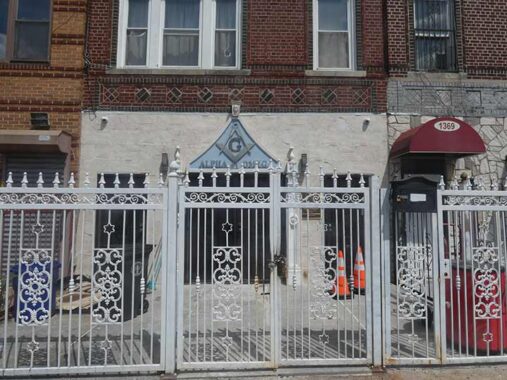
#1367 Flatbush, south of Foster, is now the Emmanuel Church of God but still bears the earmarks of former Masonic ownership includng the G and compass symbol.
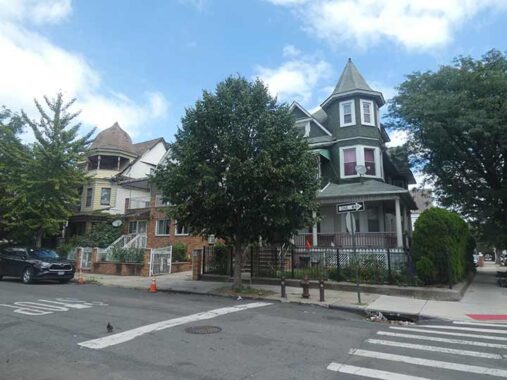
These peaked and porched buildings on Foster and East 25th Street, a block east of Flatbush Ave., mark the southern edge of Vanderveer Park, one of a number of enclaves, now most forgotten, such as Manhattan Terrace, Matthews Park, Slocum Park and Yale Park.
Vanderveer Park, which was begun in the 1892 and was developed in five phases, was financed by the Germania Rail Co. and predated Prospect Park South, which is often referred to as the first such community in Flatbush. At the turn of the century, Vanderveer Park was significantly larger than all of the surviving Victorian Flatbush enclaves. The isolated Victorians around Sears at Bedford Avenue and Albemarle Road were also part of Vanderveer Park.
Vanderveer Park was a development sponsored by Henry A. Meyer’s Germania Real Estate Company, which in 1893 purchased acreage from the Vanderveer Farm. At the time there was talk of a Flatbush annexation to Brooklyn (which happened in 1894) and Meyer set about covering newly-cut streets with ornate Victorian-era buildings. The name Vanderveer Park survives in the Vanderveer Park United Methodist Church at Glenwood Road near East 31st Street. And, there had been a Germania Place, connecting Campus Road and Flatbush Avenue north of Avenue H at Brooklyn College, but in 1959 it was changed to Hillel Place to honor the nearby Brooklyn College Hillel building, named for the first century AD Jewish religious philosopher. Lastly, Vanderveer Place remembers the name for a one-block street east of Flatbush Avenue and north of Avenue D (see below).


Two separate architectural theories of what multifamily living spaces should look like face off across Flatbush Avenue at Foster. The newer unit’s appearance is likely determined by budget, as few architects are likely, in the 2020s, to spend money on esthetics. The extra cost would be passed on to the purchaser. But it’s also determined by modern taste. Any new building that looks like the older one shown here would be derided by influencers and tiktokkers, not to mention critics in the architectural journals.
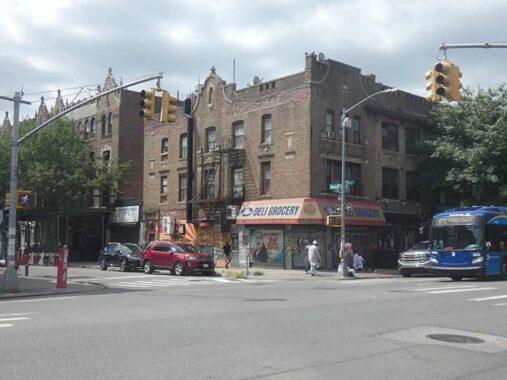
Another grouping of classic apartment buildings, with businesses on the ground floor, at Flatbush and Newkirk Avenues (check out that ornamentation at the roofline). I had originally thought of “Newkirk” as a Scottish name meaning new church, but it turns out it’s yet another of Brooklyn’s many Dutch appellations and honors the immigrant Nieukercke family, through whose farm the avenue was built in the late 1800s. The family had arrived in the colonies in 1659. As it happens the name translates to new church in Dutch as well. I once had a girlfriend who lived at #931 Newkirk and I thought it would work out in the long run because I rented an apartment in Greenpoint at #193 Green Street. It didn’t. And I soon gave up the apartment because I couldn’t get used to the idea of a bathtub in the kitchen.


Neon sign for long-gone Oldsmobile dealer, Flatbush Avenue and Avenue D. One of the earliest major car makes was Oldsmobile, founded by Ransom E. Olds in 1897 and then sold to General Motors in 1908, which continued to manufacture automobiles with the Oldsmobile imprint until 2004. The Olds Cutlass was one of the USA’s best selling cars in the 1970s and 1980s.
Oddly, the Town of Flatbush’s “alphabet avenues” were mainly renamed to sound British, to impart sophistication, when the area south of Prospect Park was developed in the early 20th Century. However, several “C” and “D” roads were born, such as Clarendon and Dorchester Roads, and roads named for longstanding Dutch families, Ditmas and Cortelyou (part of which overlay a pre-Revolutionary road to Canarsie).
Avenue D is mostly residential in its Flatbush section, but there’s also a business/retail section between Albany and Schenectady Avenue that has its own genus of modular combination stoplights/streetlights (similar to the arrangement on West 181st Street in Washington Heights). You can see those on this Street View shot.
Once Avenue D resumes from interruption in northern Canarsie, it’s lined with car repair, tire shops, wholesale lumber, and a Pepsi bottling plant, as it runs along the south side of the LIRR Bay Ridge branch. It’s a busy truck route as it ends at Linden Boulevard at the L train overpass a block south of the New Lots Avenue station.


Vanderveer Place, named as part of the Vanderveer Park development mentioned above, runs for one block from Flatbush Avenue east to East 23rd south of Clarendon Road. I had never really seen it before and was impressed by the attached brick dwellings that line it on each side. While the Charles Goell Construction Company built both sides in the mid-1910s, the buildings on the south side, developed and designed by Charles Infanger, are the best, rendered in Colonial Revival with with neo-Georgian details. The streets and the houses were built approximately where the Vanderveer farmhouse was located; only the name survives from that era. More from Suzenne Spellen in Brownstoner.


I was intrigued by #1151 Flatbush, south of Cortelyou where the avenue turns southeast, as it hints at former glory with Tudor echoes. The date of construction, 1933, is helpfully inscribed. The 1940 tax photo shows it in all its Tudor glory as a tavern called The Midwood. It has gradually devolved over the years, becoming Midwood Terrace Restaurant by the 1980s and presenting an implacable front by the mid-2020s. A plastic sign lit by interior bulbs marks a former liquor store next door.


The former Manufacturers Trust Building at the SE corner of Flatbush and Cortelyou has evolved into the Emmaus SDA Church. After becoming Manufacturers Hanover Trust (for which my mother worked), then Chemical, it’s now JP Morgan Chase. Emmaus was a town in the New Testament on the road to which, two of Christ’s disciples met Him, but failed to recognize Him at first.


This grouping of bay-windowed buildings on the NE corner of Dorchester and Flatbush, as well as those on the west side of Flatbush, appear to have had the same developer and builder.
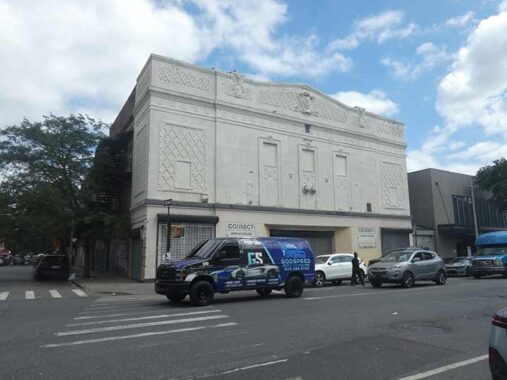
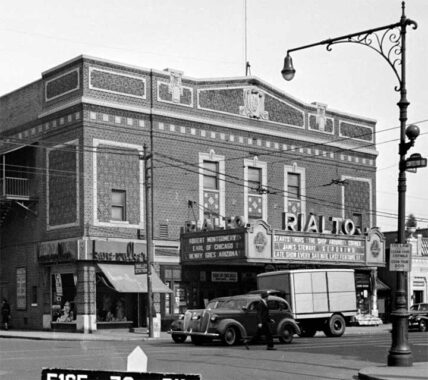
At Flatbush and Cortelyou is the remains of the old Rialto Theatre, constructed in 1916 and closed, as a theatre, in 1977.
The Rialto Theatre first opened on March 19, 1916 with Harry Lonsdale in “The Ne’re Do Well”. It was one of the first “luxury” theatres built by A.H. Schwartz, many years before he started the Century Circuit. As far as I know, the Rialto Theatre never presented more than movies, but during the silent era it employed a small orchestra and organist to play during the programs and intermissions. The Rialto Theatre’s success caused Schwartz to build a very similar Rialto Theatre in Jamaica, Queens, in 1918, with R. Thomas Short again as architect. On May 19, 1920 it was taken over by Loew’s Inc. and they remodeled the interior and partially demolished the rear to expand the auditorium. Century Theatres took over later. In 1948 some remodelling was done to the plans of architect John J. McNamara.” [Cimenatreasures]
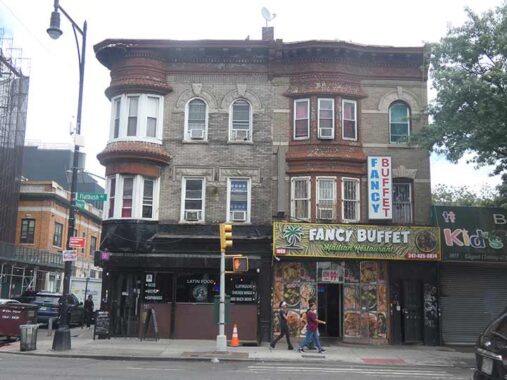
SE corner of Flatbush Avenue and Duryea Place. This Place, and Duryea Court in Bensonhurst, come from the French/Dutch Durie family, Dutch Huguenots who arrived in the town of New Utrecht in the 17th century.


The Loew’s Kings Theatre is no longer “forgotten” but has come all the way back from “Forgottenhood.” The Kings is one of those gigantic, baroque movie palaces like the Paradise on the Grand Concourse, St. George in Staten Island or Keith’s on Northern Boulevard in Flushing, Queens, whose fortunes have gone from riches to rags and have, to varying degrees, have had the glad rags reapplied.
The Kings was built in 1929 and could hold all of 3, 676 theatergoers. It featured lighting schemes enabling theater managers to change the mood in the theater depending on the time of day and whether the days’s offerings were in preshow or intermission. Ornamental plaster castings took the form of carved wood or marble; there were dozens of oil paintings and statues of mythological figures. Allan Abel, in his 1995 book “Flatbush Odyssey,” describes the Kings interior as “Xanadu designed by Kubla Khan on crack.” In its early days it presented both motion pictures and vaudeville acts, but by 1935 the baggy pants comics had shuffled off. Erasmus Hall High School held commencements at the Kings for many years. Through the 1950s and 1960s, the Kings suffered a slow decline. During a 1974 showing of “Blazing Saddles,” the projector caught on fire; finally, after featuring “Marathon Man,” “The Sailor Who Fell From Grace With The Sea” and “Exorcist II: The Heretic,” the Kings closed its doors, though it has opened on occasion for movie shoots. A musical, “Flatbush Follies,” was mounted at the Kings in 1978 for one night, but never finished when a fire broke out.
After having been the object of numerous proposals for its restoration over the past thirty years, the Kings Theatre underwent a complete renovation. The City of New York announced the plan on February 2, 2010 with a goal of returning the theatre to use as a performing arts center by 2014. The $93 million renovation was completed in partnership with a private developer, ACE Theatrical Group of Houston. ACE has previously overseen major restorations of a number of historic theaters including the Boston Opera House. The Kings’s interior spaces were restored to their 1929 appearance. Its stage facilities were completely rebuilt to modern standards, accommodating some 250 performances a year. The Kings ad on the south side of the theater has been repainted recently after surviving as a “ghost ad” for years.


The Kings had competition a couple of blocks away in the form of the Albermarle Theatre, at the SE corner of Flatbush and the titular road.
“Opened as the Albemarle Theatre on March 17, 1921 presenting vaudeville and Fox pictures. Initially it was not a success. It was still an excellent place to see event films in the 1970’s like “Star Trek: The Motion Picture” and played host to most of the horror movies of the early-1980’s like “Creepshow”.
|
In late 1984, at a time when there were few single screen cinemas left in Brooklyn, the Albemarle Theatre closed its doors due to a fire. One of the last feature presentations at the time was “Friday the 13th IV: The Final Chapter”. [Cinematreasures]


Snyder Avenue runs from the heart of Flatbush, Flatbush Avenue just south of the Dutch Reformed Church, all the way east to Ralph Avenue. Originally known as Grant Street, it was renamed to honor a prominent Dutch landowning family (as so many of Brooklyn’s streets have been); it wasn’t named for the Brooklyn Dodgers’ cleanup hitter Duke Snider, who spelled his name differently, anyway. The block between Flatbush and Bedford Avenue offers a treasure trove of hidden Forgotten items.
When you see a building of a certain age that is markedly taller than other buildings on its block, it was likely a storage tower. that was the case in 1940 when the tax photo was taken and is true today. Note the BUckminster phone number on the older photo, and the Salvation Army faded d on today’s; the organization may have had a presence in the building some time between 1940 and now.
Also note another Tudor-style building adjacent to it, and note that in a recent renovation every trace of that identity has been excised.


It’s now a well-known fact that with AI tech and cameras everywhere, owners of properties I wish to photograph quickly erect construction netting and scaffolding surrounding them, as is the case with the doyenne of the block, the former Flatbush Town Hall. Luckily I have been here many times before and have a backlog of photos to use.
The former Flatbush Town Hall was constructed in 1874-1876 (by architect John Culyer) as a rebuke lof sorts to an annexation attempt of a couple of years earlier by the City of Brooklyn. Flatbush held firm only until 1894, when it was duly absorbed, and 3 years later, Brooklyn became amalgamated in a very close vote to Greater New York. The building served as the 67th Police Precinct until 1972 and it has also been the seat of the 7th Magistrates Court. It’s a magnificent example of a style known as Ruskinian Gothic, after John Ruskin, a Victorian critic and writer who championed the Gothic style after visiting Europe in the mid-18th century. Another example is the Jefferson Market Library on 6th Avenue in the Village.


Joe Spinella’s Diplomat Bowl across the street from the old Town Hall has been closed. since at least 2003, a span of 23 years as of 2026. In the late 1970s I belonged to a bowling league here, and being carless and living in Bay Ridge, coming here took dedication. Each Tuesday night I rode the B16 bus down Fort Hamilton Parkway, transferred to the B35 at 39th Street, got out at Church and Flatbush Avenues and walked 7 blocks. After awhile, the league switched to Mark Roth’s Rainbow Lanes on Avenue X and Knapp Street. That meant a half-hour ride on the B4 to Nostrand Avenue and Avenue X, and an 8-block walk. Like I said, I was dedicated in those days. Rainbow Lanes has similarly been closed for years, and while the building is there, all trace of its role as a bowling lanes has been expunged. Spinella was a neighborhood presence who also owned a pool hall in the basement of the Albemarle Theatre (see above).
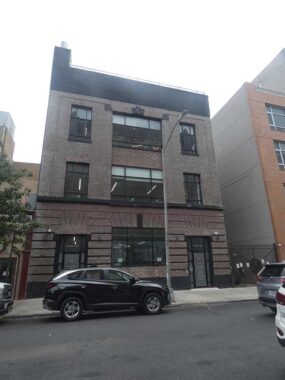
#20 Snyder Avenue, home to a variety of offices, hasn’t changed appreciably in appearance since 1940. In the past it has been a funeral home and an apparent police precinct.
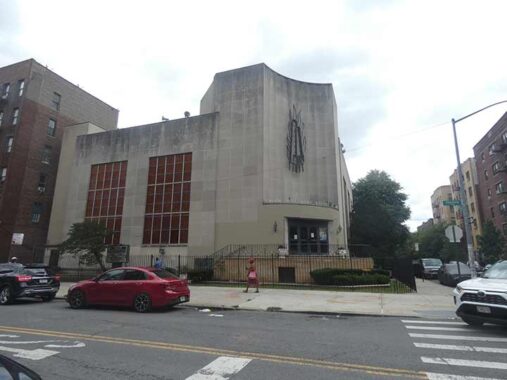
At this point I detoured briefly on Albemarle Road, Salem Missionary Baptist Church on East 21st is now in the former Shaare Torah Jewish Center. In 1980 it merged with the Flatbush Jewish Center (Church Ave & E. 5th).
Long ago, Albemarle (often misspelled Albermarle) Road was Avenue A, before many roads south of Prospect Park were given British-style names to “class them up.” It was originally the name of a dukedom and earldom in England: the name comes from Alba Marla (White Marl), referencing Aumale in Normandy.
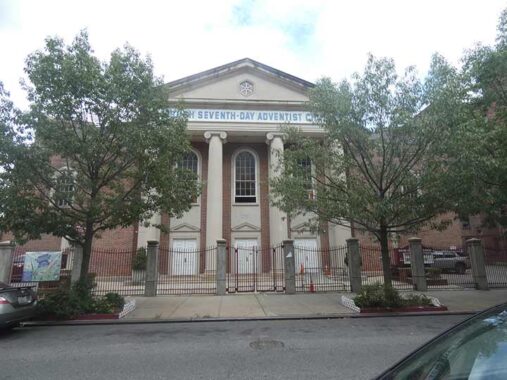
Part of the fun of hiking around in NYC is turning a corner and seeing buildings like this, with massive Ionic columns supporting a massive pediment at the Flatbush Seventh-Day Adventist Church, East 21st Street north of Albemarle Road. The SDA is a Protestant Christian denomination distinguished by its observance of Saturday as the Sabbath and its strong emphasis on the imminent return of Jesus Christ.

Albemarle Terrace


Kenmore Terrace


East 21st Street between Church Avenue and Albemarle Road rewards with the gorgeous cul-de-sacs dating to 1916-1918, Albemarle and Kenmore Terraces. The two lanes are around the corner from Flatbush Reformed Dutch Church and together, they have been designated a historic district, meaning that their architecture is safe from alteration.
Albemarle Terrace is lined on both sides, and Kenmore Terrace on one, by Georgian revival row houses that are not all quite the same: every set of windows on each building is different from the other. The alleys’ residents zealously maintain their property. Windows and doors are each painted a separate color from their neighbor’s. Kenmore Terrace’s buildings were among the first in the country to feature separate garages, reflecting the increasing popularity of the automobile; the terrace’s north side faces the 1853 Flatbush Reformed Dutch Church Parsonage. The attached buildings on both terraces can now fetch over $1M. There are also buildings on East 21st Street that match the buildings on the Terraces.
[The Flatbush Dutch Reformed Church Parsonage, on the north side of Kenmore Terrace, built in 1853,] is the second or third one to be built for the church, and originally stood on Flatbush Avenue, but was moved to its present location in 1918. And a smart move that was, too, as this new location, across from the Neo-Colonial houses of Kenmore Terrace, shows off this beautiful Greek Revival country house in all its glory. If it had still been on Flatbush it would have been long gone, or squished in between other buildings. The house is a classic 2 ½ story, peaked roof house with four chimneys, and 5 bays coming off a central hall, with a wide veranda stretching across the front and side of the house. Today, the parsonage is no longer the home of the pastor of the Reformed Church, but is used for outreach and social programs, and has a community garden and grounds beautification program. The Church was landmarked in 1966, one of the first individual landmarks after the passage of the Landmarks Law. The rest of the complex was designated in 1979. {Suzanne Spellen, Brownstoner]


This is the church that Church Avenue is named for. There’s been a church at the location of Flatbush and Church Avenues since 1654, the very beginnings of the village. Flatbush Dutch Reformed has had three incarnations: a wood structure built on orders from Governor General Peter Stuyvesant in 1654, a stone building in 1699, and the current one built from Manhattan schist dating to 1798. The churchyard goes back to the church’s very beginnings and contains stones inscribed in both English and Dutch. Among the many stained glass windows are a few by Louis Comfort Tiffany. The tower contains a clock and bell that are dated 1796, plus a 10-bell chime that was cast by the Meneely Foundry of Troy, N.Y., and installed in 1913. The church bell has tolled the death of every U.S. President.
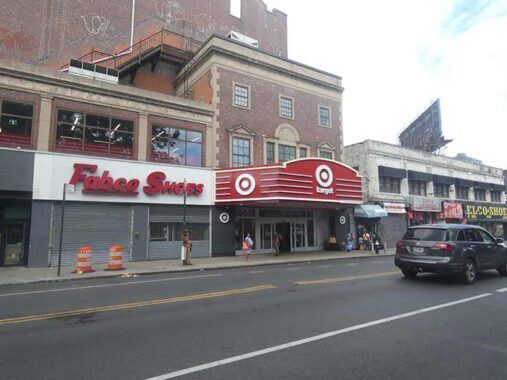
As we’ve seen, Flatbush is home to a number of theaters that have shut down or been turned into other uses. The Kenmore, on Church Avenue just across the street from the Flatbush Dutch Reformed Church, was the most recent to close; its distinctive black marquee advertised “The Matrix” in white lettering for years after the Keanu Reeves cyber-thriller had had two sequels. It was opened in 1928 and later fell under the RKO Keith banner. It was later carved up into four smaller theatres, and its fortunes fell after a gang shooting. The building formerly hosted a Modells and now, a Target.
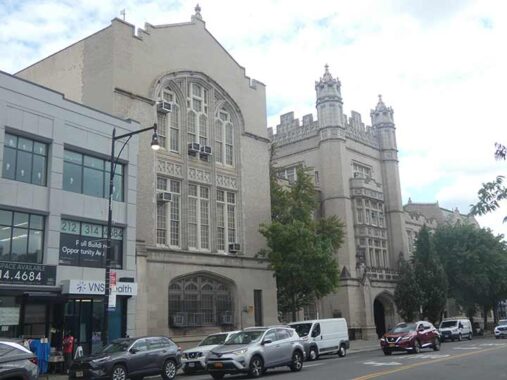
Erasmus Hall High School on Flatbush Avenue, seen from Church Avenue. The school presents two historic buildings in one location. Its white clapboard Federal-style building, constructed in 1787, housed the private academy instituted by the Reformed Dutch Church across the street. The older building isn’t visible from the street, however, since it is surrounded by the Gothic, fortress-like Erasmus Hall High School, constructed in 1905.
The original academy was funded by several Founding Fathers, including Alexander Hamilton and Aaron Burr (who didn’t agree on much else). The academy became a high school in 1896: it can boast famous alumni such as pop’s Barbra Streisand and Neil Diamond, chess king Bobby Fischer, TV’s Lainie Kazan and Bernie Kopell, and opera’s Beverly Sills. The historic academy, known by students and faculty as “the white house” can usually be glimpsed from the iron gate guarding the high school. C.B. J. Snyder’s magnificent 1905-1906 building surrounds the much older original. Erasmus Street and the former surrounding neighborhood, Erasmus, now absorbed into Flatbush, were named for Dutch scholar/philosopher Desiderius Erasmus (his parents named him Gerhard Gerhards, 1466-1536). A statue of Erasmus can be found outside the original academy building in the courtyard.
We have barely scratched Flatbush’s surface, but with this I journeyed to East 19th and Church and hopped on a B train back to Manhattan, Penn Station and home…
Check out the ForgottenBook (HarperCollins, 2006), as well as Forgotten Queens (Arcadia, 2013). I also have a chapter in the anthology “New York Calling: From Blackout to Bloomberg” (Reaktion, 2007). As always, “comment…as you see fit.” I earn a small payment when you click on any ad on the site.
9/4/26
3 comments
As a “Forgotten” fan, I’d like to extend a hearty thanks to Kevin Wash for this two part series on Midwood & Flatbush. Everything and I mean everything in both articled hits home. In this area where I grew up for some fifteen years were the best years of my adolescent and young adult life.
Every street, location, theater etc brings me back of the years between 1957 & 1972. I wish there was a time machine so I could back to my youth when I explored the locations Kevin mentioned to a much happier time for me. Thanks Kev.
My apologies for the incorrect spelling of your last name.
No, Google image search shows the Chinese characters as being:
The selected sign displays three Chinese characters that appear to read 味甲味 (wèi-jiǎ-wèi), which roughly translates to “flavor first” or “top taste.”
Character Breakdown
味 (wèi): Means taste, flavor, or smell.
甲 (jiǎ): Means first, number one, or grade A.