
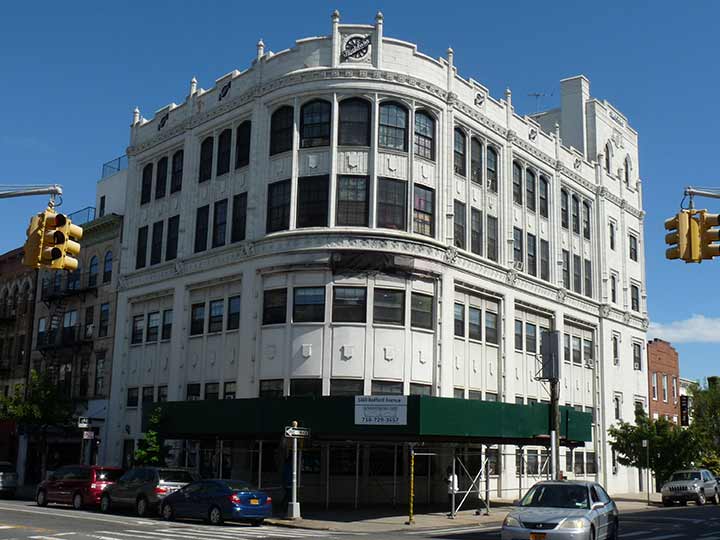

Is the Studebaker Building on the NE corner of Bedford Avenue and Sterling Place the most beautiful building on Bedford Avenue? It’s certainly the best-preserved building associated with the defunct auto manufacturer in the city by a wide margin. It is one of the last survivors of an automobile showroom row on Bedford Avenue, constructed in 1920 by Tooker and Marsh. Studebaker had moved out by 1939 and has been a dress store and showroom, a furniture manufacturer; later, a church occupied the ground floor; and in 1999 it was finally converted to residences. It’s been featured in FNY before but I’m surprised I haven’t give it its due on its own page, so that’s being corrected today.
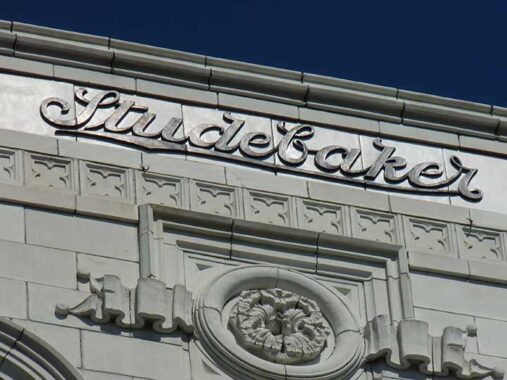
Brothers Henry and Clement Studebaker opened a blacksmith shop in South Bend, Indiana in 1852, and before long, after John Mohler Studebaker bought out his brother Henry, they expanded their business to covered-wagon maufacturing. Studebaker benefited from Civil War business and western expansion, and became the largest wagon business in the world, topping $1 million in sales by 1875, but that was only the beginning…Studebaker made a successful transition to motorized vehicles as the new century dawned, producing its first motorized vehicle, the Electric Runabout, in 1902. As it became clear that gasoline-powered autos were going to emerge, Studebaker’s first gas-powered vehicle, the Studebaker-Garford, rolled out in 1904.
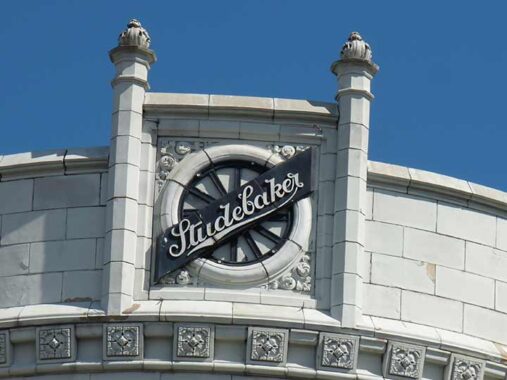
Studebaker’s wheel logo can still be detected around town but this by far is the best-kept example. Perhaps it influenced the design of NYC’s old “Wheelie” stoplights, which had a wheel design in its wrought ironwork and guided traffic from the mid-1920s to the mid-1950s.
By the time its Crown Heights showroom opened in 1920, Studebaker had sold off its original wagon works to a Louisville, KY firm: it was the only former wagon manufacturer to make a successful transition to automobiles. The 1935 Champion was likely Studebaker’s most successful model in its history, while its production peaked at over 268,000 cars in 1950; Studebaker continued production until 1966. The Studebaker imprint was later owned by Cooper Industries, the hardware and tools manufacturer that itself has an over-130 year pedigree; it later sold off its auto-parts divisions to Federal-Mogul.
Yet one more old Studebaker factory or assembly plant can be seen here on Liberty Avenue west of Merrick Boulevard. Not as spectacular, perhaps, as the one on Bedford Avenue in Crown Heights or another in Harlem, but this one is distinctive enough. It is currently ocupied by the Liberty Storage Company.
Check out the ForgottenBook (HarperCollins, 2006), as well as Forgotten Queens (Arcadia, 2013). I also have a chapter in the anthology “New York Calling: From Blackout to Bloomberg” (Reaktion, 2007). As always, “comment…as you see fit.” I earn a small payment when you click on any ad on the site.
9/1/26
5 comments
Sorry Elon, but electric cars are nothing new. Studebaker was one of many companies making them in the early 20th century. They were especially popular with women, who often hated the balky crank starters on gasoline cars. While the early electrics had limited ranges they were fine for in-town driving.
While electric cars were already losing popularity, the invention of the modern key starter for gasoline cars around 1915 largely ended their production.
My cousins had a Hawk station wagon.I thought it was so ugly
I used to squinch down in the rear seat so nobody would see me
riding in it
The facade resembles the entrance to Ebbets Field.
I know of a Studebaker automoibile dealership in New York City that, in the late 1950’s was sold. The purchaser was required to also take on a lesser-known brand that they did not really want. It was Mercedes-Benz. It’s funy how things often work out!
I recall a friends father who had a Lark model from the late ‘50’s. Sad the firm folded, there were so many on the roads in the ‘60’s.