
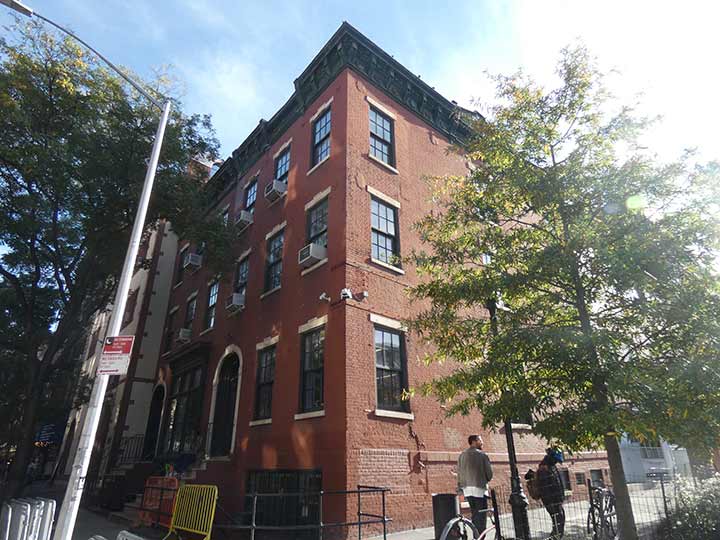

RECENTLY I took a walk on the entire length of Bleecker Street, from 8th Avenue east to the Bowery. I will have a full post sooner or later, but a couple of items will leach out before that. Here’s the Little Red Schoolhouse (now called LREI), SE corner 6th Avenue and Bleecker Street. The school and Elisabeth Irwin High School, founded in 1921, bills itself as progressive, the sitting area is called Little Red Square, and its roster of graduates can make up an all-star team of 1960s radicals, among them “Weatherwoman” Kathy Boudin and revolutionary/author Angela Davis. Boudin became a public health advocate while in prison after her conviction for her role in the robbery of a Brinks truck in 1981; Davis was celebrated by The Rolling Stones.
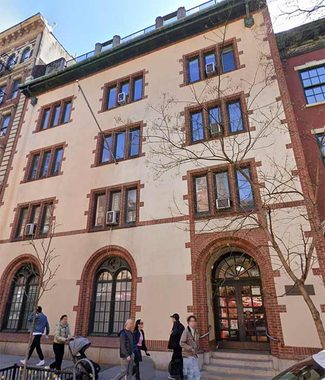
Irwin founded the experimental school at P.S. 16 on East 16th Street in a red-bricked building annex; by 1937, it had moved to another red brick building at #196 Bleecker (above). It was among the first schools to try field trips, psychological testing, and may other ideas later adopted by mainstream education. The Schoolhouse is now located at #272 Sixth Avenue at Bleecker, around the corner.
#196 Bleecker itself was constructed in 1920 by George B. Post & Sons for John P. Munn, President, University Place Presbyterian Church, in what Landmarks Preservation Commission calls “Medieval Revival.” It originally served as the Bethlehem Chapel and Memorial House for the University Place Presbyterian Church, and included a chapel, club rooms, and a day nursery.
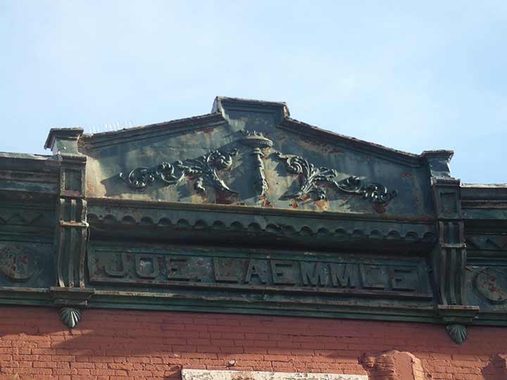
Thew title card shows the corner building, #202 Bleecker, on the corner of what used to be Hancock Street, which was “absorbed” by 6th Avenue when it was extended south along the then-new Independent Subway in the 1920s. The attached 200 and 202 Bleecker Street were originally constructed as single-family residences with peaked roofs c. 1825-1826 for Thomas Parker. The two houses were purchased by the Little Red School House in 1962 and incorporated into the physical plant in 1970. There are a pair of cornices, stamped “J. Laemmle” and “Jos. Laemmle” that date to 1889, when the building was raised from two stories to three for Laemmle Dairy Company owner Joseph Lemmle from 1889-1915.
I recognized the name Laemmle immediately because of Carl Laemmle, who produced early horror films such as “Phantom of the Opera” (1925) and “Frankenstein (1931).” I doubt there’s a family connection but at this remove, who knows.
In the late Terry Miller’s 1990 book, Greenwich Village and How It Got That Way, resident Ermanno Stingo “remembers Hancock Street as a block-long affair that teemed with people and traffic. ‘Remember, there were few through-streets connecting Bleecker and Houston before Sixth Avenue went through…’
‘I remember every Election Day Hancock Street was closed off, and crates and packing boxes were piled high as a second-floor window for great bonfires. I remember them vividly. And I also remember being taken by my mother to the cavernous Fugazy Theatre, which stood at the bottom of Hancock at Houston Street. Once, just after we paid our dime admission, some man pulled a gun and held up the box office. Mother dragged me down the aisle and hid me behind the piano. I remember the pianist went right on playing, as if nothing had happened…” Today, the space formerly occupied by Hancock Street is now a pedestrian mall, Little Red Square.
Check out the ForgottenBook (HarperCollins, 2006), as well as Forgotten Queens (Arcadia, 2013). I also have a chapter in the anthology “New York Calling: From Blackout to Bloomberg” (Reaktion, 2007). As always, “comment…as you see fit.” I earn a small payment when you click on any ad on the site, which helps in site upkeep and also aids Greater Astoria Historical Society.
11/5/26