
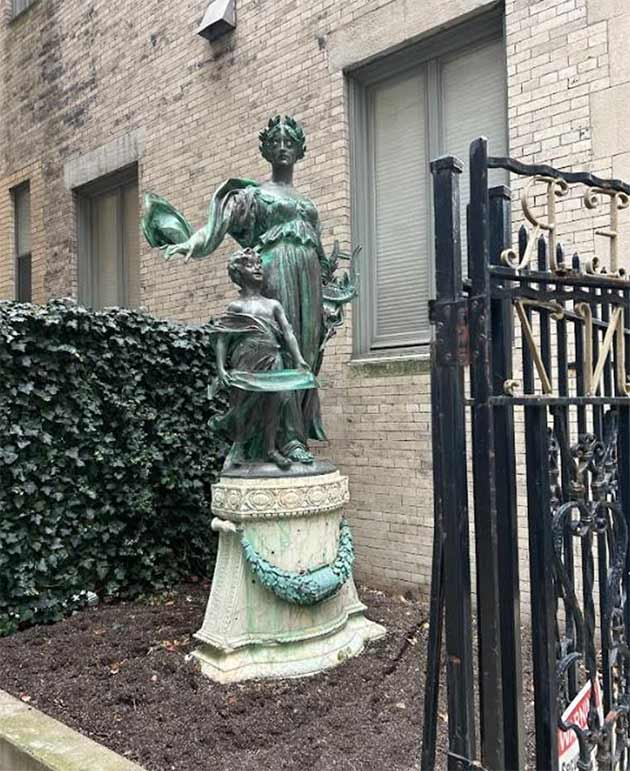


AROUND the corner from the Museum Mile of Fifth Avenue at 6 East 87th Street in a private alley is a detailed statue more worthy of a public space, known only to its owner and neighbors. Polyhymnia was a mythical Greek muse, one of Zeus’ nine daughters. Her name translates as “many songs,” as she represents sacred poetry, sacred hymn, dance and eloquence.
It is a fitting monument to the Liederkranz Club, which has been promoting German singing traditions in New York since 1847. The building’s story began in 1901 when Henry Phipps purchased the property that bordered on his mansion at the corner of 87th Street and Fifth Avenue. A smaller mansion was then built at this address for his family. It later hosted a school for children of Soviet diplomats and finally was purchased by the Liederkranz Club in 1948.
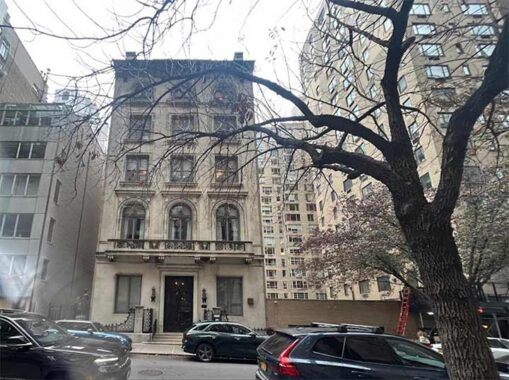
The club brought Giuseppe Morreti’s Polyhymnia sculpture to their new home. The work was created in 1897 on the golden anniversary of the club’s founding. As New York City expanded north, the Liederkranz followed, from the East Village, to Midtown, and then its present location.
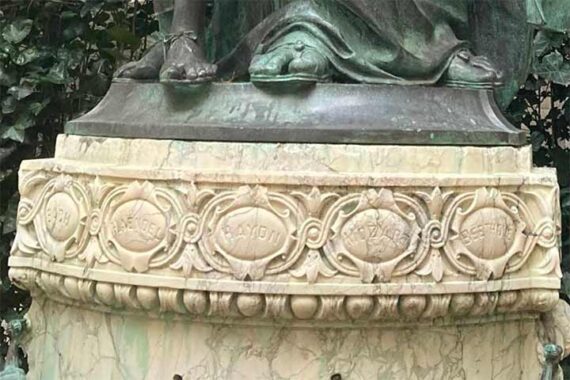
Adding to the German identity of its owners, the base of this monument lists the names Bach, Handel, Haydn, Mozart, and Beethoven. Born in Italy, the sculptor worked in Croatia, Austria, and Hungary before immigrating to New York. He doesn’t have any other visible sculptures in this city, but in Pittsburgh he made a set of works for Schenley Park, the tallest cast iron statue in Alabama, the facade statues at the Gran Teatro in Havana, and numerous monuments, sculptures, and memorials.
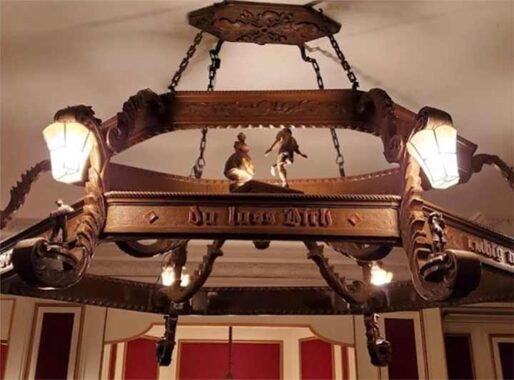
The interior of Liederkranz is decorated with portraits and sculptures relating to German culture. One item that piqued my attention is the chandelier featuring dancing figurines and slogans in gothic font. “Da lass dich” translates as “Let yourself go.”
When Liederkranz moved here, 86th Street was the commercial spine of Yorkville’s German-American community. These days, its location is ideal for parties that follow the German American Steuben Parade on Fifth Avenue.
For more on the city’s German heritage, read about this nearby mural, this billboard column, this park, this shooting society, this church, this tavern, and this former brewery, among other spots.
Sergey Kadinsky is the author of Hidden Waters of New York City: A History and Guide to 101 Forgotten Lakes, Ponds, Creeks, and Streams in the Five Boroughs (2016, Countryman Press), adjunct history professor at Touro University and the webmaster of Hidden Waters Blog.
Check out the ForgottenBook, take a look at the gift shop. As always, “comment…as you see fit.” I earn a small payment when you click on any ad on the site.
11/18/25
2 comments
I get a laugh from the way Google Street View’s privacy function blurs out her face and the face of the child next to her. Then again, it does the same to the Statue of Liberty.
Is there any connection between the Liederkranz Club and Bernie Liederkranz (better known by his stage name, Guy Smiley)?