


FLETCHER STREET, a narrow alley in the South Street Seaport area originally going three blocks between Pearl and South Streets a block north of Maiden Lane, is seen here in 1999 as I was wandering past, looking east from Front Street. As you can see the street here still boasts its century + old Belgian block paving. It appeared to be a fairly desolate area then, with parking lots on either side and a restaurant called La Barca further up the block toward West Street.
It’s named for one of the then-newish colony’s British governor from 1692-1698, Colonel Benjamin Fletcher, who granted a patent to Trinity Church to sell any dead whales that had drifted to shore for their blubber and teeth. This allowed the church to build its first building (the Episcopal parish’s present church, built in 1846, is its third). The colonel also granted the church a charter. He got in hot water (so to speak) when he encouraged NY merchants to engage in privateering (pirating) on the high seas during King William’s War.*
*See Comments
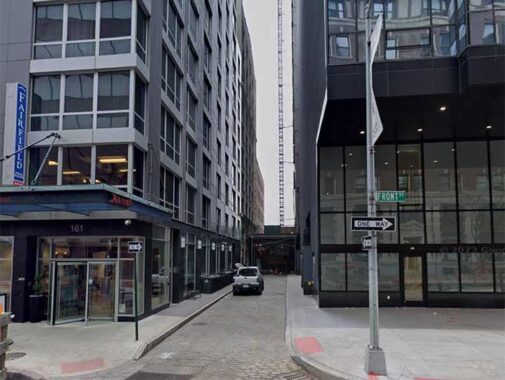
By 2024 this corner presented a completely different face entirely, as Fletcher is flanked by a pair of glass-fronted buildings: #161 Front, a Fairfield Inn hotel completed in 2016, and on the right, the AC Hotel Downtown, opened in 2019. Fletcher has been allowed to retain its Belgian blocks, as has Front Street north of it, but they’ve been smoothed out somewhat and are less bumpy.
Fletcher Street’s intersection with South has been closed off to traffic for construction for over a decade, so now the street effectively dead ends east of Front.
Info from Naming New York by Sanna Feirstein
Check out the ForgottenBook, take a look at the gift shop. As always, “comment…as you see fit.” I earn a small payment when you click on any ad on the site.
11/7/25
5 comments
Nit-picking time. Privateers were not pirates. although at first glance it might have been hard to tell the difference. Privateers were licensed by the government to prey on ships flying the flag of specified enemy nations. Generally, they’d get to keep some or all of the booty they obtained (depending on the arrangement with whoever engaged them). They were not actually outlaws. Sometimes, privateers were frustrated by a scarcity of prizes (or their crews became restive) and they exceeded their targeted authority. Then that would be an act of piracy. Or, the political winds could change while they were out at sea and they could find themselves without legal cover. It could get complicated… ask Captain Kidd.
One such privateer of that day was Captain William Kidd, who was not unknown around New York way… 😉
Kidd.After they hung him they joined his hands together and placed a
bouquet of flowers in them.Now wasnt that nice of them.
The US. Constitution, in Article I, Section 8, grants Congress the power “To declare War, grant Letters of Marque and Reprisal…:”. It is by receiving such a Letter of Marque that a privateer is given legal authority to attack ships at sea. This was how our infant nation, with limited resources to build ships and create a Navy, gave itself a bit of sea power. Congress last issued such Letters during the War of 1812. Before the Civil War, the US was one of many nations that entered into an international treaty that outlawed the use of privateers. While our Constitution still allows the practice, we would violate international law if we used it.
Always thought it would be fun to add a street sign with the family name on it…