

At the end of my Wagner-Hudson River Park jaunt in the fall of 2025, to get back to the IRT for the trip uptown to Penn Station, I meandered east on Christopher Street, well worn Forgotten New York territory but one locale I hadn’t haunted in a while. Thus, I snapped a number of photos revisiting previous highlights and hopefully, acquired a few more. Please note, this Crosstown covers only West Street east to Sheridan Square.

The east-west spine of the West Village, Christopher Street was built atop the previously existing Skinner Road, named in the colonial era for British Colonel William Skinner, son-in-law of Vice-Admiral Peter Warren. Richard Amos owned a parcel of land formerly belonging to the vast estate of Sir Peter Warren, which stretched from Christopher Street north to 21st Street west and north of what would become Washington Square Park. It is thought that Christopher and Charles Streets are named for Richard Amos’s relative and trustee of the Warren Estate named Charles Christopher Amos. But the streets didn’t go in that order…from south to north, the names went: Christopher, Amos, Charles. West 11th and 12th Streets had been named Hammond and Troy Streets, but surveyors decided to make those streets western extensions of the numbered grid. Most sources, though, still conform to Charles Christopher Amos as the namesake.
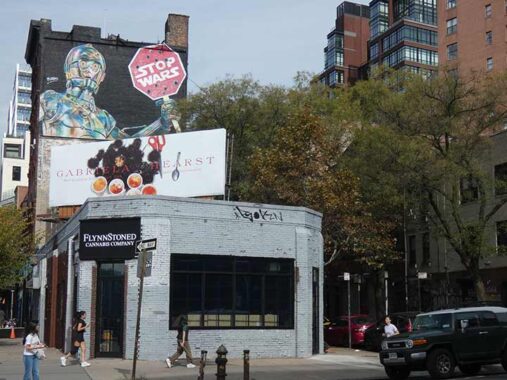
At Christopher Street’s west end at West Street is a mural depicting the Star Wars “robot”droid” character C-3PO holding a “Stop Wars” sign, an early effort by the talented Brazilian muralist Kobra.
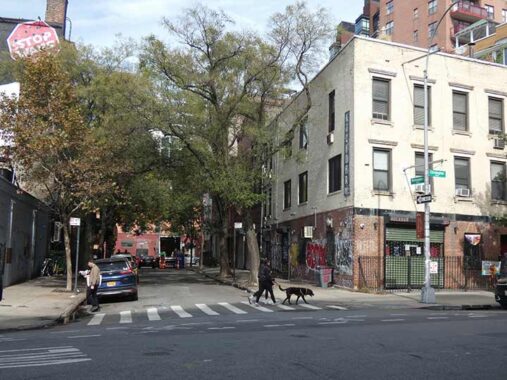
Weehawken Street is a tiny, one-block street between Christopher and West 10th Streets. It was named for a small town across the Hudson River in New Jersey best known as the site where the famed 1804 pistol duel between Vice President Aaron Burr and former Treasury Secretary Alexander Hamilton took place (Hamilton missed deliberately, while Burr didn’t and Hamilton died from his wounds). “Weehawken” is derived from a Lenape Indian phrase meaning “rocks that look like trees.”
Weehawken Street, and a couple of doors on Christopher, received Landmarks Preservation Commission recognition in 2006.
The street was once the site the Newgate State Prison, which moved upstate to Ossining (in a structure that came to be called Sing Sing) in 1828, and was replaced by a public market. The street was laid out to accommodate wagons bringing produce to and from it. Newgate State Prison is depicted in mosaics at the Christopher Street IRT station.
Weehawken wasn’t the only New Jersey town across the river that received a Manhattan street name. The south leg of Canal Street at West Street was once called Hoboken Street.


I am attracted to red-painted doors and windows, because it’s a striking color and because they often mark former firehouses. I don’t think that’s the case at Heermance Farm Purveyors at #183 Christopher, which also sports an tomato-shaped neon sign. The grocery bills itself as a “gourmet bodega” selling produce from an upstate farm established in 1730 in Tivoli, NY, Dutchess County.


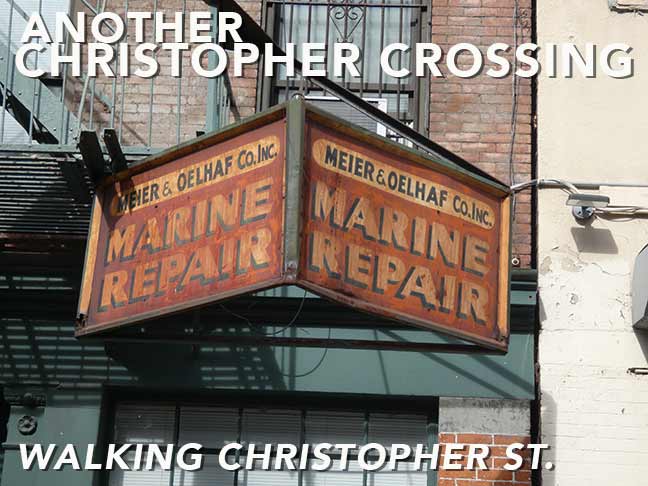
#177 Christopher (also a red entrance!) is also included in the landmarked district. It was built in 1883 and in ints early years housed four different marine repair firms, the last of which was Meier and Oelhaf, whose metal painted sign, mounted below a fire escape, has been preserved by subsequent owners over the years.
In 1920, the property was sold to Carl F. and Mary R. Oelhaf, in agreement with John H. and Margaret G. Koch. Carl Frank Oelhaf (c. 1873-1940) was born in Wurtemburg, Germany, and emigrated in 1880, while his wife, nee Mary Ruf (c. 1874-1961), was born in New York of German descent. In 1910, the Oelhaf family had purchased the property next door, No. 179 Christopher Street (lot 37), for the Meier & Oelhaf Co., its marine plumbing supplies business. Meier & Oelhaf was listed at that address in the 1918 and 1925 city directories, with Carl F. Oelhaf, president, and Mary, secretary-treasurer. John H. Koch was president of the Community Trust Co. of Bloomfield (N.J.) and a partner in the accounting firm of John H. Koch & Co. in New York City. Meier & Oelhaf Co. was listed at No. 177 in city address directories from 1929 until the early 1950s, as a marine repair firm. [LPC report]


Christopher Street is within the Greenwich Village Historic District Extension between Washington and Greenwich Streets; east of that, it’s in the GVHS proper, one of the oldest designated landmarked districts in the city. The corner building, #159-163 Christopher, went up in 1880 and for decades was owned by the Ferrara family of confectioners. The ground fllor hosts the Malatesta Trattoria, with its interesting hand painted sign. Interestingly, “mala testa” is “bad head” in Italian.
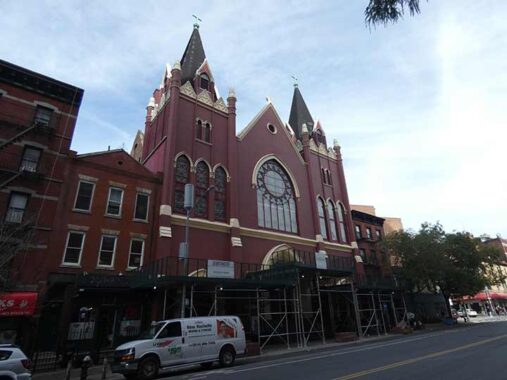
The blocky, red-bricked, twin-peaked former St. Veronica’s Church, #149-153 Christopher, was completed in 1903, after thirteen years of construction. The parish had been in existence since 1887, founded to serve Irish dockworkers along the Hudson. The site had, decades earlier, been occupied by Newgate State Prison.
Beginning in the 1980s, the church together with Mother Teresa began a ministry to AIDS victims. In June 1993 an AIDS memorial was installed at the church to commemorate over 1000 area victims. The church held an interfaith service every June in Gay Pride week. The church closed its doors in 2017, with parishioners transferring to other area Catholic churches such as Our Lady of Guadalupe on West 14th Street. The building now is home to Creative Cultural Center, hosting flamenco dance lessons.
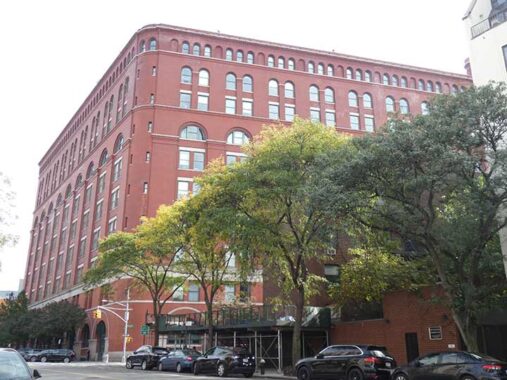
They don’t build them like this anymore, at least for utilitarian warehouses. The huge brick building with unending arches on the ground floor, named The Archives, occupies the entire block defined by Christopher, Greenwich, Washington and Barrow Streets — one of the few buildings in New York City to do so. It was constructed from 1892-1899 as a warehouse for goods awaiting inspection by US Customs. Later it became U.S. Federal Archives Building; it is currently home to condominiums, but there’s a supermarket, gym and dry cleaners on the ground floor as well as a theater in the interior. The bottom two floors were designed by Supervising Architect of the Treasury Willoughby J. Edbrooke, and they don’t have names like that anymore, either.
According to Yelp reviews, the building has a strong canine presence.
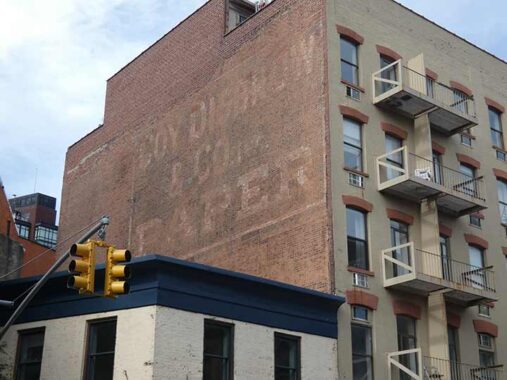
The former Coy-Disbrow Paper Company ad has faded, but not illegibly. Actually this ad is younger than some of the other ones of its type. The company moved to this building on Greenwich between Christopher and West 10th in 1930; the wholesale company had been founded by Robert Henry Coy (1877-1942) and Hamilton Thomas Disbrow (1852-1942) in 1922 on Canal Street. Disbrow was called “dean of commuters” of the Delaware, Lackawanna & Western Railroad after traveling to the city from New Jersey every day for over 70 years.
Much more on The Indispensable Walter Grutchfield’s page.
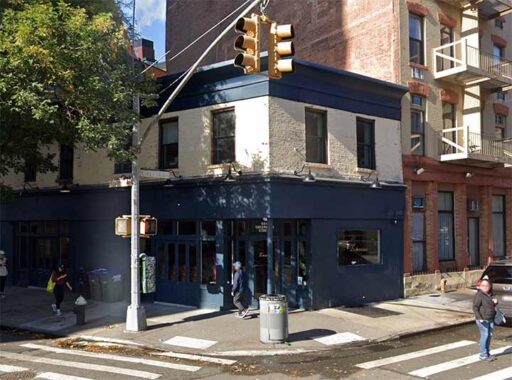
The building beneath it , #684 Greenwich, was constructed as a stable and carriage house in 1867 and later served as a factory. A succession of watering holes (including Cathedral Cafeteria, for its proximity to St. Veronica) have occupied the ground floor as well as the French restaurant Libertine.
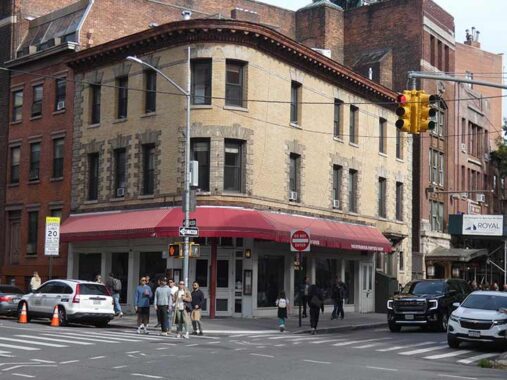
#679 Greenwich, corner of Christopher, in the Greenwich Village Historic District, designated in 1969:
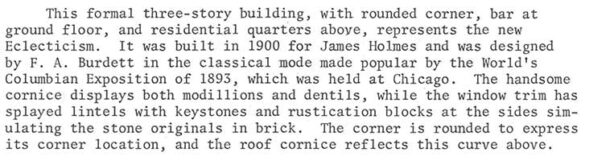
Rounded corners are unusual in lower Manhattan but not in upper Manhattan or the Bronx, where I call them the “Bronx curves.” The longtime coffee shop on the ground floor was the now shuttered Nighthawks, named for the famed painting by Edward Hopper.


The Christopher Street PATH entrance, #137 between Hudson and Greenwich, is actually its own freestanding building, constructed in 1912, with a chiseled “Hvdson & Manhattan R.R. Co.” sign (featuring the V of Importance) at the roofline and a restored iron and glass marquee in front. The AIA Guide to NYC says it’s reminiscent of a London tube station entrance.
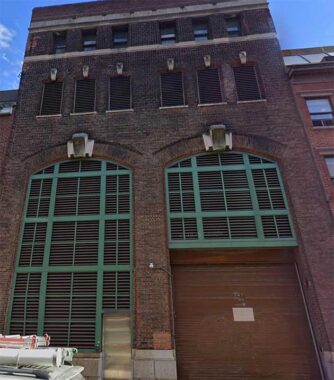
The building also wraps around to Greenwich Street, where it houses ventilation shafts. According to the LPC report, the building replaced Richard Amos’ home (see above).
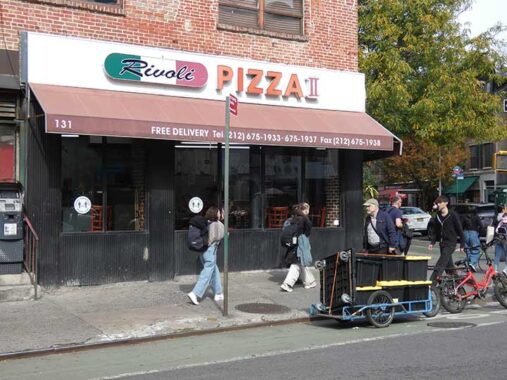
At the corner of Christopher and Hudson, this certainly looks like an old school pizzeria sign, with plastic letters in colors of the Italian flag, red, green and white, but in point of fact, it has been here only since 2014 according to Google Street View. One project I have been thinking about is sampling every “lunch counter” pizzeria in NYC, i.e. the places where I order a slice, take to a table or counter and have it there (rather than sit at a table and order with a waiter, as in restaurants). That’s a pretty daunting task, though, as there are over a thousand if not more in the five boroughs. I’d have to think, except for the grungiest dollar joints, that the quality is more or less very good no matter where in NYC I may go. Since I restrict myself to one slice per week (for health and so I don’t get tired of pizza) this would take a while. Hey, Dave Portnoy does it all over the country. The only pizza I’ve found that I don’t like is in the Artichoke chain: chewy and bland.
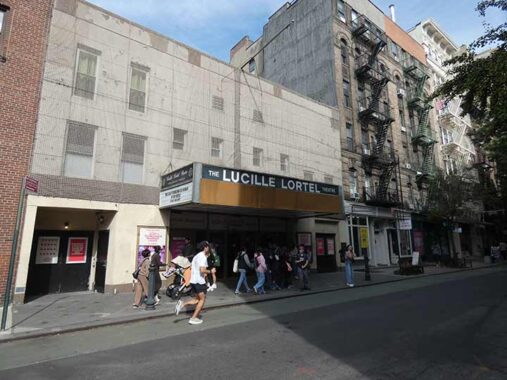
Lucille Lortel, known as the Queen of Off Broadway, could also be called the Queen of the 20th Century; she was born in 1900, and died in 1999. The old Theatre de Lys, in a building constructed in the 1860s, was acquired by Miss Lortel in 1955 — independently wealthy, she brought works by American playwrights such as McNally and Albee and Europeans Genet, Ionesco and many others to prominence for the first time in the USA. The de Lys was renamed for Lucille Lortel in 1981. There is a mini-walk of fame outside the theatre featuring famed playwrights.
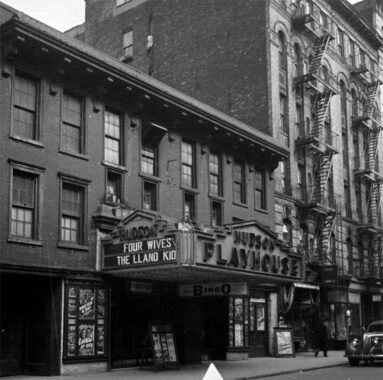
No. 121 Christopher was originally two 1868 Federal row houses that were converted into a moving picture house in 1913 and a theater sometime thereafter. In 1940, #121 was the Hudson Playhouse and was playing “Four Wives” featuring the Lane Sisters, Claude Rains and Eddie Albert, and “The Llano Kid,” a Western with Tito Guízar, from a story by O. Henry.
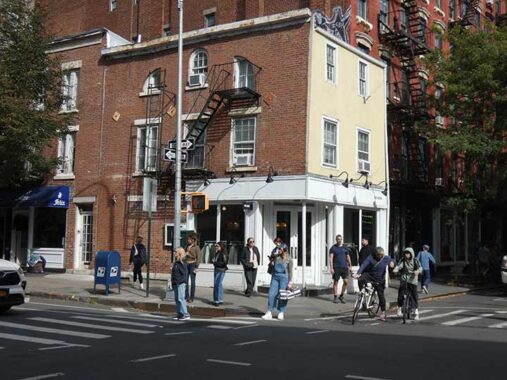
At Christopher Street, Bleecker widens briefly and turns gently east-southeast, beginning a general eastward turn that will actually point east-northeast by the time the street reaches The Bowery. According to the Manual of the Corporation of the City of New York, the widening was done in 1827 when Bleecker was still called Herring Street, necessitating the removal of three houses, and apparently was done as part of the straightening of Grove Street, one block south of Christopher (which was a road to the river as far back as colonial days when it was called the Skinner Road, for Colonel William Skinner, whose father-in-law, Peter Warren, owned much of Greenwich Village in the colonial era).
The small 2-story building at the NE corner of Bleecker and Christopher, #329 shown above, is one of the oldest in Greenwich Village; it was constructed between 1802 and 1808 during the Jefferson administration for grocer William Patterson.


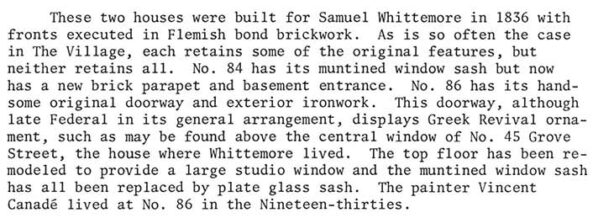
I was attracted to the well-preserved entrance doorway at #86 Christopher, as was the Landmarks Preservation Commission in 1969:
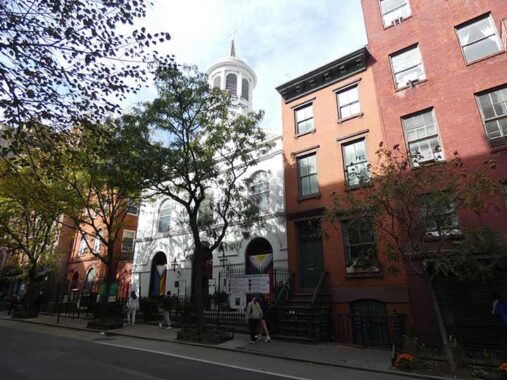
The best views of St.John’s Evangelical Lutheran Church, #81 Christopher west of 7th Avenue South, are available in the winter, when no foliage blocks the view (the photo is from October 2025). The building has stood since 1821 — it was built as the 8th Presbyterian Church and became St. Matthew’s Episcopal in 1842 and finally, St. John’s in 1858. This was also a historic church site prior to 1821, since Hartwick Seminary, the first Lutheran theological seminary in America, was founded on this site in 1797 from the will of churchman John Christopher Hartwick.
The symmetrical facade is separated into two main horizonal sections by a protruding stone course. Above, a pediment sits on a beautiful frieze with delicate Federal decoration. Three arched windows surmount three arched doorways. A set of three stone stairs run the length of the structure, giving the Village church a very old-world feel.
A superb belfry with eight louvred, arched openings between eight slender ionic columns sits on an octagonal base, surmounted by a domed cap and diminutive steeple. Daytonian in Manhattan
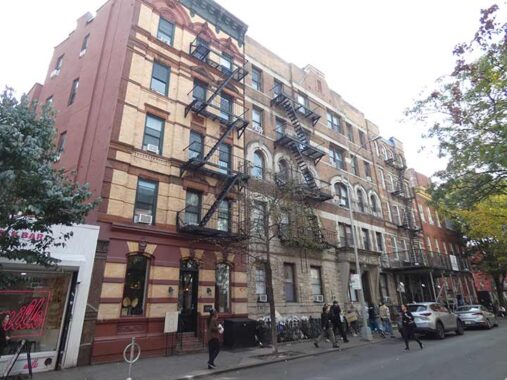
The camera wants what it wants, and mine wanted the multicolored #76 Christopher, built in 1890 and extending south to #61, as well as the adjacent #78-80 Christopher, Romanesque Revival apartment house constructed in 1889. The pediment over the entrance has some intricate stonework.


The Village Cigars facade fills the wedge formed by 7th Avenue South and Christopher, filling the bill for my attraction to red facades. The cigar store, which was founded in 1922, moved out in 2024, but the building owners have preserved its iconic signage. I discussed the building, its sale and the small wedge of territory occupied by a previous owner on this FNY page.

The intersection of 7th Avenue South and Christopher Street has existed only since the 1910s, when 7th Avenue was hammered south to connect 7th and Greenwich Avenues with Varick and Clarkson Streets. The “new” 7th Avenue South ran above a new southern extension of the IRT Subway that now comprises a lengthy chunk of the #1 train.
There’s plenty to see on Christopher St. between 6th and 7th Avenues including the Jefferson Market Library and Northern Dispensary, seen on this FNY page.
Check out the ForgottenBook, take a look at the gift shop. As always, “comment…as you see fit.” I earn a small payment when you click on any ad on the site.
3/8/26