
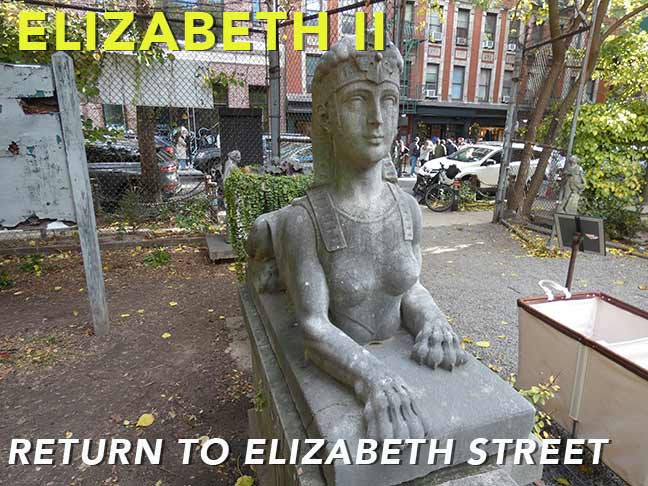

WAY back in 2013 I walked Elizabeth Street, Manhattan in its entirety, from Bayard Street in Chinatown north to Bleecker. That’s still my definitive page on the street, but in November 2025 I decided to revisit it especially since I had heard that the famed Elizabeth Street Garden, really the only green space in/near Little Italy save Petrosino Park and Sara D. Roosevelt Park, was in jeopardy: developers wanted it to build housing. The effort was thwarted, for now, but I hadn’t visited in a while, in any case.
There are a number of streets in lower Manhattan carrying women’s given names: Ann, Catherine, Hester, Elizabeth. They were named in the late 18th to early 19th centuries, and in most cases were named for wives or daughters of landowners. The namesakes of Elizabeth and Hester Street were related: Hester, daughter of Jacob Leisler, a self-appointed governor of the New York colony in the late 1600s, and Elizabeth, spouse of Nicholas Bayard II and daughter of Hester Leisler Rynders. [info: “Naming New York,” Sanna Feirstein]


I took a #6 train from Grand Central south to Spring Street, and walked three blocks east to Elizabeth. I always enjoy seeing one of the “Original 28” subway stations. This station is built along a very gentle curve on Lafayette Street (so gentle in fact that it’s not shown on street maps). The original station tablet features the mosaic bellflower theme used on similar stations built about this time.
The station moldings are painted beige and feature flowering plants. The “S” cartouches, seen in several stations at the south end of the local Lexington Ave. line serving #6 trains, feature two poppies. The stations underwent a brightening up in the 2010s and most of these ceramic cartouches shine as brightly as they did in 1904.
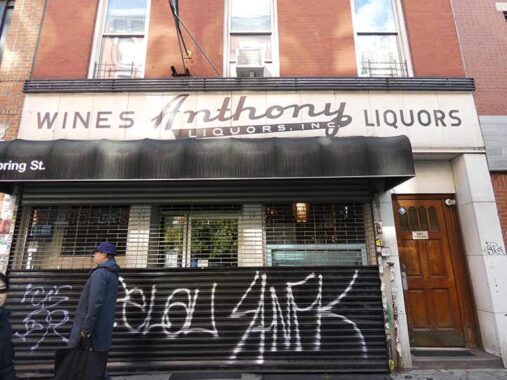
A peculiar attribute of NYC’s liquor stores is that many of them retain decades-old signage, neon or otherwise. The lettering is bold and the color scheme is basic, and the proprietors know enough to let these signs do their jobs and not interfere with them, or add to them with meaningless clutter. This store, #52 Spring, can be found just west of Mulberry and east of Lafayette.
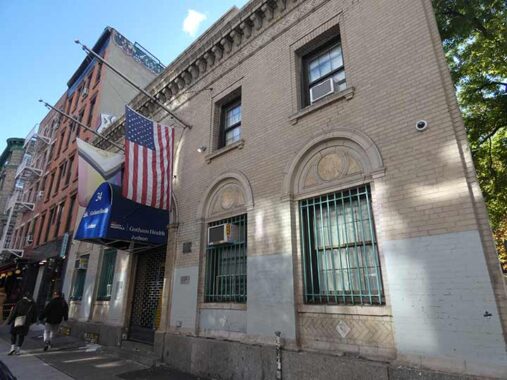
The Judson Health Center, providing care for neighborhood residents, is affiliated with Judson Memorial Church on Washington Square South. It was founded in 1921 and moved into this handsome brick building on #34 Spring, east of Mulberry, in 1950, and keeps its signage inconspicuous. The building was originally the New York Dispensary, built in 1912, a medical clinic that fulfilled the same purpose as the Northern Dispensary in Greenwich Village, and more or less what the Judson does today.
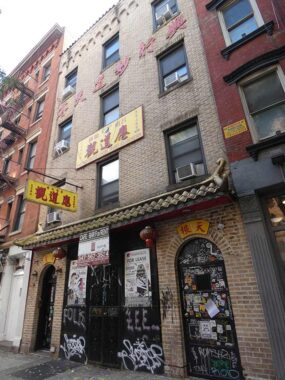
Brilliant red and yellow signage with mostly Chinese characters (translation please) decorates the Eastern USA Taoist Association Center at 16 Spring, which seems to have fallen on hard times.
Taoism at a Glance [BBC]


Till a few years ago, #11 Spring Street at the NE corner of Spring and Elizabeth was one of the most heavily-graffitied buildings in the city, as hundreds of street artists were allowed to make their various marks here. It was turned into expensive apartment units beginning in 2007. Though it has a Spring Street address, the entrance on that street is long gone and entrances are now on Elizabeth. Unfortunately the shadows weren’t in my favor on a mid-November afternoon. The building went up in 1888 as horse stable and carriage house and once had exterior ramps for the horses to gain entrance to the upper floors. By 1940 it was called the Spring Street Stables.
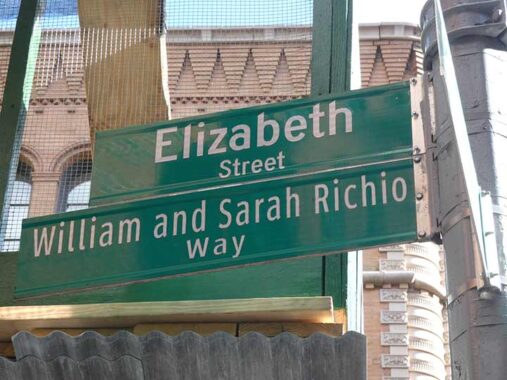
When I first began visiting Boston in the 1980s (sadly I haven’t been back since 2006, though I have traveled there 10-12 times) I noticed pretty much every other corner had an honorific sign named for a local notable, in its own peculiar design. I have begun paying more attention to NYC’s honorifics, as more and more have popped up the last couple of decades.
According to NYC former and honorific street name expert Gil Tauber, “In the late 1970’s, William Richio served on the Area Policy Board on the Lower East Side where he fought for the rights of the poor and helped youths with drug problems. Sarah Richio was the founder and Executive Director of the Neighborhood Council to Combat Poverty. Together, they established and helped preserve the Judson Healthcare Clinic on Spring Street.”
Elizabeth Street Garden
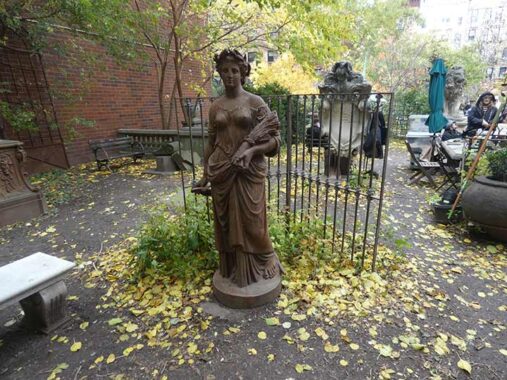
The Garden is a short ways north on Elizabeth from Spring. I like a good park like most other people but my chief fascination with the Garden involves its statuary collection, many depicting mythological figures. Many of these come from the collection of Allan Reiver, who operated the neighboring Elizabeth Street Gallery (see below).
At the entrance is a sculpture depicting Demeter, the ancient Greek goddess of agriculture, harvest, fertility, and the sacred law, known for nurturing the earth and teaching humanity farming. “As a daughter of Cronus and Rhea, she is one of the original Olympian gods. She is most famous for her deep love for her daughter, Persephone, and the grief-driven creation of the seasons.” Demeter was often shown carrying wheat sheaves. Her Roman name was Ceres from which the word “cereal” is derived.
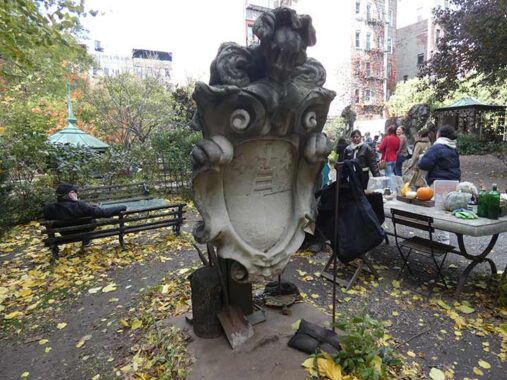
I’ll need help with some symbolism. This cartouche features a ladder-like figure and a cross in the form of a plus sign.
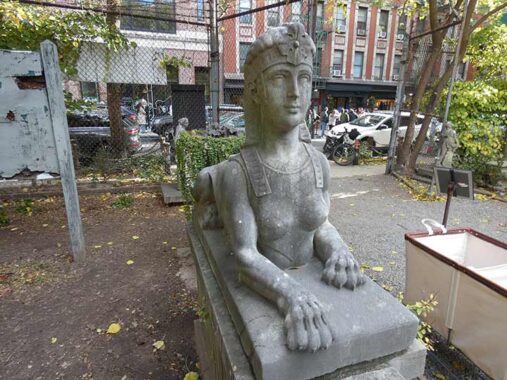
The mythological Sphinx was said to be a lion with the head and breasts of a woman. If a traveler happened upon the Sphinx, she would present him with a riddle:What goes on four legs in the morning, on two legs at noon, and on three legs in the evening?
The Sphinx devoured all who couldn’t guess the riddle until Oedipus correctly answered it:
A man, who crawls on all fours as a baby, walks on two legs as an adult, and walks with a cane in old age.
Whereupon the shamed Sphinx killed herself.
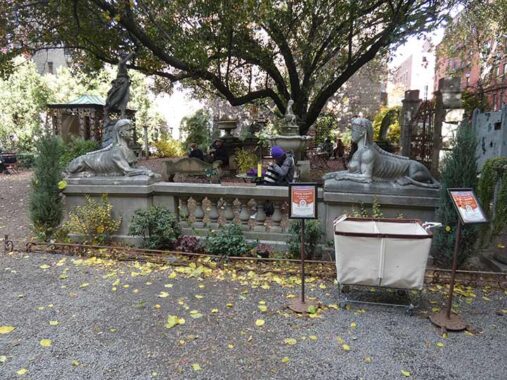
Two more sphinxes appear on this balustrade, originally a part of Lynnewood Hall, a historic mansion in Elkins Park, Pennsylvania.
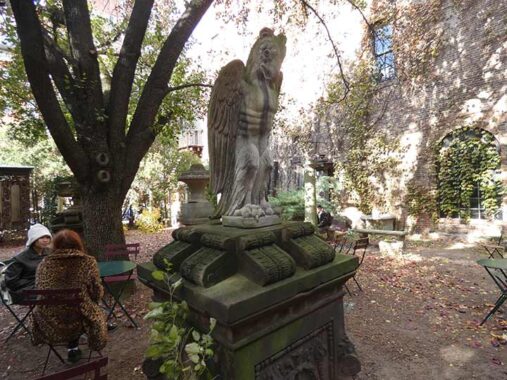
Decorative Griffins popped up on medieval and Renaissance art in Europe. These lion-eagle creatures, according to myths, guarded gold in Scythia, an ancient region located largely in today’s Russia.
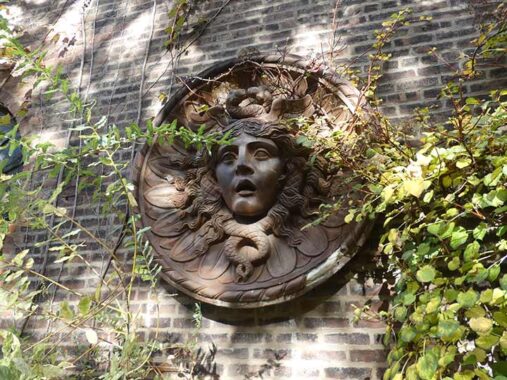
Sculptures of Medusa often were used above doorways as a warning to strangers. Her snake haired appearance turned the gazer into stone; the ancient Greek hero Perseus employed a reflective shield to attack her indirectly and beheaded her.
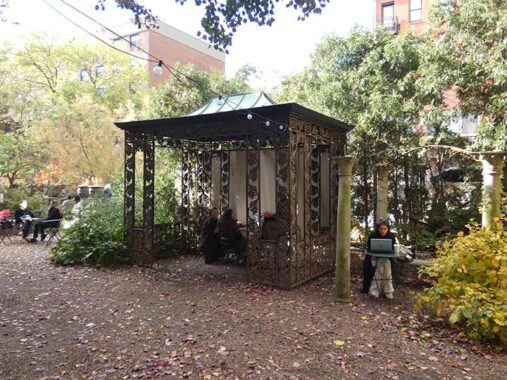
According to some sources, this copper gazebo was designed by Central Park and Prospect Park co-architect Frederick Law Olmsted.
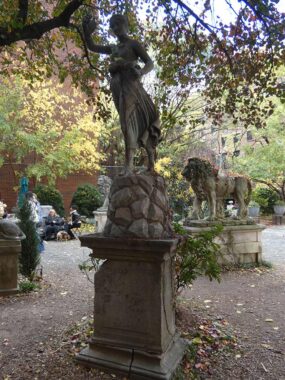
The goddess here is the little-known Hebe (pronounced ee-bee) the gods’ cupbearer on Mount Olympus, and one of Heracles (or Hercules’) many ‘conquests.’ She can also be seen in “temperance fountains” in Tompkins Square Park and Pennsylvania Avenue in Washington, DC.
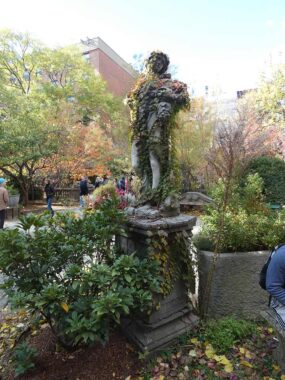
Seen through the ivy is Dionysus, “the Olympian god of wine, vegetation, pleasure, festivity, madness and wild frenzy. He was depicted as either an older, bearded god or an effeminate, long-haired youth. His attributes included the thyrsos (a pine-cone tipped staff), a drinking cup and a crown of ivy. He was usually accompanied by a troop of Satyrs and Mainades (wild female devotees).” A party!


More scenes from the ESG. As ever, click on each individual Gallery photo for a full size image.


Oddly this former firehouse (Hook and Ladder Company No. 9, built 1883) at #209 Elizabeth, just north of the Garden, has not been given Landmarks protection. The Giacchino La Rosa & Son Bread Company left the building in the 1950s. Currently it is the home of the Elizabeth Street Gallery, an architectural ornament and antiques shop.
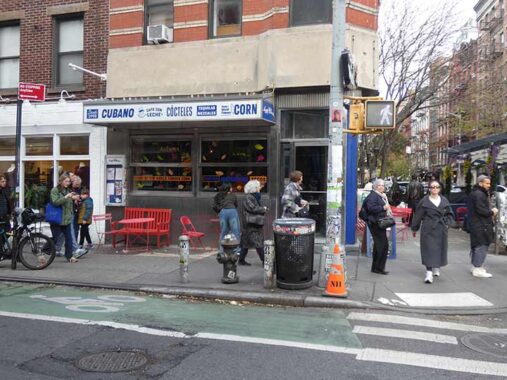
You can pick up some Spanish from NYC sidewalk signs, such as on Cafe Habana, #17 Prince Street corner of Elizabeth. But these are easy to figure out if you don’t: “coffee with milk,” “cocktails.” This part of town changes frequently and I have walked the length of Prince street twice, the first time in a suit following an in person interview, when you still put a suit on for office jockey interviews.
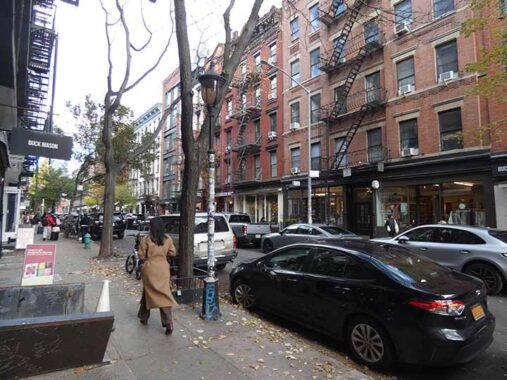
Elizabeth Street becomes decidedly more commercial in its northern stretch. Cosmetics shop Le Labo NYC, #233 Elizabeth, is flanked by two unusual lampposts whose origin is unknown, to me at least.
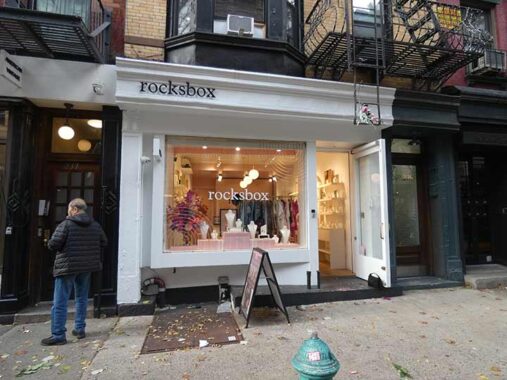
I’m attracted to distinctive storefronts even if I have no interest in the offerings. Rocksbox is a creative name for a jewelry store, and the title is rendered in a font called Plantin. For years the weekly Village Voice was set in Century Schoolbook text with “heds” in Plantin Condensed Bold. Later the NY Daily News also used it in the 1980s.


Albanese Meats is an actual butcher shop, albeit one immortalized by Martin Scorsese, who used owner Moe Albanese in an American Express ad; it has appeared in TV shows such as “The Marvelous Mrs. Maisel”. Scorsese lived on this block in 1950, when he was 8 years old. The exterior and interior still appear as they have since the 1940s. The 102-year old shop continues in business, run by Albanese’ granddaughter Jennifer Prezioso. According to the AI robot:
“Albanese Meats & Poultry, famously known as “Moe the Butcher,” is a historic butcher shop located at 238 Elizabeth St, New York, NY. Established in 1923, it is recognized as the last remaining traditional butcher in the Little Italy/Nolita neighborhood, specializing in custom-cut beef, lamb, pork, and chicken.”
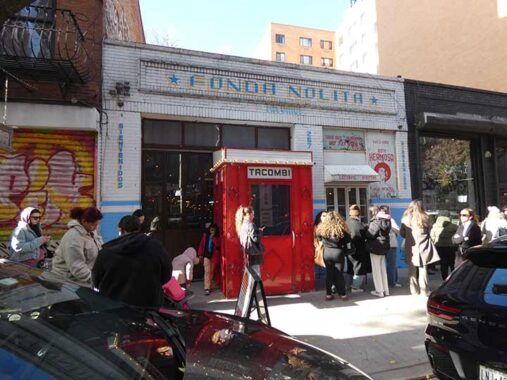
At 267 is a popular taqueria, Tacombi, in what looks like a former garage. Food is served from a Volkswagen bug wagon inside.
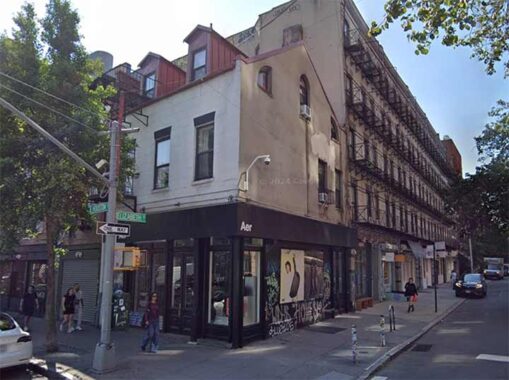
With its sharply peaked roof and dormer windows, I suspected #73 East Houston Street at Elizabeth may be a Federal rowhouse from the early 19th Century, and Tom Miller (Daytonian in Manhattan) proves me correct. It was once home to a brothel. The block of East Houston between Elizabeth and the Bowery once had an entire row of similar buildings; only this survives.
Jones Alley
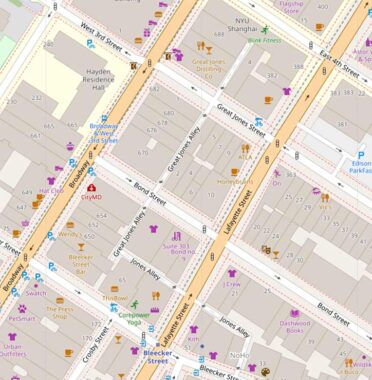
The north end of Elizabeth Street is on Bleecker. I zagged west on Bleecker and zigged up Lafayette to Cooper Square, but I’ll deal with that on another post. When I am here, I always check on a fenced-off alley known as Jones Alley, Great Jones Alley and Shinbone Alley; maps differ on what is which, and the city no longer installs street signs as the alley has been privatized. It runs from north of Great Jones south beyond Bond, then turns east past Lafayette, and then south to Bleecker. The stretch north of Bleecker is still Belgian-blocked.
This part of town is well chronicled in Forgotten NY!
Check out the ForgottenBook, take a look at the gift shop. As always, “comment…as you see fit.” I earn a small payment when you click on any ad on the site.
4/5/26