

THE Hell Gate Bridge was the final piece in the puzzle of running railroad trains into Midtown Manhattan. The tubes connecting Long Island with Penn Station opened in 1910, and Hell Gate Bridge, connecting Long Island with the mainland, opened in 1917 as the lengthiest steel arch bridge in the world until surpassed by the Bayonne Bridge in 1931. “Hellgat” means ‘beautiful strait” in Dutch, but lived up to its English transliteration as an extraordinarily dangerous stretch of water due to conflicting currents of the East River and Long Island Sound, as well as a great deal of rocks that made it treacherous for shipping until the rocks were dynamited into rubble in the late 19th Century. The construction was overseen by Gustav Lindenthal, who worked on the Williamsburg and Queensboro bridges as well. In the mid-1990s it was painted a deep maroon, which the sun has faded to light magenta.
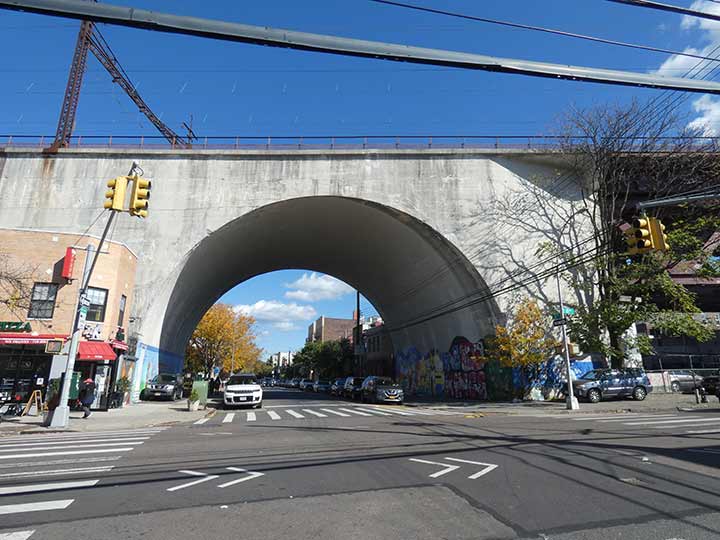
I have always admired the step and repeat nature of the concrete arches that take the steel structure to and from the arch, located in Astoria and Ward’s Island, and also a feature of the Hell Gate that has always been little remarked upon: the massive arches that take the railroad over 29th, 31st, 33rd, 36th, 37th and 38th Streets. The railroad tracks are built on a massive, concrete-supported embankment in much of its route in Astoria, and a combination of iron trestles and concrete arches span the streets beneath. I have cited them often in Forgotten NY, but not for a few years. The one seen here is on 23rd Avenue and 33rd Street.
The concrete arches, of which there are several north and south of 23rd Avenue in Astoria, are all different with no two looking the same because the railroad trestle is on a gradual ascent/descent to and from the Hell Gate Bridge. Ultimately, plans call for Metro North trains to use the approach and bridge en route to several reopened stations in eastern Bronx; the date I’ve heard for this is 2027, but you can probably add 8 to ten years to that date. We’ll see.
Check out the ForgottenBook, take a look at the gift shop. As always, “comment…as you see fit.” I earn a small payment when you click on any ad on the site.
5/20/26
5 comments
According to the MTA website, 2030 is the projected opening year for Metro-North service to and from Penn Station via the Hell Gate Bridge.
Link:
https://www.mta.info/project/penn-station-access
If that’s what the MTA offers as a projected opening, add 20 years. Maybe.
Yeah, the payoff’s likely to keep plummeting but I’ll take the over, also.
The Chief will take what is afforded to him.
The New York Connecting Rail Road with those arches and the Hell Gate Bridge have fascinated this life long Astoria resident since childhood. It would seem that those arches are solid concrete supporting the tracks. According to an article from a 1917 Railway Age Gazzette, that is not true. The concrete you see are only retaining walls. The arches were originally hollow. Every 70 feet there is a reinforced concrete wall that ties together the north and south retaining walls. Once the series of arches and viaducts though Astoria and Long Island City reached the Sunnyside Yard, a temporary narrow gauge railway was constructed to the arches. The arches were then filled using material from the Sunnyside yard excavations. It wasn’t just dumped in. It was slowly placed and compacted in thin layers until reaching the level of the permanent rail level. By doing this there was no pressure on the retaining walls. You can see despite their best efforts, this didn’t work at two locations. The arch at 38TH street apparently suffered from a structural failure years ago. The north and south walls have been strengthened by massive steel rods, turnbuckles, nuts and steel channels. Within the past 25 years, reinforcement has also been done on the arch east of Steinway Street.
What also fascinated me also were the street lights that were mounted on every arch and viaduct of the NY Connecting Rail Road. Almost all are gone now. The last time I looked the last bracket on the 36st arch was about to fall off. The last light that was being maintained, hanging from the structure over 23rd avenue,received a large compact fluorescent lamp about five years ago but is no longer working. But almost every one of the structures has some remnant of the street lights. Most of the lights received their power from an adjacent wood pole that held an astronomic time switch. Several of the time switches are still on the poles,abandoned in place. There are also corroded conduits and insulators remaining. Still intact are the green porcelain enamel street light installation number plates.