

By PATRICK O’CONNOR
Forgotten NY Contributor
My first visit to Hart Island occurred in February 2025 through a tour offered by the Parks Department Urban Park Rangers. In that tour, we saw Potter’s Fields, Civil War burial ground and monument to the disinterment, the Peace Monument and former Nike Missile Base.
Tours of the Island are granted by New York City Urban Park Rangers, on a lottery basis, and it took some time before I got back. I was able to return on two separate occasions, once for Women’s History Month and a second for a general tour of the south part of the island. Unfortunately, the buildings on the south end of the island have been torn down in recent years, after the transition of the Island’s ownership to New York City Parks Department. Some photos were made available by the Parks Rangers for re-photographing.


As mentioned in last year’s article, the Interfaith Chapel was constructed in 1935 by Catholic Charities during the time when prison inmates performed the burials. Its use ended in 1966 when the prison workhouse was closed. Scaffolding was recently removed from the chapel and replaced by a fence to keep visitors away. This tour headed south allowing for 360 views of the structure and a look at another remnant structure-a rock wall that outlines the perimeter of the quartermaster’s office for a juvenile detention center.
Hart Island continues to be an active burial ground for those who have no next-of-kin or can’t afford a cemetery plot or simply chose to be buried in this location. To date, it is believed that over 800,000 burials have taken place on Hart Island with the first interment being Louisa Van Slyke. Louisa was born at sea in 1845 and orphaned. She contracted yellow fever and passed away on April 10, 1869, with no next-of-kin.
Some interments are eventually claimed by family members and re-interments elsewhere are common. A notable example is the story of writer and poet Julia de Burgos. Born in Puerto Rico in 1914, Julia was a notable poet and activist seeking Puerto Rican independence. Living in Brooklyn in 1953, Julia left her residence and became ill, was hospitalized and died of pneumonia at age 39. No family member came forward to claim her, so she was taken for burial at Hart Island. About two months later, relatives were able to find her and plan for burial in her native Puerto Rico.


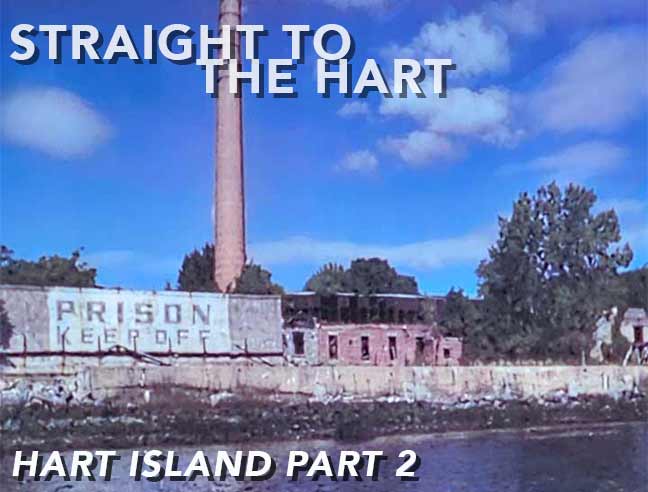
Hart Island was originally under the jurisdiction of NYC’s Department of Charities and Corrections. During my first visit, I captured the outside of the remnant prison wall from a distance. Inmates whose job was to perform the burials were paid 50 cents to one dollar per hour for their work until the practice of using prisoners ended in 2020. In subsequent trips we were able to see the inside of the prison wall and a photo of how it looked prior to demolition.
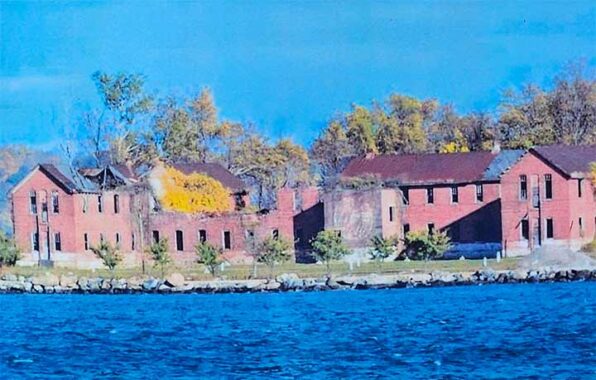
The lunatic asylum was constructed in 1885 to house up to 300 women, specifically the overflow from other locations like Blackwell’s Island. “Lunatic” was a specific reference to a woman who was deemed to be in a disordered state of mind, as compared to the term “insane” which was applied to a man with the same affliction. In 1887, 23-year-old journalist Nellie Bly feigned mental illness to go undercover to Blackwell’s Island Lunatic Asylum to expose the poor conditions and treatment of patients. Nellie Bly’s book Ten Days in a Mad-House was published the same year resulting in reforms and improvements in conditions.
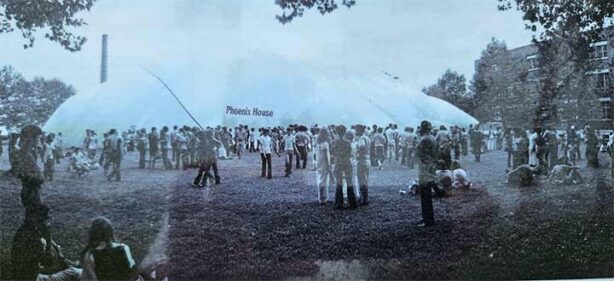
In 1967 Phoenix House was created by a group of former addicts that found traditional treatment effectiveness could be improved. Hart Island was found to be a desirable location due to its distance and isolation from the problems that drove patients to these substances. An unused building was assigned and the facility operated here until 1976 when the organization was moved to Manhattan and the era of institutions operating on Hart Island ended. During the period on Hart Island, a farm was created for patients to work and provide some of their own sustenance. In addition, Phoenix House hosted drug and alcohol-free festivals attracting musicians including The Velvet Underground and Janis Ian to perform.
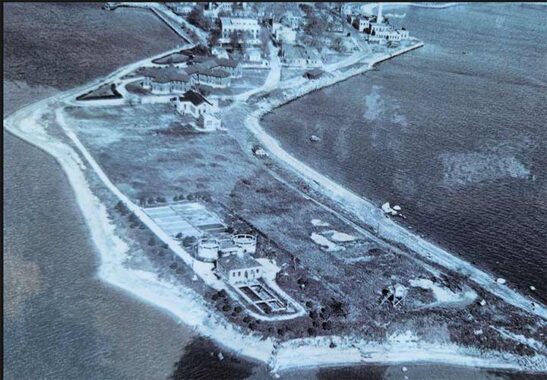
New York City initially did not purchase the entire island. Four acres along the southwest shoreline were still owned by John Hunter, a descendant of the family who owned Hunter Island. In 1922, Hunter offered to sell the four-acre parcel to the City, but to no avail. Hunter then sold the property in 1924 to Solomon Riley. Born in 1873 in Barbados, Riley came to America in 1892 and became a wealthy real estate developer in Harlem. Riley’s vision was to create a bathing beach and attractions that African Americans could enjoy since Coney Island, and other beaches were for whites only. Advertised in 1925 to be the “Negro Coney Island”, Riley built a boardwalk, a dance hall, rooming houses and purchased a fleet of 60 motorboats to ferry beach goers to the island. The City imposed a requirement to construct a wastewater treatment plant to keep the surrounding water free from pollution and bacteria. Riley complied with the requirement. Eventually the City became concerned that there would be a security risk to the prison. Riley’s land was taken through eminent domain and demolished all the features except for the wastewater treatment plant that can be seen in the aerial photo. In November 1927, Bronx County Court awarded the sum of $144,015 to Riley for the taking of the property and cost of improvements. Riley passed away in 1936 and is interred in Woodlawn Cemetery.


The 1980s brought a new infectious disease concern-AIDS. Early victims of this disease were buried in Hart Island. The first 33 victims were buried individually in the extreme south part of the Island. They were buried at the maximum depth that the backhoe could dig, about fourteen feet. Markers simply stated SC, meaning “Special Case” followed by a number and the year of burial. Later victims were buried through the normal process in the mass graves. The photo shows the mass grave grid with the single burials in the distance. A short distance away is a single marker for the first infant to die of AIDS. Inscription on the marker reads “SC-B1 1985”. B indicates the burial was a baby.
A section just south of the Chapel is resting place for many victims of COVID-19. Remains of many COVID victims were reclaimed by family when travel restrictions were lifted.


A global touchstone, a slab of granite from Vermont was built as a memorial to the victims of AIDS and COVID victims. It was first pulled in Central Park Memorial Day weekend in 2023 and placed near the ferry dock. It is said that if you dip your hand in water and leave a handprint on the touch stone, your presence will permeate into the stone and become part of the living memory.
Patrick O’Connor is a lifelong resident of Queens, retired with 40 years of service for City of New York Department of Environmental Protection and is a licensed sightseeing guide in New York City.
Check out the ForgottenBook. As always, “comment…as you see fit.” I earn a small payment when you click on any ad on the site.
7/30/26
2 comments
I cant understand why they ended inmate labor there.I heard it was
popular with the inmates.Get out of jail for awhile without all its pressures,
get some sun and fresh air,make a little money to spend at the commissary plus
the city gets cheap labor.
A possible Hart Island burial was that of John Lake, the sports editor of Newsweek magazine and one of the country’s better-known sportswriters. He disappeared without a trace in December 1967 after leaving a woman’s Midtown apartment. Extensive searches yielded no results,
That spring a body turned up in the East River, and as it had no identification the individual ended up buried on Hart Island. Years later John Lake’s son saw a picture of the body, and believe it may have been his father though given the body’s condition when found and photographed it was impossible to be sure. In any event, by that time the remains in the burial trench had become so commingled that even if there had been a positive identification there was no way to remove and rebury any one body.