
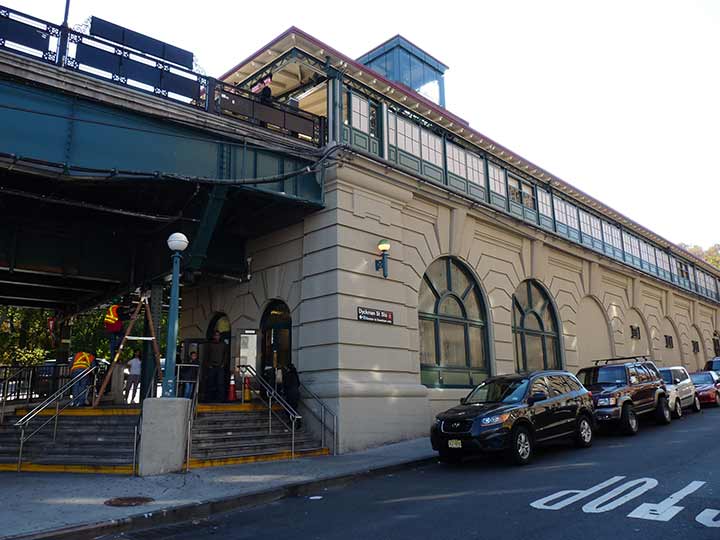

CONTINUING my fascination with subway stationhouses… not every one of the NYC subways’ outdoor stations has one. Express or important stations on the Original 28 IRT stations built by Heins and LaFarge from 1900-1904, and the extensions both underground and above that the architectural pair designed until 1908, can still be found such as the ones at Broadway and 72nd street, Bowling Green, and Atlantic Avenue. There is another one, though, that opened in 1906 that I didn’t give much thought to until the present.
The Dyckman Street station way uptown on the #1 train (seen on this FNY page) is fascinating. It was constructed on the site of a Revolutionary-era fort that many years later hosted an amusement park. At Dyckman Street The IRT emerges from, and enters, a tunnel under High Bridge Park inscribed with the title Fort George and the dates 1776 and 1905. Fort George, originally Fort Clinton, was built by US patriots at about where George Washington High School stands at Audubon Avenue and West 192nd Street. Though the British eventually captured the fort, Colonel William Baxter and his Bucks County Pennsylvania militia were able to hold off British general William Howe’s troops long enough for Washington’s troops to escape to New Jersey (much of the Revolutionary War in 1776 in the NYC area consisted of Washington escaping to fight again).
In 1895, entrepreneur Joseph Schenck and his partner, Marcus Loew (later founder of a movie theater chain) opened the Fort George Amusement Park at the end of the old 3rd Avenue trolley line on the old fort site:
During its heyday this Gotham wonderland would boast two Ferris wheels, three roller coasters, nine saloons, a pony track, several hotels, a casino, five shooting galleries, a tunnel boat ride, two music halls called the Star and the Trocadero, fortune tellers and more frankfurters, peanuts and pretzels than you can imagine. [My Inwood, which features plenty of photos and postcards of the park]
However, as “civilization” crept north to Inwood, the park’s noise became increasingly distasteful and the park came under attack from arsonists, who unsuccessfully tried to burn down the park in 1911, but succeeded two years later. By then Schenck and Loew had sold their interests and went on to the motion picture industry. The site then became part of High Bridge Park.
Since the IRT emerges here from a deep tunnel under a hill and then proceeds over a valley, engineers decided to keep the tracks level, as they did further south at 125th Street, by elevating them. The stationhouse was placed into the side of the hill, just where the tracks exit the tunnel onto the el structure.
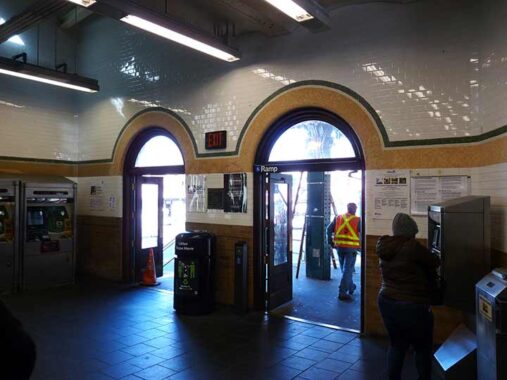
The interior of the stationhouse is rather dark and didn’t photograph well, but I notice it does contain the colored tilework in the same style exhibited by other Original 28 stations further downtown between Brooklyn Bridge and 33rd Street.
After 1908, the Heins and LaFarge firm would step away, and designer, artist and painter Squire Vickers became chief subway station designer. His reign extended until about 1940, and his vision would inform IRT, BMT and IND stations built during that span. Until 1940, separate companies ran the BMT and IRT, with the city controlling the IND (whose Modernist stations are easily told apart from the other two branches. Younger subway riders today have no idea that the subway was once three separate branches.
Check out the ForgottenBook (HarperCollins, 2006), as well as Forgotten Queens (Arcadia, 2013). I also have a chapter in the anthology “New York Calling: From Blackout to Bloomberg” (Reaktion, 2007). As always, “comment…as you see fit.” I earn a small payment when you click on any ad on the site.
8/27/26
1 comment
The Dyckman Street Station is the north end of the Fort George Tunnel, whose south end is the 157th Street #1 station. That station is a very shallow cut and cover design, one flight below the street level. Immediately to the north the land rises sharply, so the engineers had to build a deep tunnel in order to keep the tracks level. Thus, the #1 line stations at 168th, 181st, and 191st Streets are among the deepest in the system, requiring elevators for access. The land drops down above 191st Street, making Dyckman Street one of the most unique stations on the system. Stand on the platform towards the south end and the emerging train looks like it’s a mountain railroad in a western state.
The Fort George is remarkable because it was built in 1906 without the benefit of modern construction equipment. Dynamite was used to blast away the rock, and then laborers dug the tunnel foot by foot. Not easy work.