

KEW Gardens in mid-Queens was inspired in layout by the London suburb that gave it its name. It was conceived and developed in the 1890s by Manhattan lawyer Albon Platt Man and later by his son, Alrick Man, and features block upon block of Spanish Colonial, Italianate, Dutch Colonial, Tudor, and even Japanese-style homes, as well as a cluster of apartment complexes in the vicinity of the Kew Gardens LIRR station.
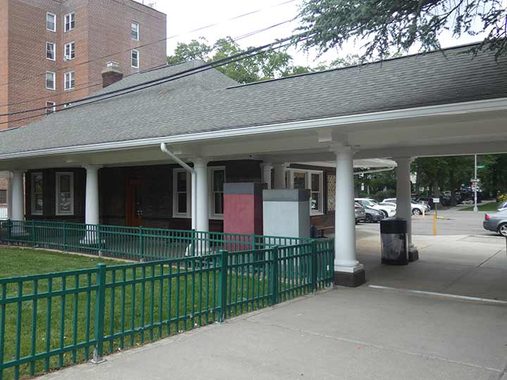
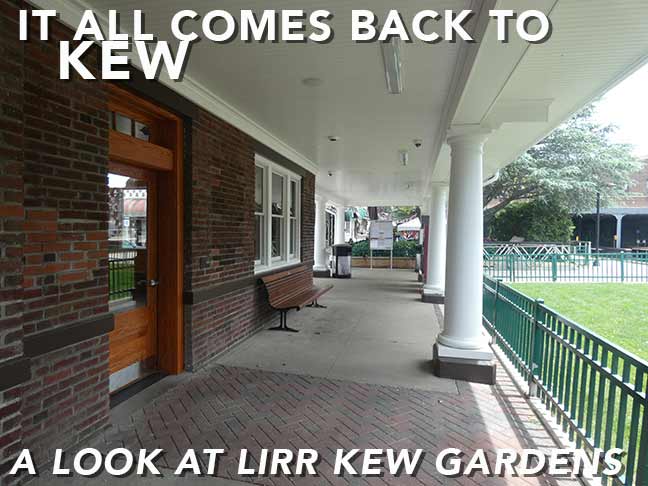
In spring 2026 I walked the length of Austin Street, which runs for a couple of miles alongside the Long Island main branch. I like the LIRR’s remaining elderly stationhouses such as Kew Gardens’, found at Austin Street and Mowbray Drive, which was built in 1909 (nearby Hopedale and Maple Grove stations closed soon after), an era when the main line ran “at grade” or even with the ground. The westbound side connecting trains to Long Island City and then Manhattan received the stationhouse, so that today only westbound patrons get a building to wait in.
Tragically, one of the worst Long Island Rail Road crashes took place just east of the station on November 22, 1950, the day before Thanksgiving, killing 78 people and injuring 363 others.


I was surprised to find Kew Gardens, which along with Forest Hills sees less service than other stations of the Main Line (most trains runs express between Woodside and Jamaica) open on the weekend, and it was a good thing I wasn’t in a hurry for a train as the next westbound was in 21 minutes. It shows signs of a recent renovation, with wood paneling and signage.


On an exterior wall is found a pair of collages of artworks created by local Kew Gardeners aged 5 to 85, commissioned by the LIRR and a local organization, Kew Gardens Potters’ Wheel. They were installed in 2011.


On Lefferts Boulevard between Austin and Grenfell Streets is the span that takes Lefferts over the tracks: it’s lined on both sides with commercial buildings. A complicated engineering solution encompasses three separate bridges on Lefferts: one for the roadway, and two on each side that support the buildings. According to the late Kew Gardens: Urban Village in the Big City author and PBS-TV host Barry Lewis, the store’s bridges actually run through the buildings’ roofs, with the storefronts hung from the bridges like a curtain on a rod. The engineering principle is similar to that of the circa-1565 Ponte Vecchio (Old Bridge) in Florence, Italy. The Lefferts Blvd. bridge had assumed its present condition by 1930.
Check out the ForgottenBook (HarperCollins, 2006), as well as Forgotten Queens (Arcadia, 2013). I also have a chapter in the anthology “New York Calling: From Blackout to Bloomberg” (Reaktion, 2007). As always, “comment…as you see fit.” I earn a small payment when you click on any ad on the site, which helps in site upkeep and also aids Greater Astoria Historical Society.
11/12/26