
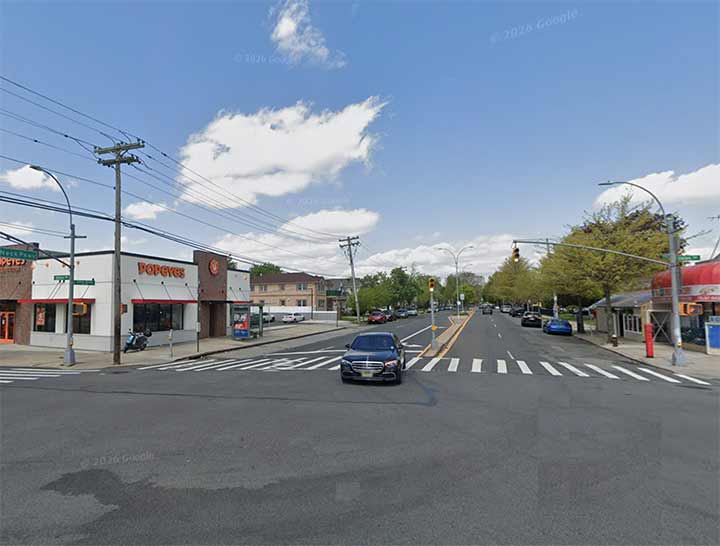

I usually don’t do “Then and Now” posts except when referring to specific buildings, but I ran across something on Facebook too engaging to pass up. First of all, above is the present-day Little Neck Parkway looking north from Union Turnpike toward Glen Oaks Village on the right, and the Queens Farm Museum on the left. Little Neck Parkway (originally Road) is a very old route running south from Little Neck Bay at Udalls Cove to Jericho Turnpike at Floral Park. It certainly dates to the 1800s and may be a Native American trail gradually built out by first the Dutch, British and Americans. Union Turnpike, meanwhile is relatively new. In the 1930s, it was extended from a short road called Union Avenue in Glendale all the way east into what became Nassau County in 1899.
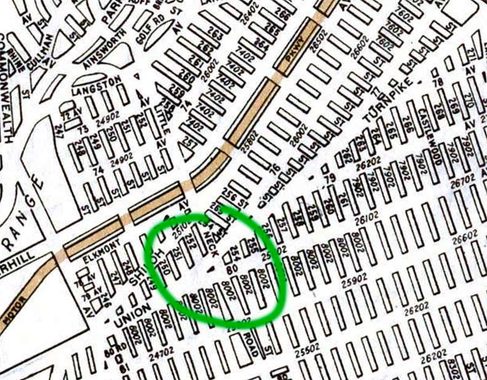
In 1922 Hagstrom produced one of its first maps of Queens. However, in eastern Queens, in the interest of not being out of date quickly, mapmakers put in the hopes and dreams of city planners and developers. Thus, only a couple of roads shown on the map existed in 1922; Little Neck Parkway and Union Turnpike were two. The only paved road was the (Vanderbilt) Motor Parkway, opened here in the 1920s (its Nassau County leg opened in 1908). This section of the Motor Parkway, closed in 1938, is no longer in existence.
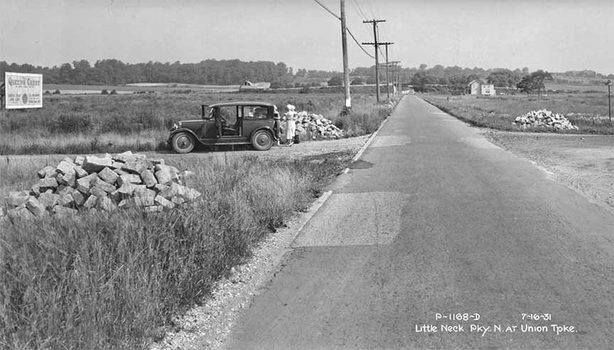
Here’s how the area actually looked in 1931; we’re either looking north from Union Turnpike itself, and the cross road is the Motor Parkway, or the cross road is Union Turnpike. On the billboard at left, a development called Queens Crest is advertised. The current batch of houses on Little Neck Parkway, seen here, may have originally been part of the development.
The bricks may have been used to pave Union Turnpike before it was asphalted. The Adriance Farmhouse may be the structure directly above the sedan. The private home on the left was probably razed when the Glen Oaks Houses were built.
Check out the ForgottenBook (HarperCollins, 2006), as well as Forgotten Queens (Arcadia, 2013). I also have a chapter in the anthology “New York Calling: From Blackout to Bloomberg” (Reaktion, 2007). As always, “comment…as you see fit.” I earn a small payment when you click on any ad on the site, which helps in site upkeep and also aids Greater Astoria Historical Society.
11/24/26