

THERE was a time when Staten Island had separate towns, as Bronx, Brooklyn and Queens had before consolidation into Greater New York in 1898. The island was divided into four separate towns beginning in the 1680s: Westfield, Northfield, Southfield, and Castleton, and in 1860, Middletown was created from portions of Castleton and Southfield, and the village of Edgewater was created within Middletown in 1866. The towns’ locations can be seen on this 1874 atlas. Only a few street names are reminders of the existence of these former towns, including the most prominent, Castleton Avenue.
Castleton, on the NE part of the island including New Brighton and St. George, was named in the 1680s for the manor of Governor Thomas Dongan who named it for his home Castletown, in the town Kildrought (now Celbridge) in County Kildare, Ireland. Staten Island’s Dongan Hills are also named for the governor, a Roman Catholic, rare for a person in a power position in colonial-era New York.
Castleton Avenue is a main shopping route in Livingston, West New Brighton and Port Richmond. It begins in New Brighton at Brook and Jersey Streets, running generally west, twisting and turning to get around some hills, before straightening out and continuing on to Nicholas Avenue in Port Richmond. The S53 bus from Brooklyn runs along Castleton Avenue between Broadway and Port Richmond Avenue.
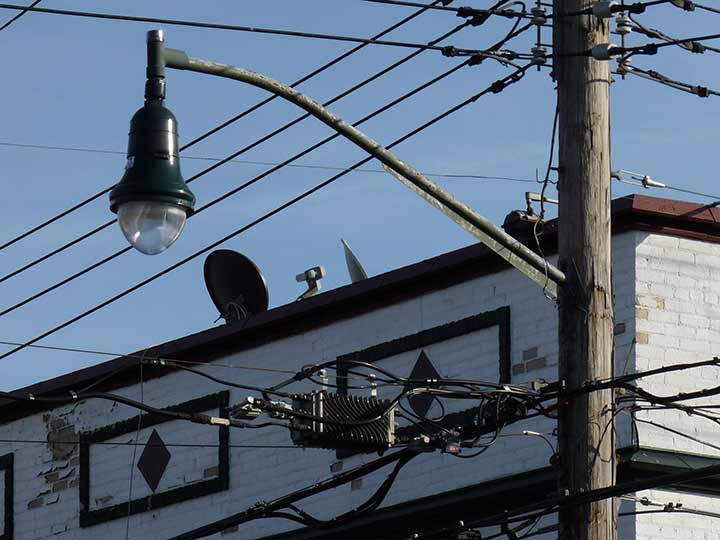
I last walked Castleton Avenue, and been in West Brighton, in 2016! Almost ten years. Where does the time go? If I can get back to walking for any distance again, I’ll revisit this corner of town. Castleton Avenue is interesting, winding through grinding poverty and near rurality, with loads of interesting architecture. What concerns me today, though, is a unique lamppost combination found nowhere else in NYC but on Castleton between North Burgher Avenue and Bodine Street.
Finned aluminum lamppost masts first appeared on telephone poles in NYC in the early 1950s. Over the years, they have carried numerous types of lamp fixtures, from incandescent and mercury lamps with and without glass reflector bowls. Then came the sodium revolution in the early 1970s. In NYC, no sodium lamps were employed without glass bowls. Lastly, in the mid-2010s, came the bright white LEDs.
The Finned Masts have carried dozens of different makes and models. But they arrived too late to carry the incandescent Bell fixtures introduced in the late 1930s, and by the 1950s, production and installation of Bells had ceased in favor of SLECO “cuplights.” That is, until the 1990s, when this stretch of Castleton saw the introduction of retro Bells that were originally made with sodium but later, white LEDs. This, Finned Masts here finally carry Bells, but it hasn’t caught on elsewhere in NYC, though in Morris Park, Bronx, double masts along Eastchester Road and Morris Park Avenue do have them.
Does anyone else in NYC chronicle this kind of thing? that’s why there’s…Forgotten New York.
Check out the ForgottenBook, take a look at the gift shop. As always, “comment…as you see fit.” I earn a small payment when you click on any ad on the site.
12/29/25
3 comments
Walked or rode the old R3 bus along Castleton Ave many times in the 1970s. Never noticed those light fixtures, which were likely a (misguided) attempt to freshen up the avenue, much like the city tried to do along Port Richmond Ave in the early ’80s. Some gorgeous architecture on Castleton Ave, including Sacred Hearth RC Church at North Burgher Ave. I made a point to visit the old ‘hood on my last sojourn back east this summer. Sacred Heart is still imposing, and the NY Public Library across the street remains a charming remnant of early 20th Century Staten Island. Thanks, Kevin!
To paraphrase Paul Simon & Arthur Garfunkle:
“.Oh what a time it was…a time of innocence, a time of confidences..preserve your memories, they’re all that’s left to you now”.
nice to get back to the roots of what drew me here!