
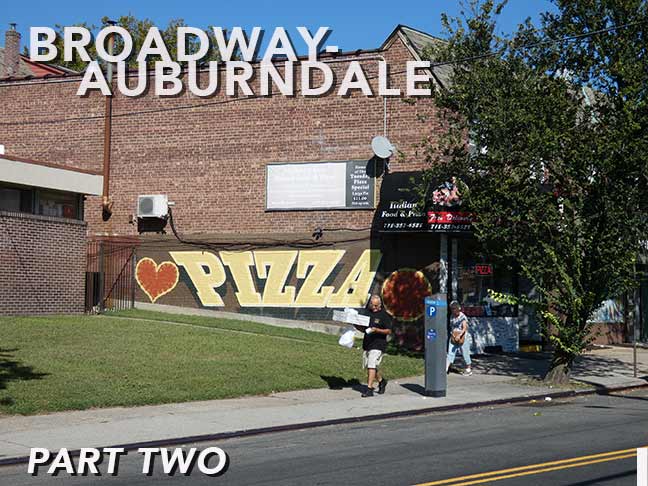

I have not really been able to do a lengthy walk with the camera since around Thanksgiving 2025, for a variety of reasons that include increasing sensitivity to wind and cold, and also a desire to not risk my back slipping on ice (which is only now beginning to melt after a 1/25/26 snowstorm). Fortunately, from July-November I was quite active indeed and have a backlog of photos that I nevertheless need to parcel out slowly before I am back in business once again. In September, I took a relatively quick walk from the Broadway LIRR station to the Auburndale-Bayside border. Very little of this area is thoroughly documented as little of it has Landmarks protection, but there are some interesting items to see and document.
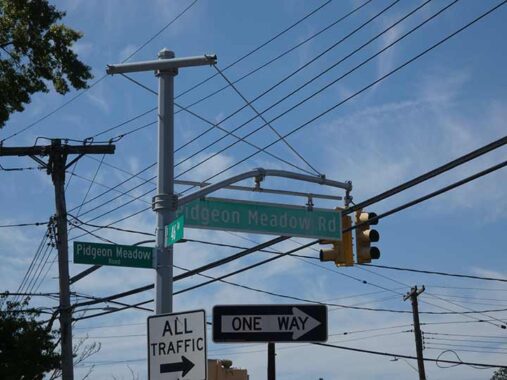
Before moving on to the next “attraction” I took note of Pidgeon Meadow Road, which skirts the west and south end of Flushing Cemetery before turning east as far at Utopia Parkway. This is a very old name, and I am still perplexed by its origin.
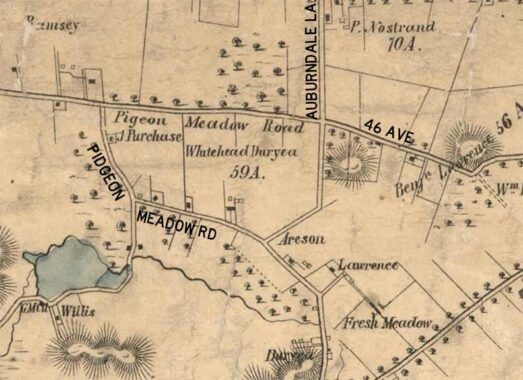
Pidgeon Meadow Road is quite old and turns up on this 1852 Dripps map, the oldest one I have access to in the area. However it’s marked here where the current 46th Avenue is. Some years ago, I researched the route, which was part of Rocky Hill Road (see below) of which only a short section remains. However, the road that is now Pidgeon Meadow Road is in place, skirting the property that is now Flushing Cemetery. Thus, in the intervening years, a switch was made. The body of water on the left is Kissena Lake.
Currently the name is spelled the same way actor Walter Pidgeon spelled his name, but in 1852, it was spelled like the bird. So, it’s up in the air, barring further research, whether the road was named for the fowl or for a local landowner named Pi(d)geon.
Flushing Cemetery
GOOGLE MAP: BROADWAY-AUBURNDALE
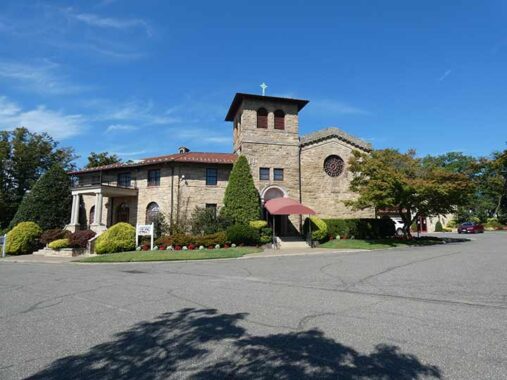
I left off at what is now called the Old Towne of Flushing Burial Ground. I then crossed 46th Avenue to Flushing Cemetery, which is even younger, even though it was founded in 1853. The main entrance of Flushing Cemetery is on 46th Avenue at Pidgeon Meadow Road and 163rd Street. This is the cemetery’s main office building, 46th Avenue and 164th Street. This beautiful ashlar-stone Spanish-style building, designed in 1916 by architects York & Sawyer at a cost of $45.000, replaced Flushing Cemetery’s original two-story finial-roofed wood building.
The Flushing Cemetery Association was formed in March 1853; until that time, Flushing had many small church and family plots scattered here and there, but no large cemetery, and in April the Association bought approximately 21 acres from local farmers at 46th Ave. (then known as Queens Ave.), 162nd St. (then Fresh Meadow La.) and what is now Pidgeon Meadow Rd. Construction and landscaping proceeded apace and the new cemetery was dedicated August 31st of that year.
Flushing Cemetery is famed as the resting place of Louis Armstrong (seen on this FNY page), as well as musicians Dizzy Gillespie (whose plot is not marked), Hazel Dorothy Scott and Johnny Hodges, U.S. Congressmen Thomas B. Jackson, John Lawrence, Lemuel Quigg, Frederic Storm, Elmer Ebenezer Studley and William W. Valk, author and pastor Adam Clayton Powell Senior, financier Bernard Baruch, restaurateur Vincent Sardi, Civil War hero and winner awardee of the Congressional Medal of Honor College Pointer Pvt. Carl Ludwig are all interred in Flushing Cemetery.
The quickly reach the east end of Auburndale, I strolled through to the Bagley Avenue gate.


Next time you’re in a (nominally) Christian cemetery, stroll up to the mausolea and peek inside. You’ll be rewarded, in most cases, with colorful stained glass depicting Jesus, Mary or Biblical scenes.
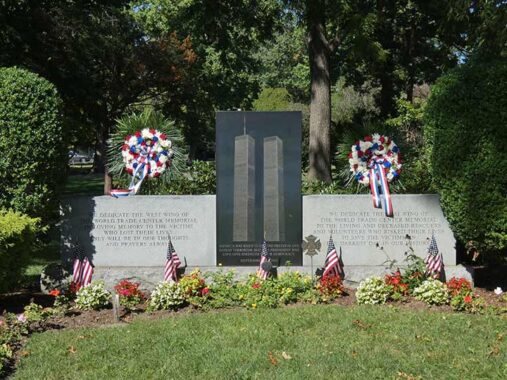
Flushing’s 9-11 monument is in the cemetery facing Pidgeon Meadow Road near the front entrance. It directly faces a nonfunctioning fountain.
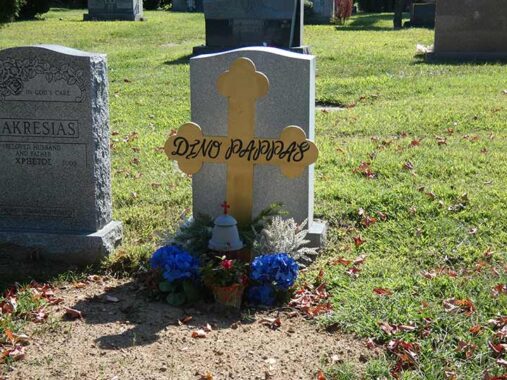
This memorial may be a temporary one until the deceased’s name can be inscribed on the stone.
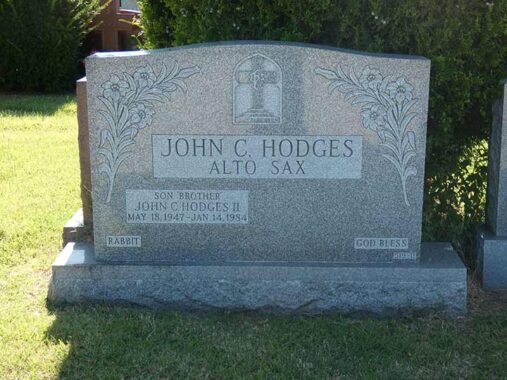
Famed saxophonist John C. “Johnny” Hodges (1907-1970), a longtime member of Duke Ellington’s group, is interred in Flushing Cemetery, along with his son, John C. Hodges II.


I exited Flushing Cemetery at its eastern gate at Auburndale Lane and Bagley Avenue. Between Auburndale Lane and Utopia Parkway south of 46th Avenues is a collection of one-and two block streets named in alphabetical order: Ashby, Bagley, Courtney, Effingham, Effington, Fairchild and Gladwin. (47th Avenue is in place of the “D” avenue, which was Delmar. There was also an H, Hilbert, now a part of Pidgeon Meadow Road.) The avenues are lined with neat two-story detached homes with lawns.
Of chief interest to me were the handsome, red and gold-bricked gateposts on Bagley and Courtney Avenues; Ashby Avenue is missing its pair, and only Courtney Avenue’s gateposts are still complete with the original pyramid-shaped cap. The avenues south of Courtney don’t have the gateposts; I have a 1940 map of the area that shows only Ashby, Bagley and Courtney Avenues, and I imagine the remaining avenues in the development were constructed after World War II, since a 1949 map shows them there. I suppose Effington through Gladwin didn’t receive the gateposts their brothers did.


Scenes along Bagley Avenue. I liked the Arts and Crafts-style little houses in this development, though some have been altered into nonrecognizability. A few years ago my friend Joanna E. and I walked all over northeast Queens rather than be cooped up by the pandemic and she got on a garage photography kick. She later lost interest in it but I have picked it up and now I’m shooting distinctive or unusual garages when I can find them.


The word “utopia” comes from two Greek words meaning “not” and “place,” and so, the word literally means “no place.” It was coined in 1516 by St. Thomas More as the title of his work about a perfect society on an imaginary island.
Moving forward to 1905, the Utopia Land Company purchased 50 acres east of the Flushing-Jamaica trolley line (now 164th Street) in today’s Fresh Meadows, planning to build cooperative homes for Jewish people then living on the Lower East Side. The streets were named for several in the Manhattan neighborhood, including Houston, Stanton, Rivington and Delancey. Work had begun, but the company went bankrupt before any housing was constructed, and the region remained woods, meadows and farmland the 1940s, when the neighborhood was built up by the Gross-Morton Park Corporation with Colonial and Cape Cod-style homes.
Now a part of greater Fresh Meadows, the area’s main north-south main drag, Utopia Parkway, was not completed until the late 40s, replacing the previous main artery, Fresh Meadow Lane, which now fills a subsidiary role. NYC-based rock group Fountains Of Wayne were sufficiently inspired by the fanciful-sounding street to name their second album after it in 1999.
A traffic island at Utopia Parkway and 188th Street is whimsically named Erewhon Mall, a reference to the 1872 Samuel Butler allegorical novel telling the story of an upside-down country near New Zealand in which it is a punishable offense to become ill, yet where criminality and immorality are looked upon as treatable diseases.
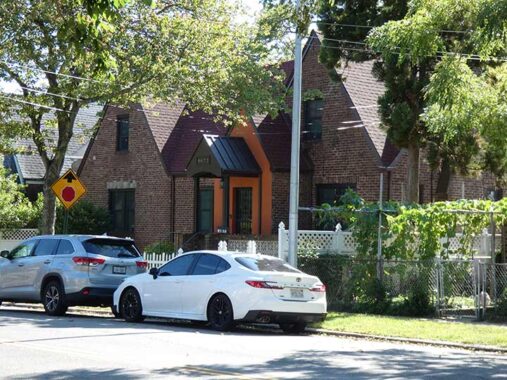
This area of Fresh Meadows is full of tidy Tudors of every description, including these brick works on 188th (Saul Weprin) Street near 47th Avenue.


If you refer to the map at the top of the page from 1853, you can see that 46th Avenue takes an odd bend on the right side of the excerpt. That bend is still there, as it gets traffic (originally horses and carts, now motorized) around a hill. It’s the original Rocky Hill Road, since given other names like Queens Avenue and presently Hollis Court Boulevard and 47th Avenue.
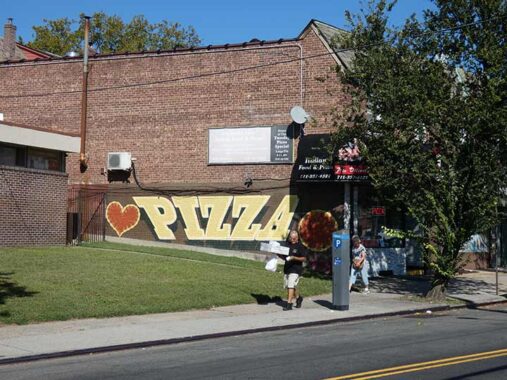
This painted pizzeria sign on 47th Avenue got my attention, though I saved my stomach for diner later.


Across 47th Avenue, I can recognize old gas station buildings when I see them. In 1940, Danny’s Auto Care sold Mobil and was known as Happy’s.
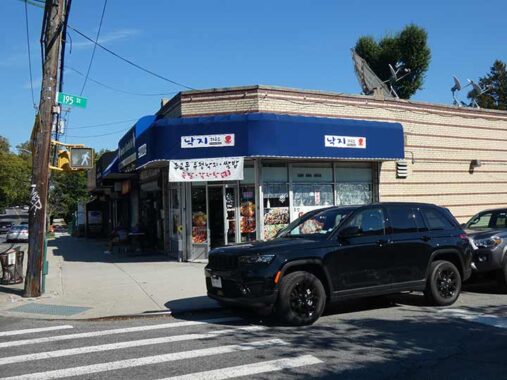
Korean script is on the awning sign at 47th Avenue and 195th Street, Octopus House Restaurant.
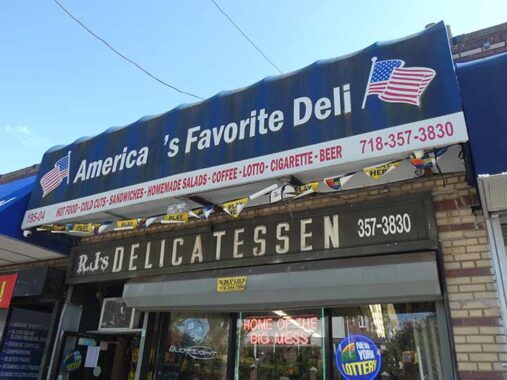
RJ’s Delicatessen, 195-04 47th Ave, became An American Deli, then American’s Favorite Deli. Because that made no sense, the n in American was painted over. However, the much older RJ’s Deli sign is still visible. “The Big Mess” is a breakfast sandwich.


In the colonial era, Rocky Hill Road stretched from Flushing east and southeast to Bellerose. Its original path can be traced along 46th, 47th and 48th Avenues, Bell Boulevard, 216th Street, Luke Place, 56th Avenue, Springfield Boulevard and Braddock Avenue.
A short piece of Rocky Hill Road remains under that name, between Francis Lewis Blvd. and the Clearview Expressway. It forms a traffic triangle with 47th Avenue and 202nd Street.


Our Lady of La Salette, a tiny Roman Catholic church at 47th Avenue and 204th Street, gained a small measure of fame for offering masses in Latin, in opposition to post-Vatican II Church reforms. Its congregants are mostly Spanish-speaking. The church was founded in 1985. The church takes its name from a vision of Mary, Mother of Jesus, by two children in LaSalette, a village in the French Alps.


The Clearview Expressway pedestrian crossing at 46th Avenue sontains its original 1950s lampposts, with yellow sodium fixtures, now themselves antiques as they date to the 1970s. The poles originally held incandescent lamps. This is one of the few pedestrian bridges with a name: Christopher’s Crossing.


There are a number of head-scratcher street names in Bayside, where some named Streets appear in thickets of numbered Streets. One is Oceania Street which runs from Northern Boulevard south to beyond the LIE, where it merges with 210th Street. It slots in between 208th and 210th, and so, to be Captain Obvious, it takes the place of 209th. Why Oceania? The street is nowhere near any bodies of water at all. Perhaps one of the companies developing the area in the early 20th Century was called Oceania; today, the name is a political term for the southwest Pacific including Australia and the islands comprising Indonesia and Polynesia.
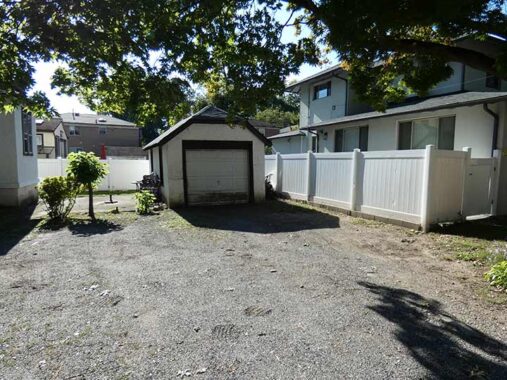
Finishing with another garage…
Check out the ForgottenBook, take a look at the gift shop. As always, “comment…as you see fit.” I earn a small payment when you click on any ad on the site.
2/14/26
4 comments
Hi, Kevin. Great article! There is a nice old sign that says ‘Flushing Cemetery’ on the grounds just inside Pidgeon Meadow and 164 St., possibly to capitalize on the trolley that ran there. The ‘E’ street is ‘Effington’. I enjoyed your author’s talk at the Bayside Historical Society.
The CMH isn’t a prize that is won. As a U.S.Army veteran, I’m extremely disappointed by you describing in that disrespectful way. The Medal of Honor is the highest U.S. military decoration, awarded by the President in Congress’s name to service members who distinguish themselves through supreme gallantry and risk of life above and beyond the call of duty in action against an enemy. Established in 1861, it has three versions (Army, Navy, Air Force) and requires rigorous, documented evidence of bravery.
All right, changed to “awardee.”
Winner,awardee? Whats the diff?
Why you got a bust his balls over a few lousy words