
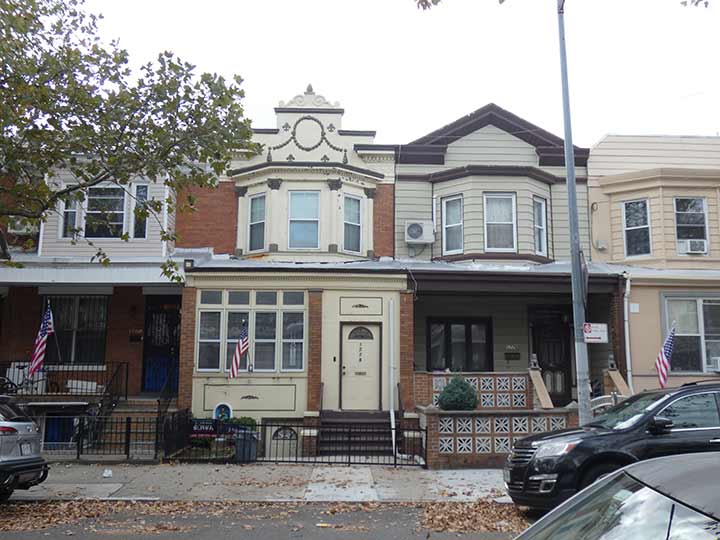

I was unsteadily rambling north on West 8th Street in Gravesend in November 2025 when, south of Kings Highway, I noticed some attached houses that were a “cut above” the usual one family houses built on Gravesend’s side streets, and I realized I had encountered them before.
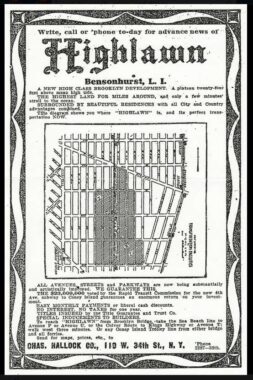
It turns out that this was adjacent to a real estate development called Highlawn, but what I’ve shown you here wasn’t it! According to Gravesend historian Joseph Ditta the houses north of Highlawn are the result of speculation by developer Otto Singer.
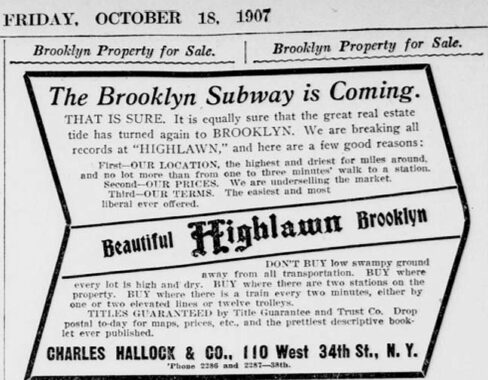
Highlawn was advertised in October 1907 newspapers, developed by Charles Hallock. the development was on streets mostly south of Highlawn Avenue/Avenue R, between West 4th and 10th Streets. It got as far south as Avenue U. It’s advertised as being on high ground, away from the marshiness of South Brooklyn, thence the “high.”
Hallock, apparently, got Brooklyn’s leaders to change the name of Avenue R to “Highlawn Avenue.” It’s not the only “letter avenue” in Brooklyn to change to something else; Avenues A through G were given British names as various developers wanted a more sophisticated atmosphere. Avenue Q became Quentin Road, probably for Theodore Roosevelt’s son, Quentin, a casualty who was shot down in France in a World War I incident in 1918, but some accounts dispute that.
Check out the ForgottenBook, take a look at the gift shop. As always, “comment…as you see fit.” I earn a small payment when you click on any ad on the site.
4/10/26
7 comments
While Quentin Roosevelt was the only child of a president to die in combat, his brother Archibald was the only US serviceman ever to be 100% disabled for the same injury in two different wars. His left knee was shattered in World War I and he was discharged with a 100% disability rating. When World War II broke out he joined the Army. Having an existing 100% disability was a complete disqualification but Archibald got an exception because of who he was. Soon enough his left knee was shattered again and he once again got discharged with a 100% disability rating. That was the end of his military career.
Their older brother Ted, Jr., was presumably the only child of a President to lead troops ashore on D-Day. Henry Fonda played him in The Longest Day.
On July 12, 1944, Theodore Roosevelt, Jr. died in his sleep of a heart attack, at the age of 56. General Omar Bradley later said Roosevelt’s action on Utah Beach was the bravest thing he had ever seen, and, in a letter to his wife, General George Patton wrote, “He was one of the bravest men I ever knew.”
For more information about Theodore Roosevelt I recommend:
https://www.foxnews.com/opinion/bret-baier-teddy-roosevelts-powerful-lessons-strength-duty-country?msockid=07ae200c6dce619c22b036216cb160bc
Of the thousands of troops who stormed ashore on D-Day Theodore Jr. was the oldest.
How can you get wounded in the exact same place twice?
It’s all a matter of getting the paperwork right.