

I have been rereading the great S.T. Joshi‘s two-volume H.P. Lovecraft biography, “I Am Providence,” as one does, when one passage struck me enough for me to investigate. It took a bit of digging, but I think I found my quarry. First, a bit of background. Brooklyn Heights’ leafy lanes have been a mecca for the lions of literature for much of the 20th Century and on into the 21st; it all began in the pre-Civil War period when Walt Whitman’s Leaves of Grass was published on Fulton Street. At one time or another Whitman, W. H. Auden, Truman Capote, Hart Crane, Norman Mailer, Arthur Miller, Henry Miller, Carson McCullers, and Thomas Wolfe have all lived in Brooklyn Heights, attracted by its quiet, its atmosphere and its contingent of like-minded literati.
There was one writer, though, whose time in Brooklyn Heights was most decidedly a depressing period in his life. Howard Phillips Lovecraft (1890-1937), while read only by pulp fiction fans in his lifetime, became, by some critics, second only to Edgar Allan Poe (whose time in NYC was also less than cheerful for the author) in the horror genre. Beginning in the 70s, when I was a teenager, I thrilled to his “Dunwich Horror”, “Call of Cthulhu” , “At the Mountains of Madness” and other stories imagining a universe rife with hostile forces utterly indifferent to the everyday cares and desires of man. Lovecraft was born to a wealthy family in Providence, Rhode Island in 1890. In 1904, his family would lose its fortune after the death of its patriarch, his grandfather the industrialist Whipple Phillips, and Lovecraft was to lead a hand-to-mouth existence for most of his life. Without sinking into actual poverty; Lovecraft burned off his inheritance while making scant money on literary revisions, ghost writing, and the sales of his own tales.
In 1921 Lovecraft met his future wife, Sonia Greene, during his amateur journalism days. The two would marry in 1924 at St. Paul’s Chapel on Broadway and Fulton Street in Manhattan, and Lovecraft would move to Sonia’s home in Brooklyn, in an apartment on 259 Parkside Avenue; after a year, they would move to 169 Clinton Street. Lovecraft biographer and scholar S.T. Joshi has pointed out that in the Twenties, 259 Parkside, in a neighborhood now known as Lefferts Gardens, was a middle-to-upper class area and 169 Clinton was rather downmarket. By the mid-20th century those roles would be decidedly reversed.
By his own account (Lovecraft was one of the most voluminous letter writers of his time) he was miserable in Brooklyn Heights; his efforts to find work came to nothing, and he depended on money sent from Providence by his aunts, Annie Gamwell and Lillian Clark, as well as from Sonia, who embarked on opening a series of unsuccessful hat shops in the Midwest. It was a decidedly unusual two-year marriage Sonia and Lovecraft had from 1924-1926; she helped support him while living hundreds of miles away much of the time.
Lovecraft intensely disliked New York City; born into aristocracy in New England, he kept the mindset of wealth and privilege he had long since lost. He disdained New York’s madding crowds, and there is more than a hint of racism in his screeds complaining about New York’s cosmopolitan makeup. This resentment asserted itself in two stories he wrote in 1925, during his Brooklyn “exile”: “He”, a story of a mysterious stranger who provokes attacks by sprits of native Americans or Asians, and “The Horror at Red Hook”, a lurid story of devil worship. “Red Hook” in particular reads like an atlas of Brooklyn: protagonist Robert Suydam, his wife Cornelia Gerritsen, and his dwelling, on Martense Street, are all from Brooklyn street names.
After months of Lovecraft trying to persuade his aunts to let him return to Providence, they acquiesced, but apparently balked at allowing Sonia to move there as well; to some in conservative New England in 1926, a businesswoman wife was a stigma, not an asset. The two would eventually divorce. By the spring of 1926 the man whose gravestone reads “I Am Providence” had returned home, where he would lead a quiet existence, writing the occasional weird tale, traveling, and carrying on his amazingly prodigious correspondence, all written in longhand, with friends all over the USA. He died young, of cancer, in 1937 at the age of 46.
In Joshi’s biography, he says that on the night of September 5, 1925, Lovecraft and writer friends Samuel Loveman and Rhinehart Kleiner “undertook a late night exploration into a region of Brooklyn not far from 169 Clinton—Union Place, a small cobblestoned street (now sadly demolished) that Lovecraft describes as follows:”
Litten only by the gibbous moon, & by a solitary lamp-post that flickered fantastically, there lay beyond that wooden tunnel a little realm apart—a brooding backwater of the 1850s, where in a quadrangle facing a central iron-railed bit of park stood side by side the high-stepped houses of elder days, each in its iron-fenced yard with garden or grass-plot, & totally innocent of the injudicious restorer’s vandal touch. Silence rested soothingly on every hand, & the outer universe faded from consciousness as it retreated from sight. Here dreamed the past inviolate—leisurely, graceful & unperturbed; defying all that might occur in the seething hell of life beyond that protecting archway.
Where was Union Place? Well, Joshi took a small liberty in describing its location as “a region of Brooklyn not far from 169 Clinton.” In fact, if the location I have found is correct, it’s a couple of miles away from Brooklyn Heights. Still, Lovecraft was also a flaneur in addition to a writer and epistolarian, and explored places like I do, by walking.
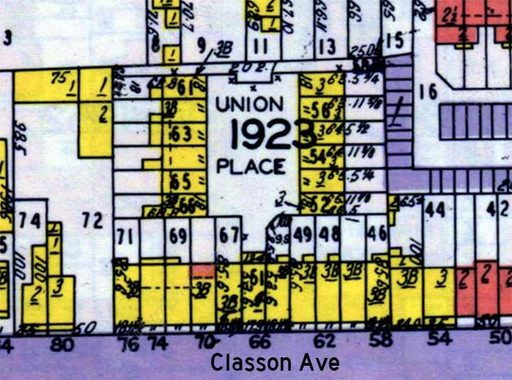
My research reveals that Union Place was a small enclave at #266 Classon Avenue between DeKalb and Willoughby Avenues. Unless one passed through the entrance, these houses were invisible from Classon Avenue. You can see the small dwellings Lovecraft talked about facing a central open space, “the iron-railed bit of park.”
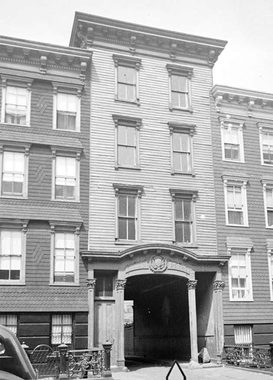
I haven’t uncovered any photos of the houses, but here’s a tax photo from 1940 that reveals “the protecting archway.” It’s hard to see here but the words “Union Place” are on the arch. There was a multi-unit building atop the arch, and we can infer that the houses were found within. Such an arrangement would be heavily gated today and you would need a key or password to enter.
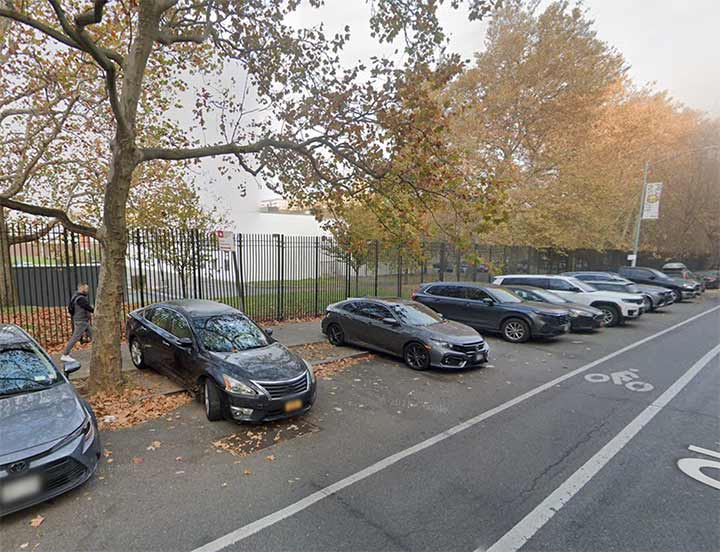
Alas, Union Place is long gone, and as pictured above, that side of Classon now faces the east end of the Pratt Institute campus. “Throughout the mid-to-late 1950s (with major townhouse demolitions documented around 1958), existing residential structures between Pratt’s scattered buildings were cleared. Ryerson Street, Grand Avenue, Steuben Street, and Emerson Place were closed to through traffic, unifying the grounds into an enclosed campus stretching from Hall Street to Classon Avenue .”
169 Clinton, corner of State, is still there, though.
Check out the ForgottenBook (HarperCollins, 2006), as well as Forgotten Queens (Arcadia, 2013). I also have a chapter in the anthology “New York Calling: From Blackout to Bloomberg” (Reaktion, 2007). As always, “comment…as you see fit.” I earn a small payment when you click on any ad on the site, which helps in site upkeep and also aids Greater Astoria Historical Society.
11/16/26