
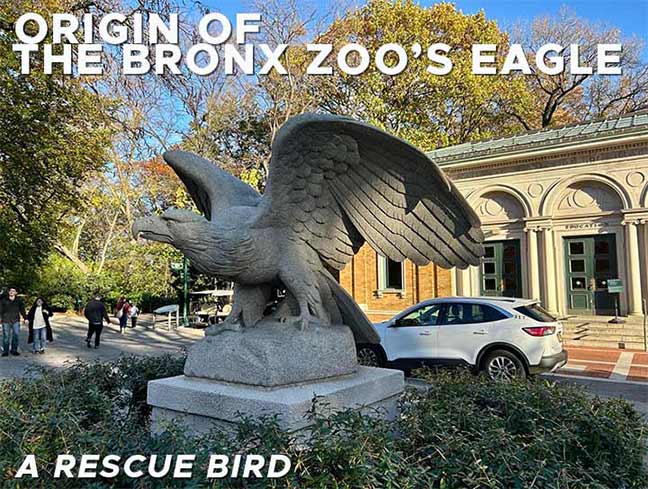


On a recent visit to the Bronx Zoo, I had the opportunity to document items that I missed in my essay published last summer. The crouching eagle at the Education Building facing the sea lion pool was rescued from the demolition of the City Hall Post Office in 1938. Its original home was built at the junction of Park Row and Broadway, an unpopular seizure of parkland for an extravagant Second Empire-style postal building.
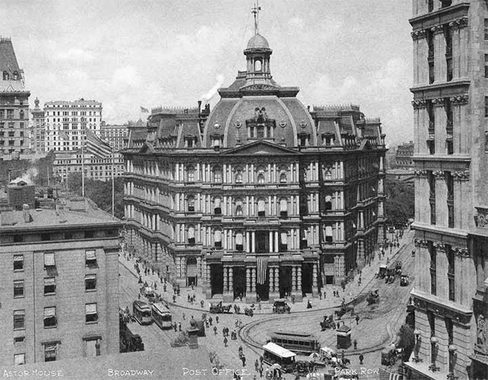
The design was the result of a competition in which 52 entries were judged, with Alfred B. Mullett as the architect. His post office resembled his other public works, the Old Executive Office Building in Washington and the Old Post Office in St. Louis. Completed in 1880, it succeeded the former Middle Dutch Church on Nassau Street as the city’s main post office.
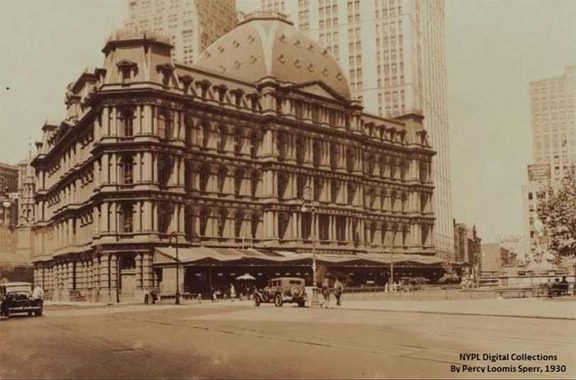

From its beginning, it was regarded as an eyesore and nicknamed Mullett’s Folly. By 1910, the Farley General Post Office in Midtown assumed many of its duties and calls grew for the demolition of the City Hall Post Office. This downtown post office was moved to the Federal Office Building a block to the west at 90 Church Street. No trace of the building was left and Mail Street that ran behind the building was incorporated into the park.
|
|
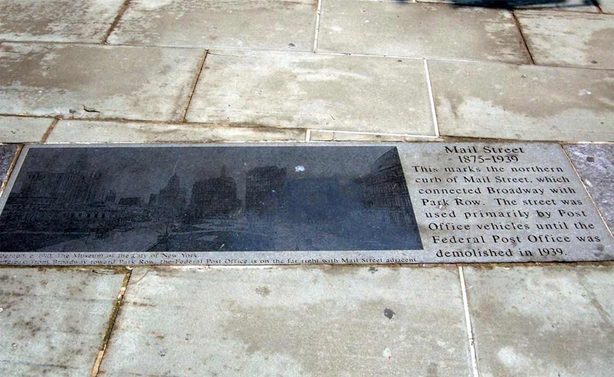
Besides this eagle, a few other reminders of its presence can be seen across the city. In City Hall Park is an inscription marking this forgotten one-block street where mail delivery trucks unloaded their cargo. At Grant’s Tomb are two more eagles that stood atop the old post office, one facing Broadway and the other facing Park Row. They now guard the entrance to the nation’s largest presidential tomb.
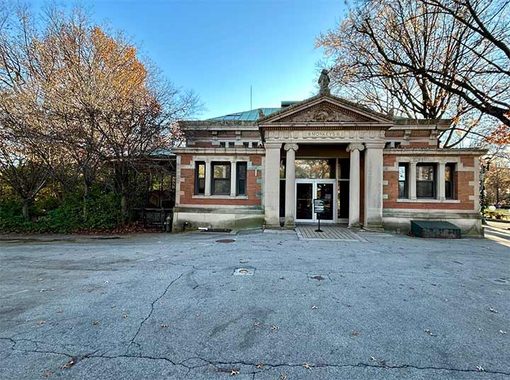
Returning to Bronx Zoo, the landmarked Monkey House near this eagle closed to the public in 2012, when its resident primates were given more spacious and naturalistic dwellings. While the former Lion House now houses the smaller fauna of Madagascar, the Monkey House remains closed to the public and the cages behind this landmarked building remain unchanged for now. This is where in 1906, the zoo hosted Congolese native Ota Benga with the monkeys. The city’s African-American leaders protested the exhibit for equating an African human with animals.
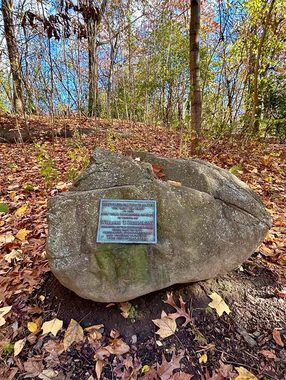
The director of the zoo at the time was William T. Hornaday, a pioneer in wildlife conservaiton deserving of accolades for saving endangered animals from extinction. But his casual dismissal of opposition to Ota Benga’s appearance in a cage has not been judged favorably by history. On a path in the zoo is a plaque on a stone honoring the founding director. Hornaday’s partner in founding the zoo, Madison Grant also cared for preserving endangered animals. He was far more racist and there are no plaques honoring his role at the zoo. Likewise with Henry Fairfield Osborn. A plaque honoring Hornaday appears on the path opposite the enclosure for Father Pere’s Deer.
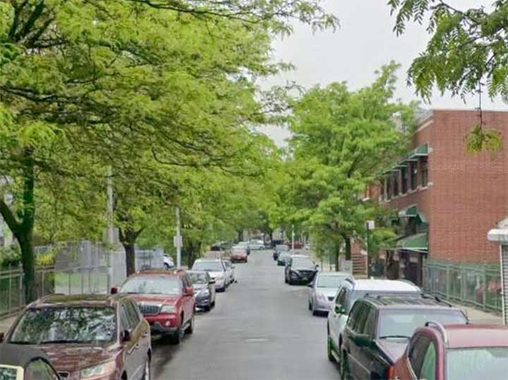
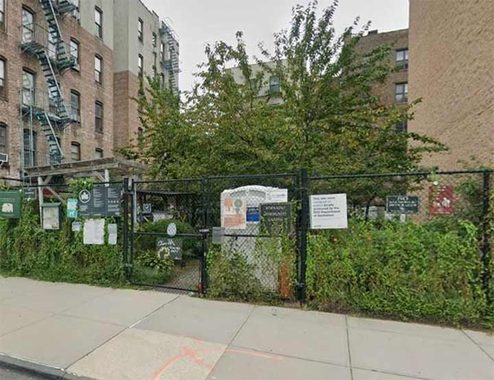
A block to the south of Bronx zoo is the two-block long Hornaday Place named in honor of the zoo founder. It is nondescript architecturally and features a community garden that also carries his name. It is the only street in the city named after someone who worked at this great zoo.
Sergey Kadinsky is the author of Hidden Waters of New York City: A History and Guide to 101 Forgotten Lakes, Ponds, Creeks, and Streams in the Five Boroughs (2016, Countryman Press), adjunct history professor at Touro University and the webmaster of Hidden Waters Blog.
Check out the ForgottenBook (HarperCollins, 2006), as well as Forgotten Queens (Arcadia, 2013). I also have a chapter in the anthology “New York Calling: From Blackout to Bloomberg” (Reaktion, 2007). As always, “comment…as you see fit.” I earn a small payment when you click on any ad on the site, which helps in site upkeep and also aids Greater Astoria Historical Society.
11/29/26