


On the eastern edge of Queens, Alley Pond Park takes up 635 acres from the head of Little Neck Bay on the north to Union Turnpike on its south. A natural forest bisected by highways, the park is named for a steep ravine that widens into the bay. Long before the arrival of urbanization, it was known as The Alley, and like nature’s city, it has high-rises.
The most famous of these is the Alley Pond Giant, a tulip tree that is the tallest and oldest living organism in the city. Estimated to be more than 350 years old, it emerged as a sapling when this land was a Dutch colony. Its height exceeds 130 feet. The tree grows near the bottom of a glacial kettle hole near the interchange of Cross Island Parkway and Long Island Expressway, which slashed through the park in 1940 and 1958, respectively.

Looking at a photo of the interchange’s construction in 1955 from the Municipal Archives, the forest sandwiched between the Oakland Golf & Country Club and the Alley Creek wetland is where the Alley Pond giant stands. At the time, the Long Island Expressway was being extended though this park on its way east into the suburbs.
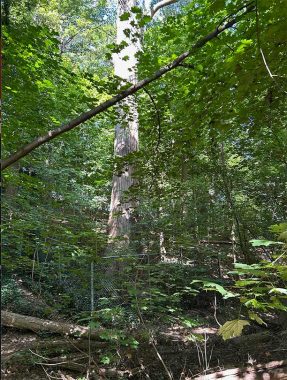
To see this tree, one would descend into the kettle on a footpath, and then into the thickness of the vegetation. The tree is protected by a chain link fence, so that no one would vandalize it or attempt to climb up the trunk.
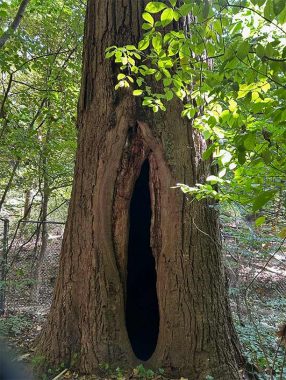
Another reason for the fence is that the trunk has a hollow on its base that can fit a person. It is not a threat to the life of the tree, which adapts to the cavity, which in turn becomes a habitat for small animals and microorganisms. If not for the fence, I can imagine people posing for photos here.
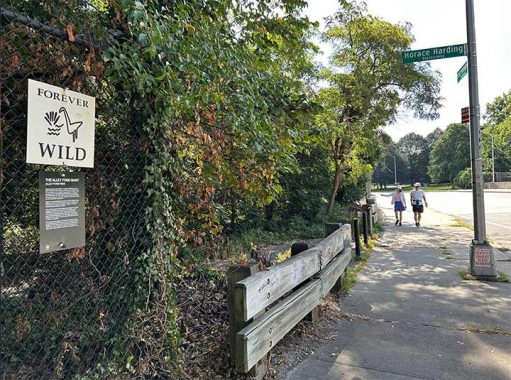
Looking up, one can see its canopy piercing above its neighbors for maximum sunlight. The historic sign for this park hangs on the fence at the corner of Long Island Expressway and East Hampton Boulevard, where the footpath enters the park. It notes that the tree was a witness to President George Washington’s 1790 tour of Long Island. On his visit to nearby communities, the presidential entourage traveled on Northern Boulevard, nearly a mile to the north of this tree. The sign also notes the tree’s scientific name, Liriodendron tulipfera. It brings to mind a smaller park two blocks to the west of this sign.
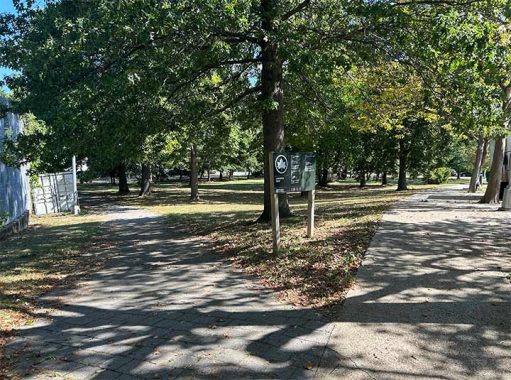
Linnaeus Playground honors 18th century Swedish botanist Carolus Linnaeus. The scientific community recognizes Linnaeus as the founder of the binomial system of species classification. There is also a short street in Flushing named for him, as that neighborhood was famous for its nurseries before becoming part of New York City. This park has a baseball field and a rolling lawn with trees, but no benches, play equipment, or informative signage. It is surrounded by houses built in the 1960s on the former Oakland golf course. A smaller portion of the course was developed as Queensborough Community College. Kevin visited this corner of Bayside for his 2022 essay on Cloverdale Boulevard, another botanical name on the map.

Concerning the city’s famous trees, others such as the late Weeping Beech of Flushing and Camperdown Elm of Prospect Park are more visible and accessible to the public, and that’s why the Alley Pond Giant is the most deserving of an essay on Forgotten-NY. To reach it, one truly must know where to find it as its exact location is not marked on the footpath. NYC Parks has a detailed list of its “great trees” with a map marking the approximate spots for each of these trees.
Sergey Kadinsky is the author of Hidden Waters of New York City: A History and Guide to 101 Forgotten Lakes, Ponds, Creeks, and Streams in the Five Boroughs (2016, Countryman Press), adjunct history professor at Touro University and the webmaster of Hidden Waters Blog.
Check out the ForgottenBook, take a look at the gift shop. As always, “comment…as you see fit.” I earn a small payment when you click on any ad on the site.
9/10/25
11 comments
1970? Must be a typo.
You found us out. Fixed.
Beautiful coverage, thanks! However, George Washington passed through here in 1790, not 1970.
You got us. Fixed.
I don’t think George Washington passed through in 1970, more like 1790.
You caught us. Fixed.
Thank you for this very interesting essay. As I’ve mentioned previously, I had the pleasure of living in the Alley Pond Co-op from 1991-2000. In that time my wife, my daughter & myself had the pleasure o several Park Ranger walking tour through Alley Pond Park. However, you shold edit out an obvious typgraphical error; George Washington’s tour of the area occured in 1790, not 1970:
https://manhassetlibrary.org/site/wp-content/uploads/GeorgeWashingtonsTourOctober14version.pdf
aside from that, well done. Alley Pond Park is a welcoming oasis.
George Washington died in 1979 of a broken heart when the Iranians took all those kids hostages. His last words were said to have been whispered to Kissinger: “shit, these ingrates didn’t listen to me in 1797, and they still don’t listen to me now. No foreign entangling alliances, God dammit!”
I think they better come up with something better than just a chain link
fence around that tree.Theres been a whole spate of famous landmark
trees being deliberately killed or cut down in recent years here and abroad
just out of pure maliciousness.
“Why?Because we can,thats why”
Had been talking to one of my brothers who reminded me of something from when we were young. On Francis Lewis Blvd south of the LIE, at I believe south east side of the intersection of 73rd.
>
> There had been a group of wooden buildings which had the appearance of old military barracks’s. They were surrounded by a tall chain link fence topped with barbed wire. My Dad had thought they might be the remnants of some type of military installation from WW2.
>
> I wondered if there was some relation to the weather service as I recall seeing an anemometer and other equipment and antennae.
>
> I periodically searched for info but so far have not found anything. Wondering if you have any info. I think they were still there through the late ’70’s / early ’80’s. Never saw anyone there as we drove past on numerous occasions.
>
> Also of note, in that area is an old concrete overpass which is a remnant of the Vanderbilt Motor Parkway.
>
> Wanted to say thanks for your efforts. I grew up in Brooklyn and Queens, and have always enjoyed your insights.