


WALK through downtown Flushing and you may feel that you’re in a westernized Chinese-speaking society. This isn’t Hong Kong or Taiwan, but when did the first Chinese-Americans settle in this historic neighborhood? Most writers assert that this community grew in the 1970s, after Taiwanese immigrants felt out of place in Manhattan’s Chinatown, where most residents spoke Cantonese. They were later joined by mainlanders and Hong Kongers. Another story relates to the 1950s, when Reverend Paul Szto was the first Chinese pastor to settle in Queens.

In that decade, the Lum family established their restaurant on Northern Boulevard near Union Street. It stayed in business through 1991. Actor/rapper Awkwafina’s family ran that restaurant, and she speaks proudly of its history and popularity. The address later became a Korean restaurant and the building was torn down in favor of a high-rise in 2024.
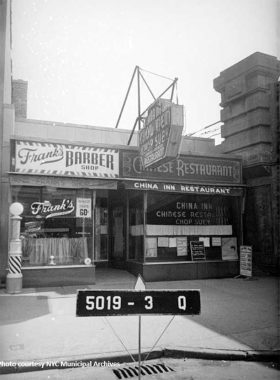
But it wasn’t the first Chinese establishment in Flushing. Recent generations of Flushing residents remember the small shop at 39-20 Main Street as Barone’s Pizza, which was in business from 1971 through 2016. It is easy to assume that the pizzeria predated the Chinese businesses, but a city tax photo from 1939 shows China Inn Restaurant at this site.
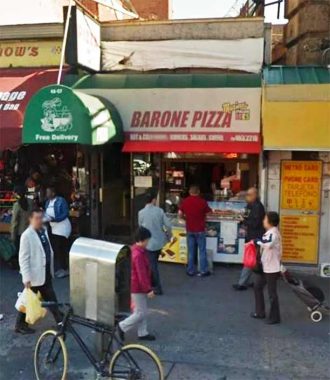
When was this restaurant established and when did it close? Considering its small size, the internet is silent and there’s very little documentation on it. The best sources here would be tax records and phone books.
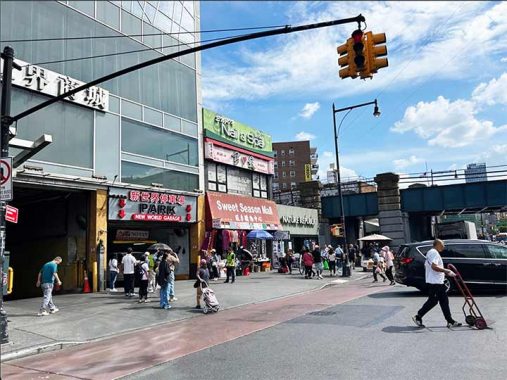
After Barone’s Pizza closed, this store became Nature Republic, a beauty supplies business. For a pizzeria nearby with more longevity, Lucia Pizza on 136-55 Roosevelt Avenue has been serving slices since 1962. On the south side of the tracks was a laundry business run by a Chinese family. Facing discrimination in many other sectors, Chinese immigrants became associated with laundries.
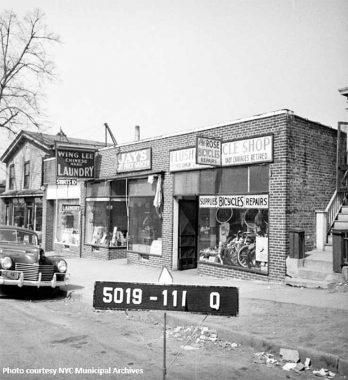
In the 1930s, the city’s Chinese restaurants often advertised Chow Mein and Chop Suey on their signage. Most American consumers did not know what those words meant other than indicating Chinese food. Eventually, those words fell out of usage, going the way of “luncheonette.”

But the China Inn was not the oldest Chinese restaurant in Flushing. An older photo shows a chop suey restaurant one block to the north, also without any online record of its existence. It didn’t last long as this property was redeveloped in 1939 with a clothing store, and then in 2024, a jewelry business built a new structure here.
According to the google AI robot:
Chop suey is a dish from American Chinese cuisine and other forms of overseas Chinese cuisine, generally consisting of meat (usually chicken, pork, beef, shrimp or fish) and eggs, cooked quickly with vegetables such as bean sprouts, cabbage, and celery, and bound in a starch-thickened sauce. It is typically served with rice, but can become the Chinese-American form of chow mein with the substitution of stir-fried noodles for rice.
Chow mein is a dish of Chinese stir-fried noodles with vegetables and sometimes meat or tofu.
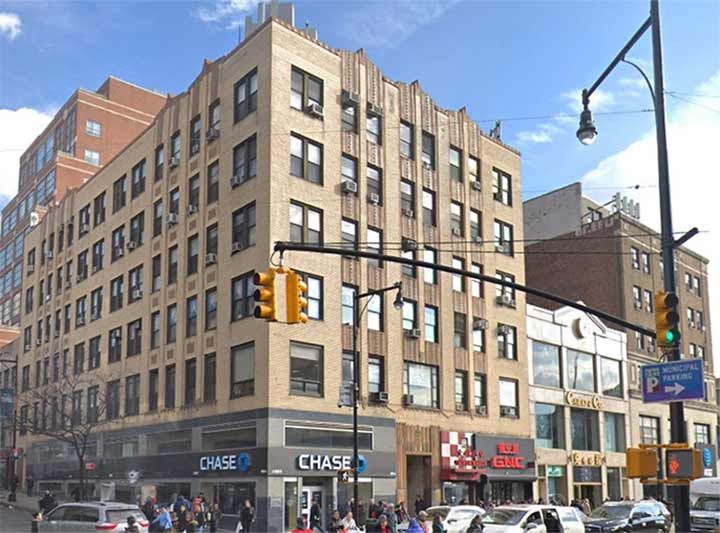
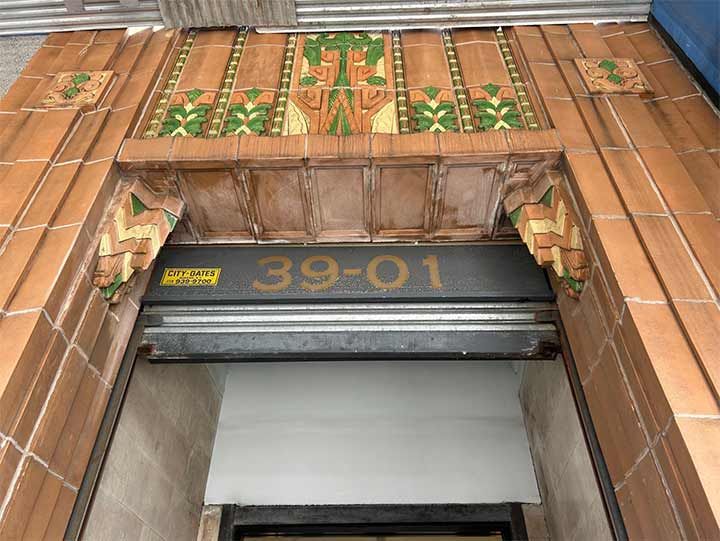
Notably, the restaurant stood between the Art Deco-style Greater Flushing Chamber of Commerce and the Chase Bank buildings. As seen in this 1939 photo taken by the Queens Borough President’s office, these two buildings served as the commercial anchors of downtown Flushing. Greater Flushing Chamber of Commerce formed in 1928, functioning until 2012, when other neighborhood business groups overshadowed its role.

As long as the bank building has stood on the corner of Roosevelt Avenue and Main Street, it has had a clock telling the time. After Chase Bank moved out, the ground floor hosted a Duane Reade and presently it is an AT&T store, with the telecom giant’s logo dutifully accompanying the timepiece.
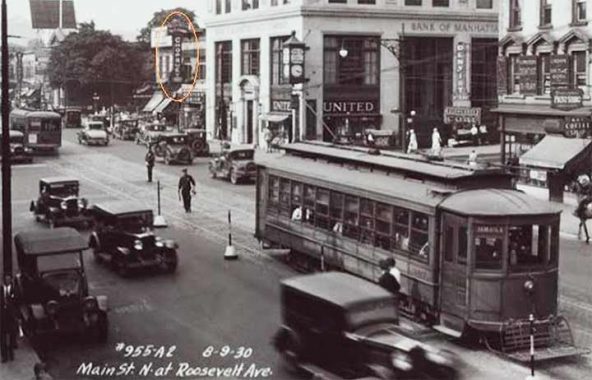
The Chop Suey restaurant on Main Street appears in a photo from 1930. At the time, the Chinese Exclusion Act was in effect and the Gentleman’s Agreement with Japan, severely limiting the number of immigrants from the Far East. Most Chinese-Americans were related to those whose families arrived here before 1882. At the time, the Chamber of Commerce office was not yet built.

A photo from 1944 shows Chung King Tea Room operating at the same time as China Inn. Its namesake may have been the city of Chongqing, an inland city on the Yangtze River that served as China’s capital during World War Two. It stood between two hat shops, of them named for Danbury, Connecticut where hatmaking was as defining of the city as steel was to Pittsburgh and cars to Detroit.
[Those aren’t large snowflakes; likely the negative got wet before it was developed — Ed.]
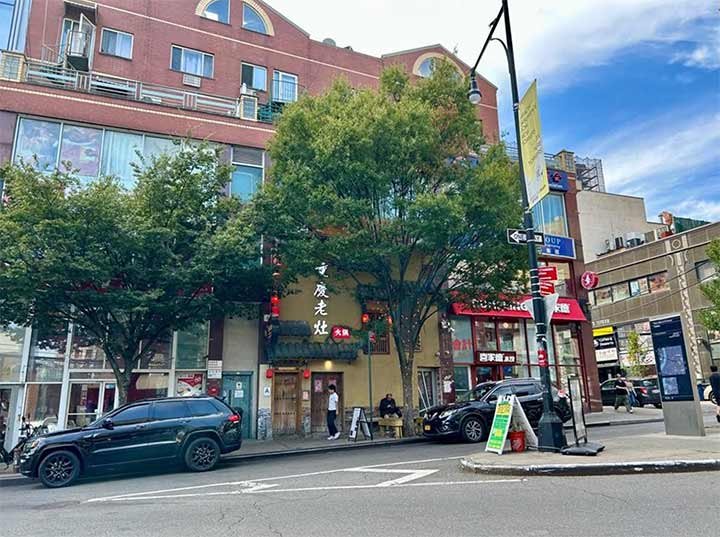
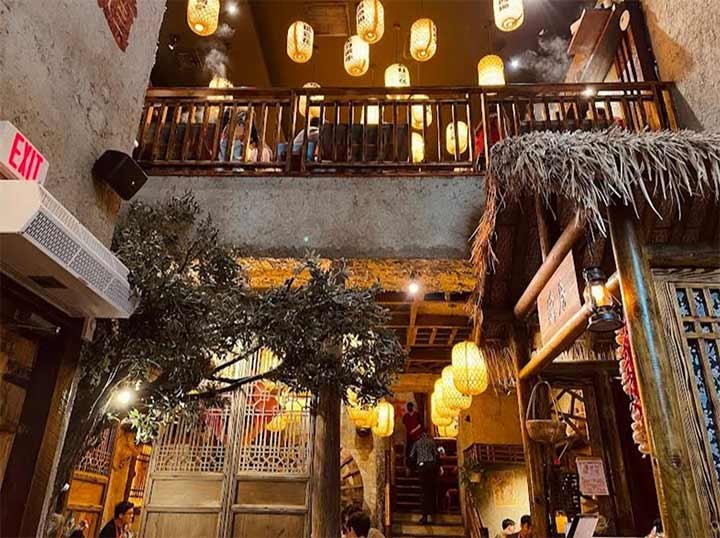
The city’s name brings to mind a recent restaurant, Chongqing Lao Zao on Prince Street, which opened in 2019. Its interior has the look of an old Chinese village, very much in contrast to the glass and steel boxes being built in today’s cities, here and in China. In 2025, it was mentioned in the New York Times as one of the 100 best restaurants in the city.
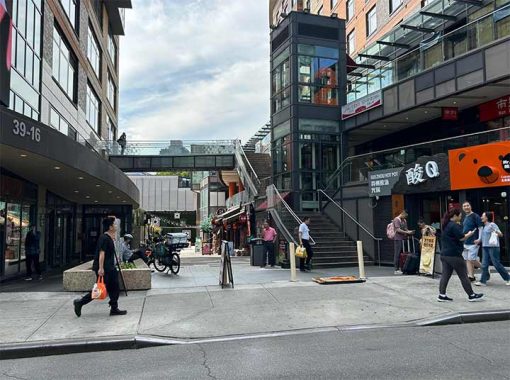
At 39-16 Prince Street is a private alley that hosts three Chinese restaurants as of 2025: Beijing Hot Pot, Szechuan Opera, and Szechuan Mountain House, which all have that wooden traditional village interior. Sometimes the diaspora is as good at preserving traditional architecture as the historical homeland. Also spelled as Sichuan, this mountainous province in southern China invented the kung pao chicken, among other items that are standard on Chinese-American menus.
This alley was developed in 2015 as One Fulton Square. There were many streets named for Fulton across Queens prior to their numerization, but none in this immediate area. Other examples of traditional East Asian architecture include the Chinese Scholar’s Garden at Snug Harbor, Astor Chinese Garden Court at the Metropolitan Museum, and the Korean Buddhist temple on 32nd Avenue.
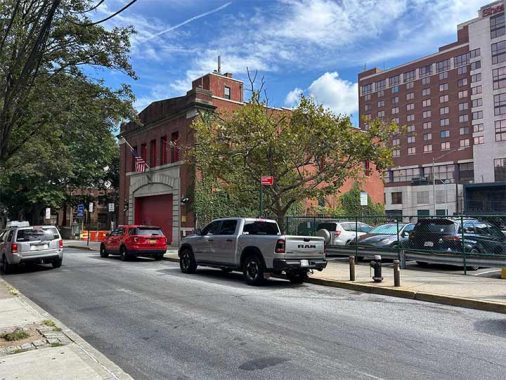
Considering the tight streets of downtown Flushing, it doesn’t appear easy for FDNY EMS Battalion 52 to get there quickly. This building originally functioned as Engine Co. 272, Hook & Ladder Co. 129, which moved to a firehouse on Union Street near Roosevelt Avenue in 1974. The former firehouse here stands in a municipal parking lot that was cleared around it.

From a distance, 39-15 Prince Street appears like any other post-millennial glass box hosting offices and small businesses. It stands next to the 14-story Sheraton LaGuardia East, the largest hotel in downtown Flushing, which opened in 1991 as the tallest structure in Flushing at the time. Its construction was funded by Taiwanese investors who recognized potential in a full-service hotel in an outer borough not located next to an airport.
Also concerning history, Prince Street in Queens is not named for royalty. Its namesake is Robert Prince, a horticulturist who established a commercial nursery here in 1737. He first limited his business to apple, plum, pear and other fruit and flowering trees, and later expanded to shade and ornamental trees. The Linnaean Gardens nursery hosted a British prince during the American Revolution, and President Washington on his 1790 tour of Long Island. It ran as a family business for five generations through 1869. The family’s manuscripts are kept at the USDA National Agricultural Library. A small street, Linnaeus Place, honors the family’s history here. You can find the nursery’s location on my page about Flushing’s long-forgotten Town Pond.
In this neighborhood of immigrants, the Prince nursery introduced the lebanese cedar and chinese magnolia to America, among other species.
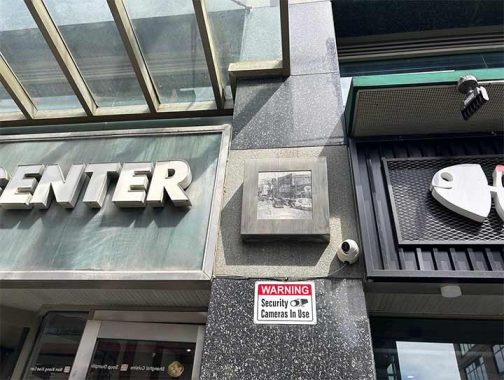
A closer look at 39-15 Prince Street reveals square photos on the building depicting historic downtown Flushing. One such example has the Taft Theater on Main Street, which was named for the former president and demolished in 1955. Don’t despair for the heaviest president, as his name still appears on a high school in the Bronx. Raymond Chan, the architect of Prince Center, is based in Flushing, designing a dozen other buildings within a mile of this address and beyond.
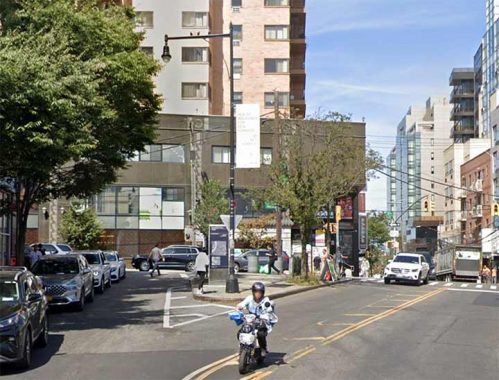
An unnamed triangle in front of Chongqing Lao Zao splits up Prince Street. It was created when Prince Street was extended into Garden Street in the early 20th century. The two names can be seen on maps as early as 1841. Flushing’s horticultural heritage on the map also appears on its south side, where there’s an alphabetical sequence of Ash, Beech, and Cherry streets, ending with Rose.
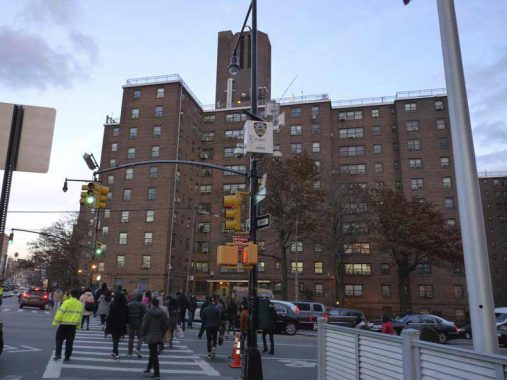
A block west of the downtown nexus of Roosevelt Avenue and Main Street, NYCHA Bland Houses, have a name that evokes the appearance of these low-income projects, but the namesake here is Flushing native James A. Bland (1854-1911) who learned to play the banjo from his father, graduated from Howard University at age 19 and composed nearly 700 minstrel songs, but only a handful had his name as the author. He performed before European royalty but The World’s Greatest Minstrel Man died in poverty.
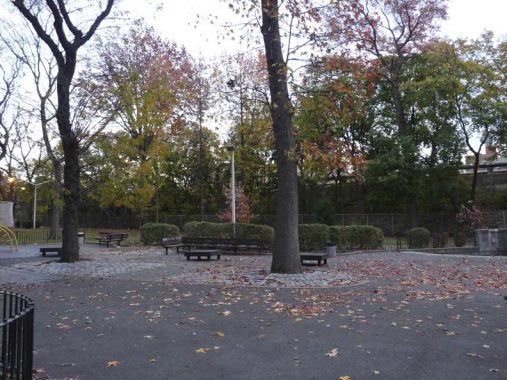
NYCHA projects throughout the city were products of power broker Robert Moses, who often built them in tandem with parks and public schools. Bland Playground is the much-needed green space in this dense downtown. Behind the basketball courts is the Port Washington Branch that offers a quick train ride to Manhattan and points east.
In today’s Flushing, it is not possible to count how many Chinese restaurants are in business within this dense square mile. Along with its largest ethnic group, Flushing has a centuries-old history of Quakers, Dutch, African-Americans, Jews, and others who contributed to its changing downtown cityscape.
You can learn more about the history of downtown Flushing by reading Kevin’s 2015 essay Deep Flushing.
Sergey Kadinsky is the author of Hidden Waters of New York City: A History and Guide to 101 Forgotten Lakes, Ponds, Creeks, and Streams in the Five Boroughs (2016, Countryman Press), adjunct history professor at Touro University and the webmaster of Hidden Waters Blog.
Check out the ForgottenBook, take a look at the gift shop. As always, “comment…as you see fit.” I earn a small payment when you click on any ad on the site.
9/20/25
11 comments
It may be old school, but I find chicken chow mein one of the more satisfying Chinese items, especially for lunch.
Great article and photos as usual from Sergey. My ancestors were on Flushing’s Main Street in the 1690s. Just curious why you called it South Asian. I was expecting to read about Indian, Pakistani, or Bangladeshi (Bangladeshan?) interloping into Flushing, with that headline. But in your article it was all Chinese, who most would consider East Asian, not South.
Since changed to East.
First, let me echo Peter’s post above about Chicken Chow Mein. Always loved it, as well as its first cousin, Moo Goo Gai Pan. The Honeymooners immortal character Ed Norton was a fan of Chinese cuisine. Think of the episode when Norton is trying to set his watch by the aroma of Moo Goo Gai Pan wafting into Ralph Kramden’s apartment.
Second, my wife and I lived in the downtown Flushing area between 1973 and 1978, in an apartment on Union Street near Franklin Ave. We outgrew that place when a second child was on the way, and moved east into Nassau County. I remember Lum’s restaurant, a traditional Cantonese eatery, as well as Old Roma, an old-style Italian red sauce place on 40th Road just west of Main Street.
Andy:
To quote Maurice Chevalier: “Ah yes, I remeber it well” I lived in that area from 1974-78.. Lum’s was great. I also remember a great little Italian restaurant at the intersection of Roosevelt Ave & Northern Blvd. It was located in a shopping mall. It featured a great shrimp marinara. It was family owned; the hostess was the owner’s wife who was dependably cheerful, polite, & efficient. If I remember correctly, dinner for two was less than $20 (including tax & gratuity). Sigh….
there was a laundry building on the corner of 163st and 45 ave that did all the laundry for the chinese laundry’s., i can remember the green delivery trucks.
Lum’s was one of the more “exotic” places to eat out back then. It was a special family treat. DiMaggio’s on Northern Boulevard, near 149th Street, was another dining spot.
In the photo of Wing Lee’s laundry there is a sigh advertising that shirts were laundered for $.10. I tried to imitate the sign by typing “10 cents”, using the cent-symbol, but, alas, it is gone from my keypad (although it remains on my old manual typewriter).
The Chop Suey restaurant on Main Street, shown in two different photos, may have been a more significant establishment than we are assuming. The neon sign in front of it is of significant size and would have been a costly investment for the business.
Lastly, to say “meet me under the clock” would be a common direction recognized by generations of residents of Flushing, Whitestone and Bayside. They might have taken one of the many bus lines to meet “downtown” to go shopping, or to go to a movie at the RKO Keith’s, (or the other theatre on Main Street just south of the LIRR, whose name escapes me), or to take the IRT (yes, we called it that) to go into Manhattan.
The 1930 photo shows streetcars while the 1944 photo shows buses. Gives you an idea how early the replacement was taking place in certain areas. That replacement was a great “conspiracy theory” that had the virtue of actually being, y’know, TRUE. 😉
Except for the people who work there,I have never seen any Chinese
people eating at a Chinese restaurant.
Years ago I was at a Chinese restaurant on Bowery and I knew it was the
real deal because I was the only white guy.It was a cafeteria where you pushed
trays along in front of steam tables.Cant recall seeing anyone using
chopsticks,either
Lived in Flushing on the “hill” when first married for eight years beginning in the mid ‘70’s. Remember eating at Lum’s and going to the movies at the RKO and the Main St. At that time the area had a very large population of people from India. As is typical for NYC neighborhoods, it began to change with a significant number of immigrants from Korea and It became known as Little Seoul. Chinese began moving into the area in large numbers in the ‘80’s. Who knows how it will change in the future.
My husband and I lived in Flushing, on 41st Ave., in the early 1980s when we were first married. This was when Flushing was rapidly becoming a Chinese neighborhood; however, there were also sizeable Korean and Indian populations at that time. We would love to go into Korean groceries and just buy stuff without knowing what exactly we were getting, as the labels were all in Korean…Also have fond memories of eating at Lum’s. Thanks for the memories!