
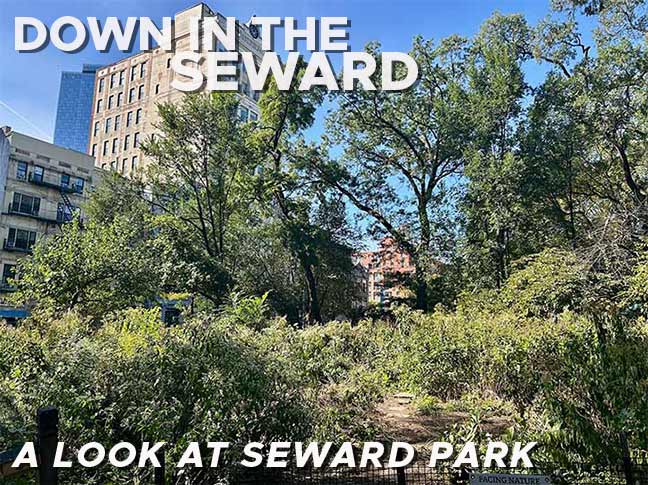


WE’VE been to the Lower East Side many times in the history of Forgotten-NY and each time we return there’s something old that we haven’t yet documented. The Tenement Museum will always be here, landmarked and open to the public, while identical 19th century walk-ups gradually fall to the wrecking crews in favor of glassy condo towers. Amidst the changing cityscape, Seward Park has been a constant feature since 1903.

It remains as crowded today as when it opened and on account of the foot traffic, the street map mosaic containing the spray shower is heavily deteriorated and could face the same fate as the late World’s Fair mosaics of Flushing Meadows. They simply cannot survive outdoors, being subject to weather damage and foot traffic.
[Untapped Cities claims those Flushing Meadows mosaics are in storage; hopefully, they can again be shown somewhere. –Ed.]

The mosaic was installed as part of a reconstruction of Seward Park in 2001, featuring an old map of the neighborhood with quotations provided by the Tenement Museum. Mosaics are difficult to conserve, as tiles must match the size and color of the missing pieces. When damage occurs, the fills the space with concrete or simply leaves it blank. In a way, the disappearing grid of this old map evokes the Lower East Side of the past century, when blocks of tenements were condemned and transformed into superblocks for housing projects, co-ops, and parks.
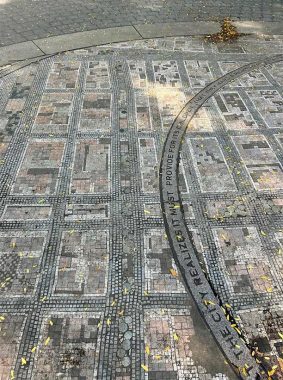
There is no date given for this map, but it is clearly after 1942, when Allen Street was widened. At the word “must” is Delancey Street, whose median space was designated as Schiff Parkway, in honor of philanthropist Jacob H. Schiff, a German-born financier who was influential in the city’s commercial and political scenes.
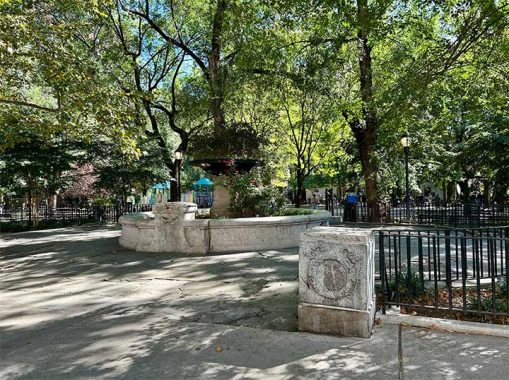
This Upper East Side millionaire identified with the poor Jews of the Lower East Side not only through his philanthropy but also by walking its streets without being identified. His name also appears on an uptown playground. At Seward Park, there is a dry fountain serving as a planter, offering no clues on its connection to Schiff.
Donated by Schiff to the city, the fountain initially stood at Straus Square, with local children splashing in it, not yet having public pools as an alternative. In 1953, a war memorial column was dedicated at this site.
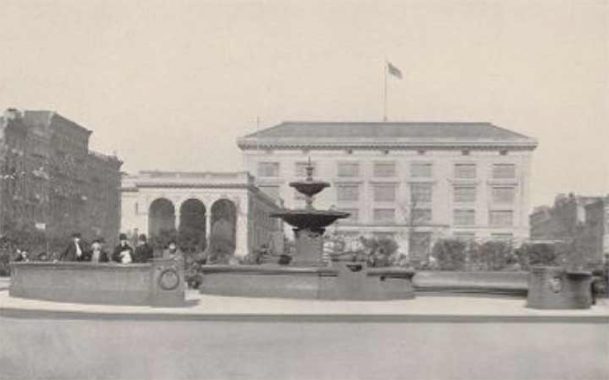
An undated photo from the NYPL Digital Collections shows the fountain in an earlier time, when it spouted water. Honoring Schiff, it was designed by Arnold W. Brunner, a Beaux Arts architect who also designed the Asser Levy Bathhouse. In the background is the old Public School 62, which later became Seward Park High School. In the 1930s, This school received its present building on the opposite side of Essex Street.
Another beaux arts element in this park was its original field house, which was nearly identical to its contemporaries in Thomas Jefferson Park, Tompkins Square Park, Union Square Park, and McGolrick Park. It was demolished in the 1930s in favor of an updated structure placed inside the park.
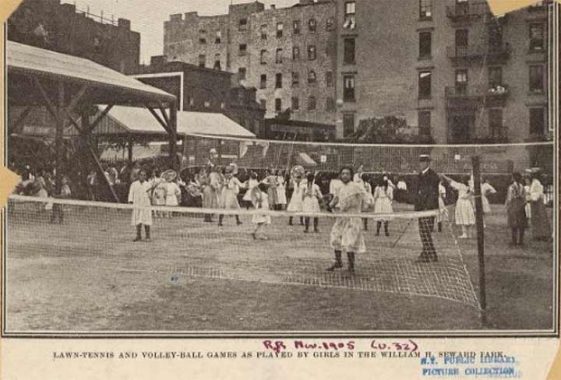
The park serves as a national precedent, having built the first public urban playground when it opened. It had a maypole and seesaws, which are distant memories for parkgoers. Its namesake was a former New York governor and senator, who later served as the Secretary of State best known for purchasing Alaska from the Russians.
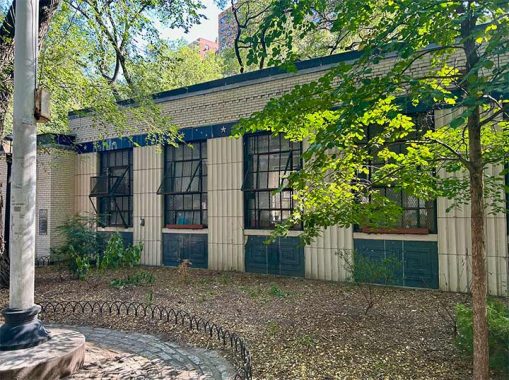
The present field house opened in 1941. During the reconstruction of East River Park, it hosted the LES Ecology Center but presently the space is not in use. The Art Deco design evokes Greek elements and patriotic stars.

The landmarked NYPL Seward Park Branch shares its name with the park, a philanthropic gift from Andrew Carnegie. The pedestrian areas bordering the library preserve portions of Jefferson and Division Streets demapped in the 1950s for the Seward Park co-ops. Kevin has a detailed essay explaining the latter’s name.
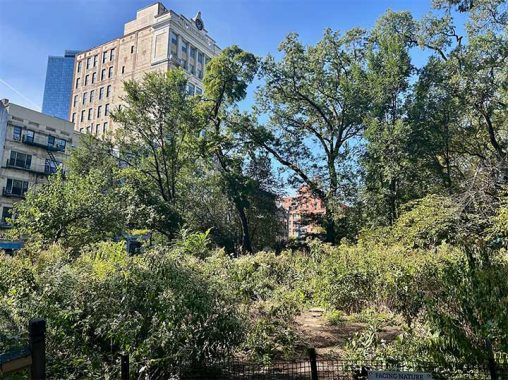
What’s old is new again, as the southeast corner of the park near the library has a community garden maintained by the Seward Park Conservancy. In the prewar years, this exact spot had a school farm garden. The landmarked tower facing this garden was built for the progressive newspaper The Forward and now contains luxury apartments.
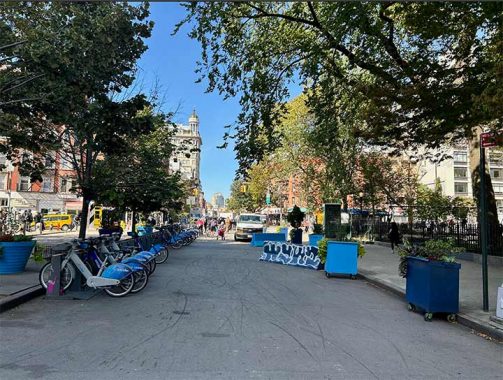
The portion of Canal Street on the south side of Seward Park was pedestrianized in 2017 and given a Citibike corral, connecting the park with the triangular Straus Square. Bound by Canal and Essex streets, and East Broadway, Kevin described this triangle in detail in 2013 and in 2023. Prior to its present name, it was known as Rutgers Square, the only park in the area prior to Seward Park. It hosted the Schiff Fountain before its relocation to the larger park across the street.

Being located on an intersection facing the offices of the Jewish Daily Forward, it was a frequent venue for progressive rallies, such as this gathering in June 1917, opposing the draft during World War One. As a political gathering spot, it appeared in early 20th century news reports almost as often as Union Square, particularly because it is in the heart of this very activist neighborhood.

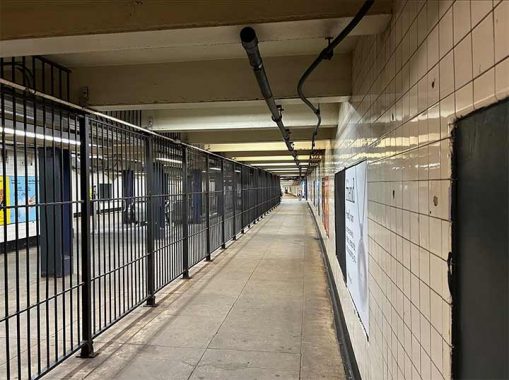
Underneath Straus Square is the entrance to the East Broadway station on the F train. Being close to the East River, it is very deep underground and having been built during the Great Depression, offers no ornamentation in its design. In 1992, artist Noel Copeland and students of the Henry Street Settlement installed a set of panels in this otherwise boring station. The subway tunnel connecting this station to Brooklyn is the Rutgers Street Tunnel, whose namesake street honors the neighborhood’s colonial landowner.
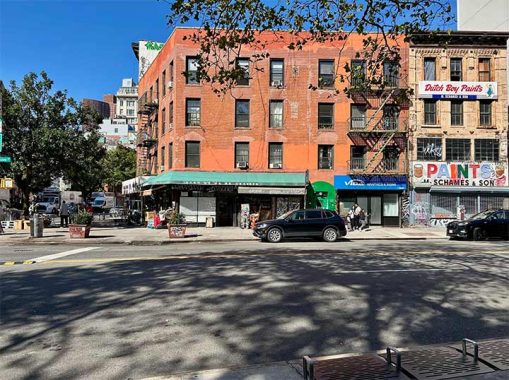
Across Essex Street is a building with a diagonal corner, marking a vanished piece of Division Street that ran through the footprint of Seward Park. How old is the M. Schames paint store seen here? (The Indispensable) Walter Grutchfeld knows the answer. The century-old paint business relocated to Delancey Street in 2010, when the city declared the building next to it unsafe, and it was then demolished.

The site of 5 Essex Street has been empty since then, with bamboo planted recently for the Chinatown look. In Oct. 2024, this “alley” hosted a Chinese opera performance, its location billed as the Bamboo Garden.

Looking back in time, advocacy for the creation of this park occurred over many years until the city acquired the site in 1897. At the Harvard University collection is a map of the park, showing an athletic field and winding paths hemmed in by the street grid.
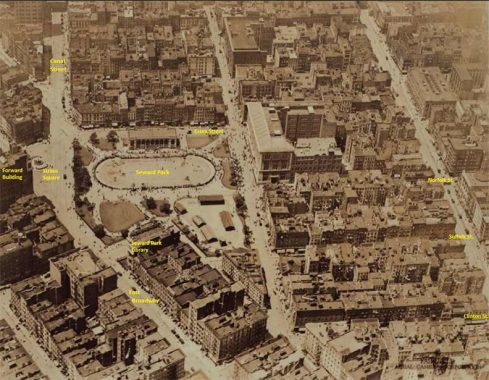
A view of the park from the 1930s shows the crowded neighborhood surrounding the park. Later designated as the Seward Park Urban Renewal Area (SPURA), these ten blocks were razed and replaced with four towers-in-the park superblocks. Designed to retain middle-class families in the neighborhood, they were developed as the Seward Park Co-op. For more images of this “slum clearance,” see my earlier essay about Essex Market.


By the 1950s, housing projects were beginning to eliminate some of the old tenements surrounding this park. Eventually, the park would be facing high-rise apartments rather than old walk ups. Circled here is the Rutgers Bathhouse, which would be saved, only to be demolished in 2019.
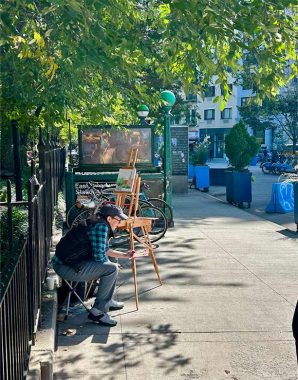
While the park’s mosaics are in danger, it will always appear the same in paintings by social expressionist painters Ben Shahn and Maurice Becker, and ashcan artist Jerome Myers. The park continues in its role as an outdoor studio as I passed by an artist capturing the streetscape around the park.
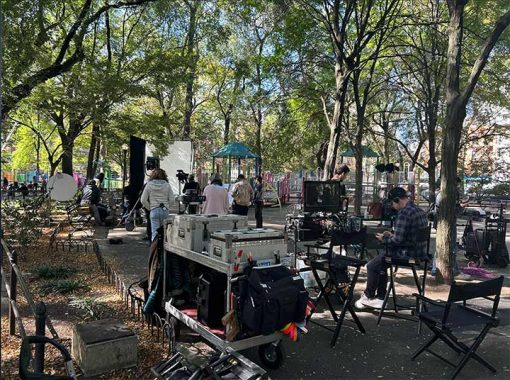
On my visit to the park, filmmakers were present. When I asked who was starring, I was only told that it would be a comedy movie without any further details. No alterations needed to be done to this park for this movie, in contrast to an earlier Lower East Side essay that I wrote relating to Timothée Chalamet.
You can learn more about the history of this neighborhood by visiting each of the hyperlinks posted in the essay above.
Sergey Kadinsky is the author of Hidden Waters of New York City: A History and Guide to 101 Forgotten Lakes, Ponds, Creeks, and Streams in the Five Boroughs (2016, Countryman Press), adjunct history professor at Touro University and the webmaster of Hidden Waters Blog.
Check out the ForgottenBook, take a look at the gift shop. As always, “comment…as you see fit.” I earn a small payment when you click on any ad on the site.
10/11/25
3 comments
At the dedication of the new Seward Park playground,the kids couldnt
take it any longer.Before the last politico could even finish his speech
they burst through the cordon holding them back and swarmed the new
playground.The police were powerless to stop them.It was a children’s
riot.
Fascinating urban history from you, as usual. Have you ever considered writing up Squibb Park on Columbia Heights in Brooklyn? I remember when it had a wading pool, seesaws, jungle jim and more.
There’s a new biography of Seward that I heard mentioned on “All Of It” radio program on WNYC recently, called “The Sewards of New York
A Biography of a Leading American Political Family” by Thomas P. Slaughter. I’ve put it on my book list to read in the future.
https://www.cornellpress.cornell.edu/book/9781501782657/the-sewards-of-new-york/