

MANY of the Harlem River bridges have been lost over the years, including the Third Avenue and Willis Avenue bridges, which were replaced with new bridges several years ago. Before I knew they would be replaced, I repeatedly crossed the Harlem River over its bridges way back in 2009. The longstanding Madison Avenue, Macombs Dam, 145th Street, and University Heights bridges, built in the early 20th Century and designed by Alfred Pancoast Boller, are still in place.
Boller’s wikipedia entry is short, but brimming with NYC history.
Alfred Pancoast Boller (February 23, 1840 – December 9, 1912) was a civil engineer and bridge designer. He was the chief engineer on several bridge building projects during the late 1800 and neary 1900s. Born in Philadelphia, Pennsylvania in the United States, Boller graduated from the University of Pennsylvania in Philadelphia and from Rensselaer Polytechnic Institute in Troy,New York. He co-founded an engineering company, Boller & Hodge, that was based in New York City. Boller designed the third Market Street Bridge in Williamsport, Pennsylvania, the Madison Avenue and University Heights Bridges in New York City and the Connecticut River Bridge in Connecticut. He was also the chief engineer of Manhattan‘s elevated railroads.
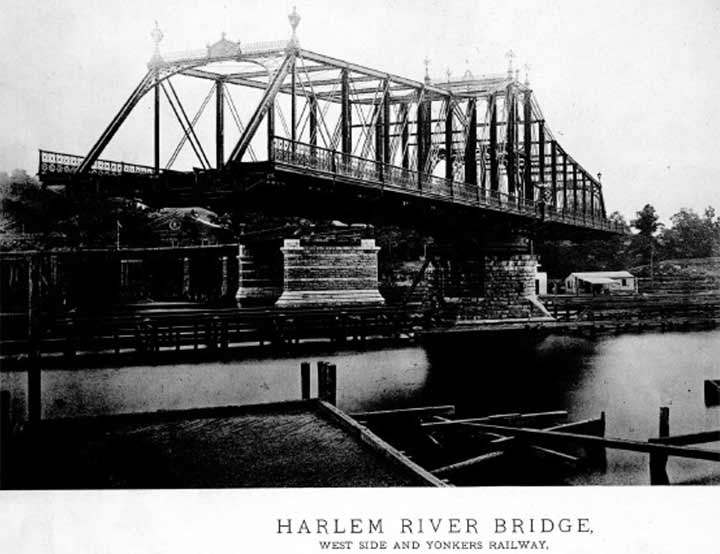
One of Boller’s bridges is truly lost, the Putnam Bridge that spanned the Harlem River between the northern end of 8th Avenue (now Frederick Douglass Boulevard) and Sedgwick Avenue in the Bronx. It carried the 9th Avenue Elevated across the river, where it hooked up with the elevated Lexington Avenue line (the #4 train) above Jerome Avenue. Once in the Bronx, the 9th Avenue el went into. atunnel under the Bronx’s hilly topography, and way back in 1999 I visited this tunnel with other railbuffs (by then it was filled with car wrecks) before the City dragged out the wrecks and sealed the tunnel.

The Putnam Bridge opened in 1881 and originally carried tracks of the New York City & Northern Railroad and its successor, New York and Putnam RR to Manhattan before its southern terminal was cut back to the Sedgwick Avenue station in 1918. Later, the 9th Avenue El tracks were added to the bridge, and they were in use until 1958, when the last remnant of the el was the Polo Grounds Shuttle. When the Giants moved to San Francisco, that last bit of the el was retired and the bridge itself was torn down in 1960 after it was considered impractical to make it a roadway. From the beginning, pedestrians had had access and were able to cross the river by walking on the bridge. The New York and Putnam carried passenger service in the Bronx and Westchester until 1958 and freight until 1970. Its remains are now a nature trail in Van Cortlandt Park.
Check out the ForgottenBook, take a look at the gift shop. As always, “comment…as you see fit.” I earn a small payment when you click on any ad on the site.
10/17/25
6 comments
Did Cromwell Ave actually exist south of McClellan Ave?
I did a Polo Grounds Shuttle Jane’s Walk in 2019 tracing its route. Hard to believe there’s an abandoned tunnel underfoot there.
I did the December 1999 and January walking tours. Took lots of photos. I couldn’t believe how dark that tunnel was if you didn’t have a flashlight
.I brought my 3 “D” cell flashlight to navigate the darkness. Today’s LED flashlights are like night and day.
Excellent posting. The 9th Ave. elevated tracks were added to the Putnam Bridge as part of the Dual Contracts expansion of New York’s rapid transit system; the IRT took over the tracks from the New York Central RR, which simply relocated its Putnam Division train terminal to a new station on the east bank of the Harlem River, where the Major Deegan Expressway is today. Originally, the Putnam Division and its predecessors terminated at 155th Street, right outside the Polo Grounds.
The Hagstrom Map reproduced in the posting is from after 1918, when the IRT began using the bridge, and before 1923, when the original Yankee Stadium opened. Note that the map does not show the Stadium; long-gone Doughty Street cuts through the stadium site. The current stadium immediately north, opened in 2009, occupies the right of way of the old 9th Ave. el, just west of where it joined the #4 line along River Avenue. The stub of that connection is still there today.
Yes it’s the 1922 edition
Probably a bigger source of traffic for the shuttle were the Putnam Division trains terminating at Sedgwick. This service was abandoned in 1958.