
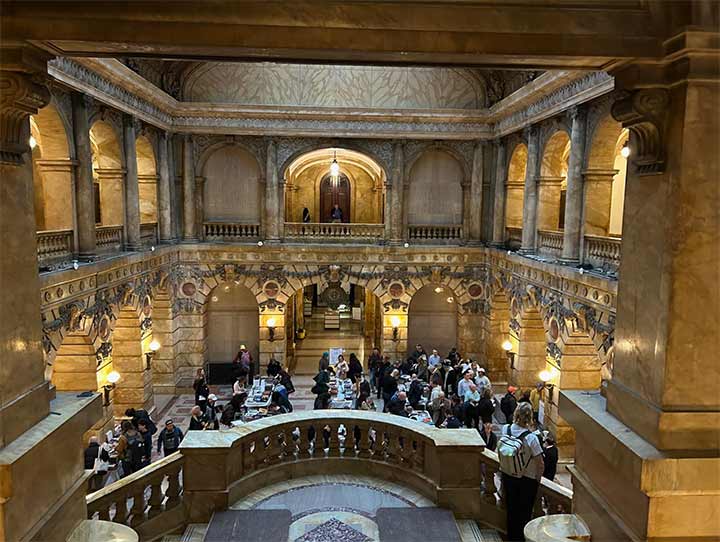


THE city’s Hall of Records at 31 Chambers Street is an unlikely candidate for a Forgotten-NY essay as its exterior and interior are landmarked, it appeared in numerous movies, and there are detailed videos discussing its design and history.
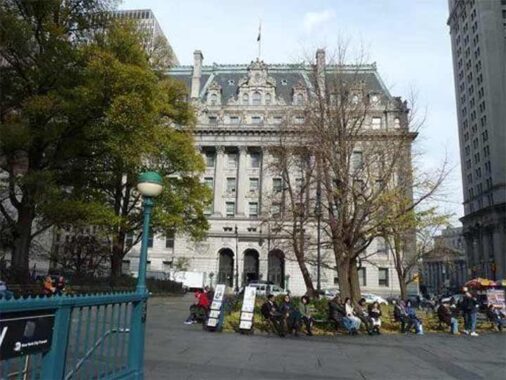
Kevin wrote about this building, which also hosts the Manhattan Surrogate’s Court, on his visit to Elk Street in 2021, looking up at its statues of famous New Yorkers and on a walk around City Hall Park in 2024. This building marks the start of Centre Street and Chambers Street. With every mention of the Hall of Records, Kevin urged readers to see its interior and I had my opportunity on Nov. 7, 2025, when the Municipal Archives had a sale to unload duplicate and unnecessary books.
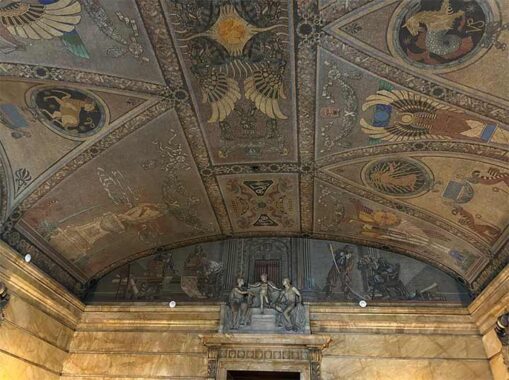
The building’s exterior was clad in construction scaffolding that morning so there wasn’t much to see, but in the entrance lobby, buyers standing in line for the security check looked up at the mosaic of the zodiac symbols separated by wreath designs and partially mummified ancient Egyptians. The ceiling is the work of muralist William De Leftwich Dodge, whose portfolio of interiors includes the Library of Congress, New York State Capitol, and Buffalo City Hall.


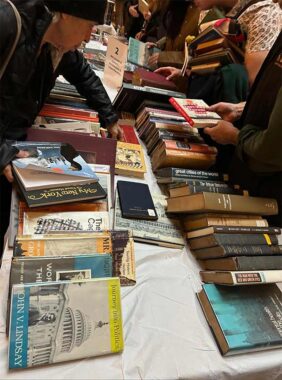
The books did not disappoint. One table featured memoirs by former mayors, agency commissioners, and urban planners. John V. Lindsay ran this city from 1966 to 1973, a very tumultuous period. This statuesque Manhattanite stood at 6’4”.
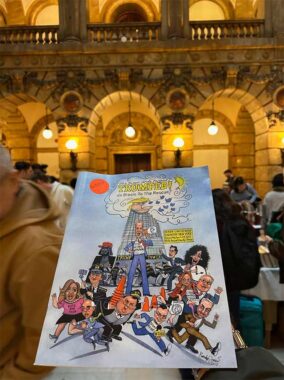
Reminiscent of Lindsey in terms of liberal politics and height was Bill De Blasio, who topped Lindsay by an inch. He was the city’s 109th mayor, serving from 2014 to 2021. Similar to the White House Correspondents Dinner, the City Hall press corps has the Inner Circle Show every year in which reporters roast the mayor with parodies of pop songs and Broadway show tunes. De Blasio’s tenure overlapped with President Trump’s first term, two outside personalities that often clashed on social media and city-federal policies.
In the background here, the cost of the marble interior was criticized by mayor Robert Van Wyck. “We don’t want an opera house made out of what is intended to be an office building,” he famously said.
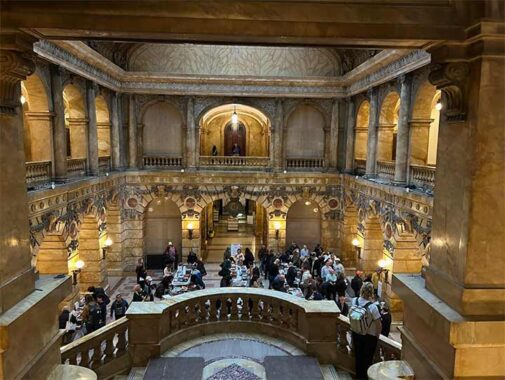
Van Wyck recognized that John Rochester Thomas was inspired by the Paris Opera House and the beaux arts style that was sweeping the nation in the early 20th century. Thomas was initially selected to design a new City Hall but after state lawmakers preserved the 1812 seat of government by law, his design was instead used to build the Hall of Records.
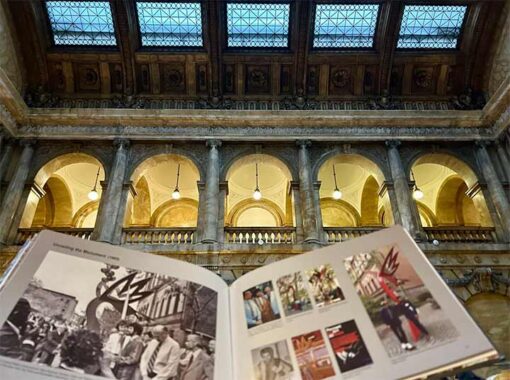
Another book which caught my attention was artist Jorge Luis Rodriguez’s portfolio. In 1895, he was the first artist selected to design a public artwork under the city’s Percent for Art law, with a sculpture in an East Harlem park. Looking up, the great hall has a skylight that was beautifully restored in 2020 after many years of leaking rain water.
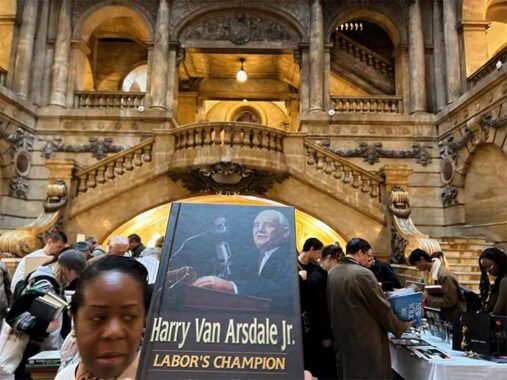
The staircase overlooking the great hall brought the Grand Central Terminal to mind, as it has an identical layout. This book celebrates Harry van Arsdale Jr, first president of the New York City Central Labor Council, who rose to power through the electricians union which built the Electchester co-ops in Queens. He led contract negotiations and his endorsement in elections carried weight. He also revived the city’s Labor Day Parade. As a former resident of Electchester and a union member since college, he’s one of my favorite historical New Yorkers.
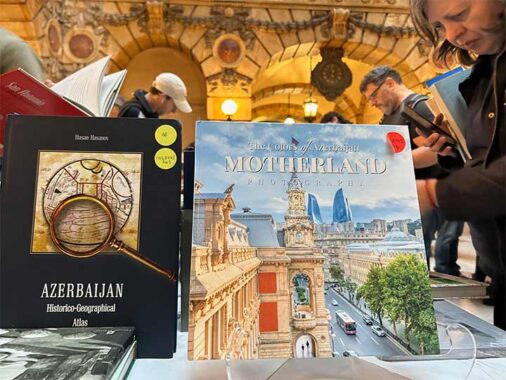
In terms of beaux arts architecture, the sale had books from other cities including oil-rich Baku, the capital of Azerbaijan. I highly recommend visiting this scenic country, sandwiched between Russia and Iran, where Asia and Europe meet.
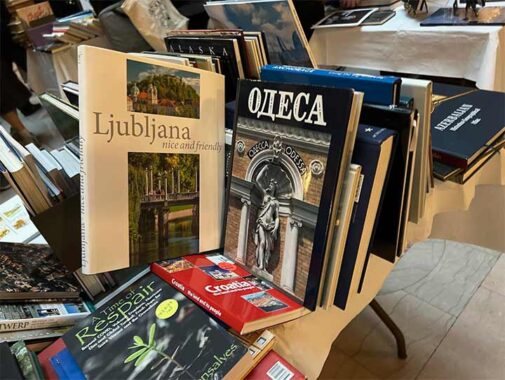
Another table had books from Eastern Europe, where major cities also have their examples of classicist architecture, civic palaces, and opera houses. Eric Adams, the city’s 110th mayor, often compared other world cities to New York.
“New York is the Islamabad of America,” he said during a flag-raising in New York with the Pakistani consul. “New York is the Tel Aviv of America,” he said on a visit to Israel. On the topic of Mexico: “New York is the Mexico City of America,” on a visit to a Mexican bakery in Woodside.
Odesa would certainly be the Ukrainian counterpart to New York for its ethnic diversity, historic Jewish community, economic role as a seaport, and beaux arts architecture. I haven’t been there since I was a toddler visiting my great-grandparents.
Ljubljana is the capital of Slovenia, the most peaceful of the former Yugoslav republics. The “city of love” is pronounced as Loob-Liana, where Melania Trump attended college before dropping out to pursue a modeling career.

Outside the Hall of Records, on the corner of Elk and Chambers streets is a city-owned parking lot. Why hasn’t it been developed yet? Certainly, some municipal workers commute to work by car, or perhaps it was left bare because there are bodies buried underneath, relating to the nearby African Burial Ground and the Poor House that stood on the site of the Tweed Courthouse. Prior to the revolution, the British constructed a defensive wall along Chambers Street, which was then the northern limit of the developed city.
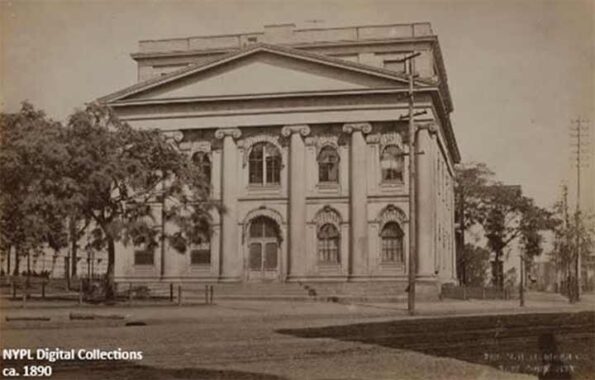
The city’s original Hall of Records stood across the street in City Hall Park, a former prison dating to 1756 that was inadequate and unsafe for holding the paperwork of a growing metropolis. Daytonian in Manhattan describes the old Hall of Records in great detail. The beautification of the park and subway construction doomed the historic building.
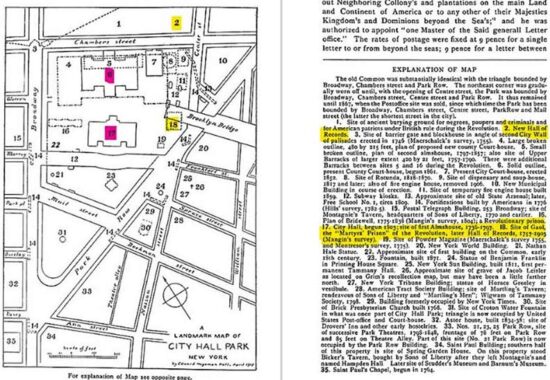
The 1910 historical survey of the park by Edward Hagaman Hall shows other buildings that stood in the park over the centuries. Highlighted in yellow are the present and former Hall of Records, and in maroon, the only two buildings presently inside the park: City Hall and the Tweed Courthouse.

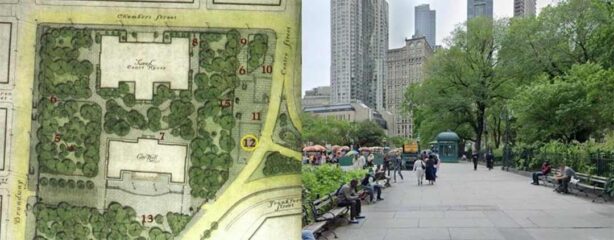
When the old Hall of Records was facing demolition, New-York Historical Society and the American Scenic and Historic Preservation Society argued that the building deserved to be saved on account of its longevity and role during the American Revolution. “Gratitude and pride alike dictate that in some form and in some place these historic stones should be preserved,” they argued. Their wish was granted in 1998, when the park was updated with paving stones marking the site of this old building and other long-gone structures inside the park, along with markers describing their history.
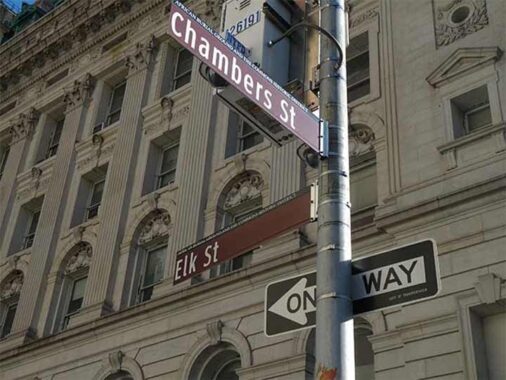
Before returning to work, I had one more question to resolve, the name of Chambers Street. I used to think that it refers to the judicial chambers of the courthouses here, or the City Council chamber. But it’s as much a wrong assumption as Holland Tunnel being named for a country or Outerbridge Crossing for its far-off location.
The street that carries the address of the Hall of Records is named for colonial period attorney John Chambers. It is a fitting name as this street used to have the offices of newspapers and Chambers represented John Peter Zenger in the 1735 trial that set the precedent for the freedom to criticize the government.
Sergey Kadinsky is the author of Hidden Waters of New York City: A History and Guide to 101 Forgotten Lakes, Ponds, Creeks, and Streams in the Five Boroughs (2016, Countryman Press), adjunct history professor at Touro University and the webmaster of Hidden Waters Blog.
Check out the ForgottenBook, take a look at the gift shop. As always, “comment…as you see fit.” I earn a small payment when you click on any ad on the site.
11/15/2025
4 comments
Edifying as usual. particularly that map toward the end.
When you think of all the money that was poured into that thing
that could have been used to build hospitals or schools.
Its just another Tweed courthouse.
It’s not just another Tweed Courthouse. While the Hall of Records Building was certainly built in a grand, and ornate, style, I have never seen suggestions of graft or corruption connected to its construction. The Tweed Courthouse, on the other hand, is not grand, or ornate, but was the vehicle by which massive sums of money went in to the pockets of Boss Tweed and his cronies. Mayor Van Wyck’s comment on the cost of using marble on the Hall of Records Building’s interior was a concern about expense. On the other extreme, Boss Tweed bought a marble quarry which sold much of the marble used in the Tweed Courthouse construction. Construction of the Tweed Courthouse is the greatest example of political machine corruption in the history of New York City and New York State. I daresay it may be the worst in US history.
Have you seen whats going on now?