

HOPING I’ll be able to return to lengthy walks sometime soon but fortunately, I do have a backlog of photos such as the 133 I got during a June 2024 walk from Brooklyn Heights to Prospect Park, primarily using Hicks, Columbia, Union, Sackett Streets and Berkeley Place. As with the previous post from Sunset Park to Maspeth, I’ll need to divide things among multiple posts. As with all my forays, I seek out bits of infrastructure and architecture I find interesting, as I hope that’s what you’re seeking as well. This will be somewhat shorter than the previous two segments, as I meander up Sackett Street and Berkeley Place.
GOOGLE MAP: BROOKLYN HEIGHTS TO PROSPECT PARK
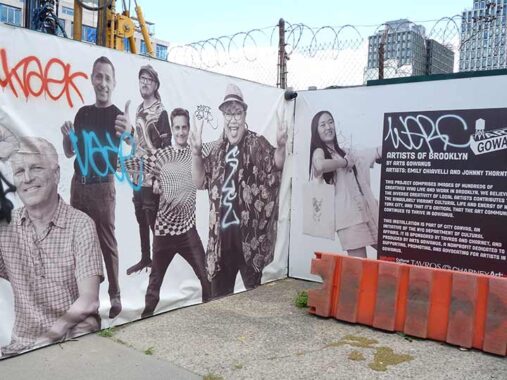
I had left off at the Union Street Bridge at the end of Part 2, and I will resume a block north on Sackett presently. Since construction fencing tends to stay up for years, developers have begun to try to make them a little more interesting. Here in front of what will be #300 Nevins Street are dozens of photos of Shiny Happy People that, at first I thought were stock images, showing the kinds of people who will be buying apartments when it’s finished. The truth is a bit hazier. The images are real area residents, “creatives” or artists, as a sign on one panel says. Somehow, I doubt a whole lot of artists will be able to buy the “affordable” apartments in #300 Nevins as well as the two greenish high rises, Society Brooklyn and Sackett Place, going up at Bond and Sackett Streets in the middle of the new Gowanus Highrise Section.
Since these photos were obtained in 2024, I presume additional progress has been made at #300 Nevins.
I discuss the Sackett/Nevins area on this FNY page. Pressing on:
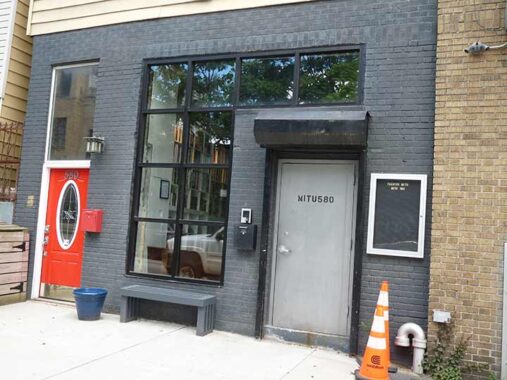
If you think all performance theaters looks like the ones in the Times Square area, here’s a different-looking one, MITU580, #580 Sackett Street will change your mind somewhat:
MITU580 is a multi-use art space in Brooklyn, NY founded and operated by interdisciplinary performance company, Mitu. The company has retrofitted this former glass recycling facility into 2,400 square feet of flexible space intended to intersect the fields of performance, installation art, new-media, and design. MITU580 is at once a studio space and performance venue to house all of Mitu’s programming, as well as a state-of-the-art production facility capable of hosting all types of innovative performances and events. This facility is a unique gathering place where interdisciplinary arts practice is interrogated, incubated, and produced. [Theatremitu]
Interior photos available at the link.
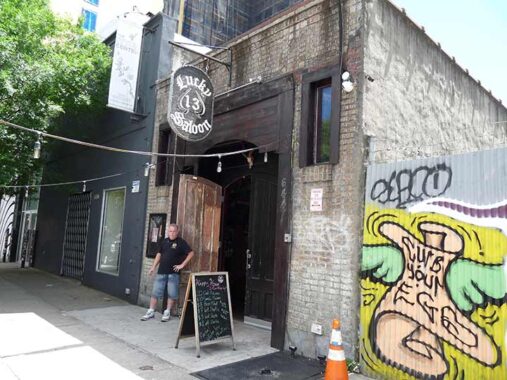
I didn’t stop into Lucky 13, #644 Sackett, but it’s a dive in every sense: “Heavy metal. Punk. Hardcore. Rock’n’Roll. $5 cans o’beer and gogo dancers all night, every night. Never a cover to get into the bar itself, only at the back room door for shows. FUN.” More photos here.
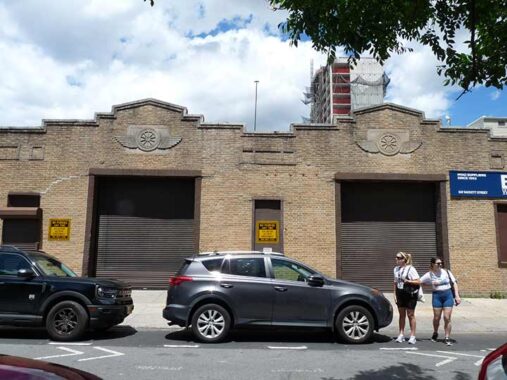
Many early 20th Century garages are marked by spoked-wheel and wings symbolism, resembling the logo of the Detroit Red Wings.
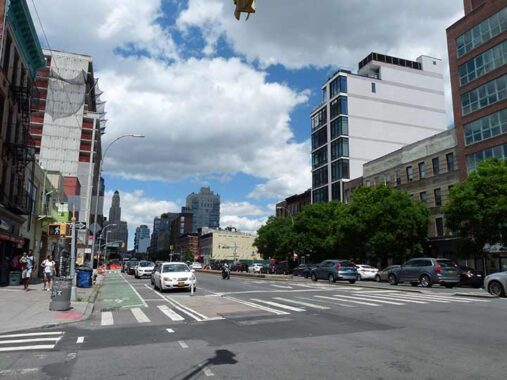
4th Avenue in the Gowanus/Park Slope area, seen here looking north, has largely changed since FNY surveyed it back in 2006, becoming a high-rise haven with more and more going up each year.
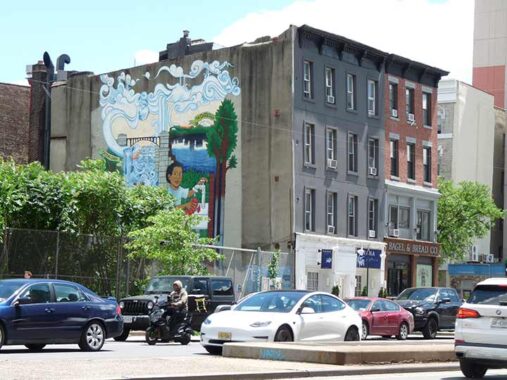
Though some of 4th Avenue’s large area murals have been painted over some of its old spirit remains here on this exposed wall between Sackett and Union Street.


I was attracted to this multifamily building, #716 Sackett with twin bays either side of the entrance with intricate moldings and peaked pediments on the ground floor windows. It was actually once one of a pair of identical buildings, but #714 was torn down and replaced with a more practical-looking brick building some decades ago. This section is the easternmost block of Sackett, but only because it changes its name at 5th Avenue.


If you look at maps of the City of Brooklyn from the mid-1800s, you see, though, that Sackett Street and its parallel streets Butler, Baltic, Douglas(s), Degraw, and Sackett once extended all the way east into Bedford-Stuyvesant. Only later did they receive their current names, all of them Places, not Streets.
What happened? Murder happened.
On March 20, 1873, Lizzie Lloyd King, a.k.a. Kate Stoddard, shot dead her boyfriend, Charles Goodrich, who wished to break off the relationship, at 731 Degraw, just west of 5th Avenue (the address has been renumbered since) . She fled with several of Goodrich’s possessions before returning the next day to clean and dress the corpse before going to her job at a hat factory. Just another day in Park Slope. After a three-month investigation, aided by Stoddard’s friend Mary Handley, the murderer was apprehended and sentenced to the State Lunatic Asylum in Auburn, NY; the building still stands. A 2013 play by Claudia Barnett examined the murder in the context of the works of Emily Dickinson.
Real estate values in the area dropped as a result of the murder. As a result, the decision was made to change Degraw Street’s name, and the other parallel streets in the area followed suit between 1874 and 1881. Warren and Baltic became “Prospect” and “Park,” a bit clever, for nearby Prospect Park; Butler, “Sterling Place’ for William Alexander, Lord Stirling, who led the patriots in the Revolutionary battle at the Old Stone House; Douglass (the name isn’t connected with abolitionist and orator Frederick Douglass) became St. John’s Place, for St. John’s Episcopal Church, built in 1870 on Douglass in 1870; Degraw became Lincoln Place, for Abraham Lincoln; and Sackett became Berkeley Place, for Irish philosopher and Anglican minster George Berkeley (1685-1753), for whom Berkeley, CA and UC Berkeley are also named. Unlike Beverl(e)y Road furher south, there’s no confusion about the e before the y in Berkeley.
Meanwhile, Wyckoff Street becomes St. Marks Place at 3rd Avenue and then, St. Mark’s Avenue at 5th Avenue. The name puzzles me, since the nearest St, Mark’s Church is the Episcopal church at Brooklyn Avenue and Union Street in Crown Heights.
If you look at a less detailed map, you would think that each of these streets lead directly into their renamed brethren across 5th Avenue. Not true. There’s a slight jog across 5th Avenue between Warren Street/Prospect Place; Baltic Street/Park Place; and Douglass Street/St. John’s Place. The connection is smoother with the other renamed streets across 5th,
In the 1870s, Sackett Street was eliminated east of Grand Army Plaza so that Eastern Parkway could be constructed.
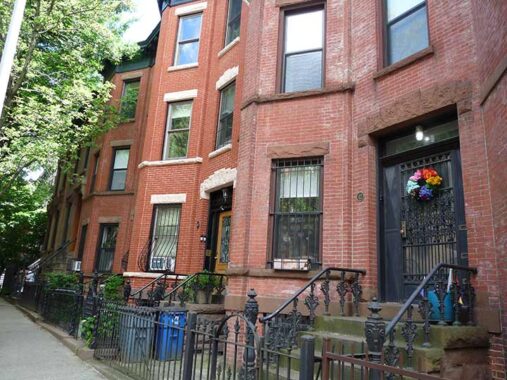
East of 5th Avenue, Berkeley Place enters a pair of areas designated by the Landmarks Preservation Commission, Park Slope Historic District Extension II and the first Park Slope Historic District and thus, building details are better known. I was attracted to the triangular bays and brick construction at #12-16 Berkeley Place, built in 1891 in the Romanesque Revival style by developer H.B. Lyons and architect Walter M. Coots. Those entrance stairs railings may be originals.
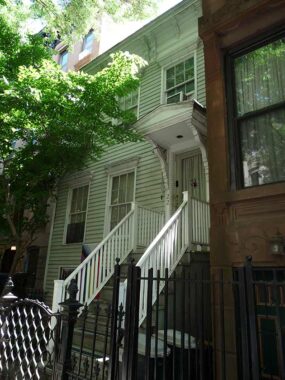
I always like finding wood frame buildings in Brownstoneland, like #22 Berkeley Place. It’s like finding those intact peanuts in the Cracker Jack box. The LPC cannot poinpoint the year of construction, saying anywhere between 1850 and 1869.
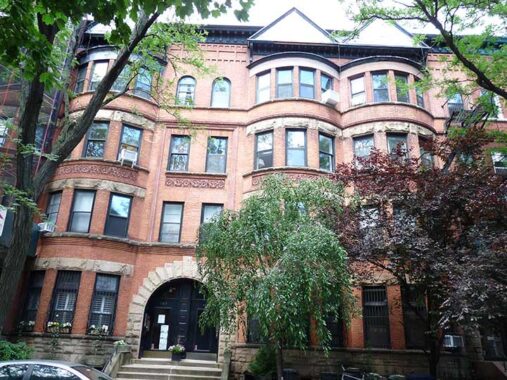
Two of the buildings in this group, at #99-109 Berkeley, east of 6th Avenue:


#116 (right), #118 Berkeley, a pair of woodframes between 6th and 7th Avenues constructed by architect M.J. Morrill in 1862. #118 looks more unaltered that #116.
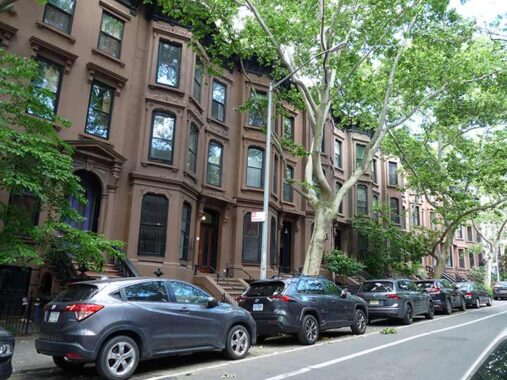
#127-135 Berkeley: LPC: “In 1880 these five brownstones were built by owner-architect builder T. H. Brush of Brooklyn. They were planned to accommodate three families each, a radical departure in this area of single family dwellings.” Today, multifamily dwellings are the only buildings modern urbanists consider worthy of consideration.
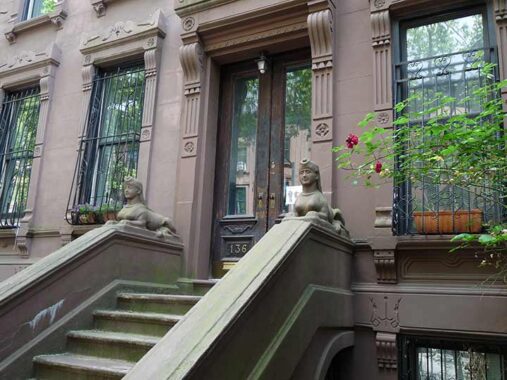
A pair of Sphinxes guards this brownstone at #136 Berkeley. Architect Brush also designed these dwellings in 1882.
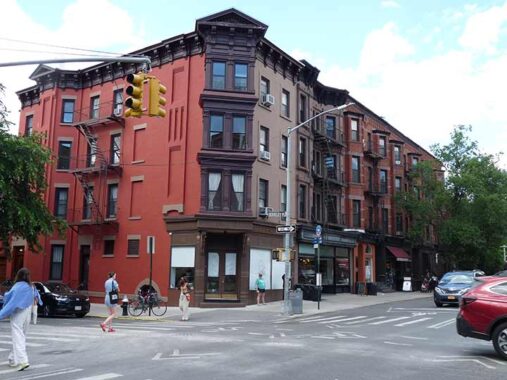
Corner bays like this one at #76 7th Avenue at Berkeley are found often in Park Slope (architect Cevedra B. Sheldon, 1888) and I have always wanted to live in one of the corner apartments, since it has three separate views. You can even find them on 5th Avenue, where they afforded views of the elevated train that ran there from the 1880s to 1940.
I don’t have the time or energy to devote myself to talking about every building on Berkeley Place, but a visit to Park Slope is essential to see how premier residential buildings used to be built. Well worth a trip, even though rents and purchases are now far beyond what most can afford. Yet people can, and do, pay plenty for them.
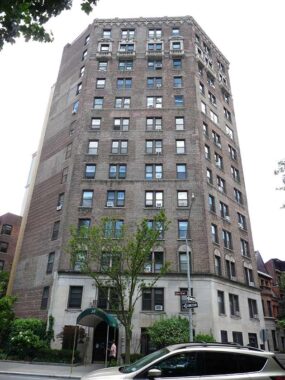
At the east end of Berkeley Place it meets Plaza Street, built in a semicircle surrounding Grand Army Plaza and ringed with high rise apartment buildings. Here, Berkeley Place briefly reenters Park Slope Historic District Extension II as Plaza Street wasn’t originally included in the LPC Park Slope landmarked district in the 1960s.
LPC: This Medieval Revival style apartment house was designed by architect Rosario Candela and built in 1926-27 for Marvin Sheiblen at a time when earlier row houses and surviving freestanding houses were being replaced by much taller apartment houses. The building’s inventive combination of Gothic and Classical details, such as scrolled, foliated and heraldic elements, executed in brick, limestone and terra cotta, as well as its richly-decorated, asymmetrically-placed main entryway, elaborate window surrounds, and terra-cotta cornice, is characteristic of the style. The building remains largely intact.
Check out the ForgottenBook, take a look at the gift shop. As always, “comment…as you see fit.” I earn a small payment when you click on any ad on the site.
1/11/26
4 comments
25 years ago I had a doctor, Jonathan Layton, on Berkeley Place. If he’d slammed me against the wall and been more forceful about a diagnosis he made (which turned out to be accurate) my health in the succeeding years would have been much better. But he just made the diagnosis in a casual manor, sigh. Layton is still around, just not on that street.
199 Berkeley Place is well known as the former home of Clem and Claire Labine. They transformed their brownstone into a piece of Victorian splendor.
RE: Mitu580 – “… interdicspinary arts prractice is interrogated, incubated, & produced” WTF?! This reads like a paassage from Orwell’s “1984”. However, in comtemporaary urban America “acadeemic speak” like ths is used to condition passive citizens to accept the unacceptable. I wonder if the owner has been recruited by your new authoritarian mayor. Run for you life while you can…
Kevin,
My great-grandparents owned 109 Berkeley Place, the highest numbered Romanesque Revival House that you mentioned. It’s notable for being the only house painted of the 6 (We did not paint it, my great-grandfather was a mason and would have known better) If I remember correctly, it was abandoned and my great-grandfather squatted in it until the City gave him the deed. They also simultaneously owned 49 7th Avenue, around the corner and up a few blocks, which is notable for having the very-rare double-stoop configuration, nearly all Brownstones in Park Slope have their own dedicated stoops which do not come anywhere close to touching their neighbors…
Of course, it was 100% necessary to have 2 Houses, my great-grandparents had 10 children, including my grandfather, who outlived all of his siblings, younger and older. My grandfather’s 8 sisters were, for the most part, talented seamstresses who had sewing machines in the house, and did what was called ‘Home Work’ for the factories in the area, which is really how they were able to afford to buy anything at all. Various members of my family lived in these houses over the years, until they moved to Midwood, several stops down on the BMT Brighton Line.
By pure happenstance, my parents own 110 Berkeley Place, which I used to live in as well!