


THE main branch of the Long Island Railroad runs east-west through the heart of Queens, exiting the borough into Nassau County in Bellerose. The railroad also diverges into two branches running southeast, the western one at 150th Street and Archer Avenue and the eastern one at 177th Street, The two branches run southeast through Springfield Gardens and St. Albans respectively, combing just east of 225th Street to form the Babylon Branch. It’s the westernmost branch I am talking about today, which has station stops at Locust Manor and Laurelton. I haven’t been in the neighborhood since a walk on Baisley Boulevard awhile back, so I am using screen captures from Google Street View here.
The LIRR branch is bridged over several area roads such as 111th Avenue, shown above. What’s unusual is that long-ago lighting, which may or may not have been original, is preserved in several of the viaducts.

These are what I call “cuplights without the cups” manufactured by SLECO. With full housing, these were once deployed all over NYC and found a home on both castiron lamps and more modern octagonal lamps first introduced in the 1950s. As pendant lamps, they could also be found beneath highway and elevated train trestles. This is a rarer variant without the housing, and with mesh wire to protect the incandescent bulb, possibly against vandals. Another variant without the housing, but with the glass reflector bowl, can be found on 1st Avenue beneath Windsor Tower south of the United Nations.
Im most cases the Department of Transportation no longer services these lamps (Check me in Comments), though I did find a lit one on Baisley Boulevard (see link). 111th Avenue isn’t the only railroad trestle that still claims this feature; they can be found on trestles spanning Guy Brewer Boulevard, Foch Boulevard, Farmers Boulevard and even Springfield Boulevard. Meanwhile other overpasses on 110th Avenue and Linden Boulevard have “newer” sodium pendants, some of which are themselves three decades old.
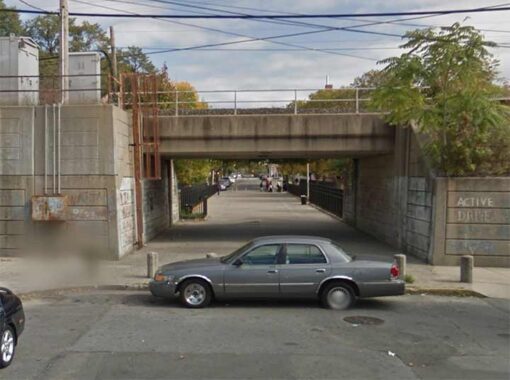
The branch also features some interesting pedestrian-only crossings, such as this one at 109th Avenue.
Check out the ForgottenBook, take a look at the gift shop. As always, “comment…as you see fit.” I earn a small payment when you click on any ad on the site.
3/11/26
6 comments
Looks like the owner of the grey Mercury Marquis in the final photo had paid “Gergle” to blur out his flat rear tire.
Chief: Also note that the the right front wheel isn’t OEM. The Mercury brand died over ten years ago & as a result, resale value is low, Therefore he has parked it at this remote location & he waits patiently for the apprentice thieves at “midnight auto parts” to steal it & sell it, to quote Johnny Cash, “One piece at a time”. Eventually he will contact his insurer to file a claim & then wait for the check to arrive.
Don’t forget about the overpasses for the abandoned lines like the Rockaway Beach LIRR. Some of those overpasses look like they are about to collapse.
I recall quite a few of these underpasses were equipped with fluorescent fixtures installed during the 1960’s and early 1970’s. By the early 2000’s most were broken and not being maintained.
This branch of the LIRR, known as the Atlantic Branch, was largely ground level until the mid-late 1950s with grade crossings of such major streets as Linden Boulevard, New York (now Guy Brewer) Boulevard, Farmers Boulevard, 140th Avenue and Springfield Boulevard. They’re visible in a 1951 aerial view of NYC. https://nyc.maps.arcgis.com/apps/instant/media/index.html?appid=e011fd05a86a4c09bd0b91fbc387f3eb.
So the lighting fixtures in the overpasses that replaced these crossings may date from that era.
During 2011, the railroad overpass on 44th street a little south of Astoria Blvd. South, had two new high pressure sodium fixtures installed to replace two incandescent fixtures that had not been maintained for many years. Each of the two light fixtures had a designation tag mounted next to it. The odd thing is the tags read LIRR44-1 and LIRR44-2. Obviously indicating fixture #1 and #2 on the 44th Street railroad overpass. Except that overpass has no connection with the Long Island Rail Road. Two tracks are Amtrak’s and the remaining track is Conrail.