
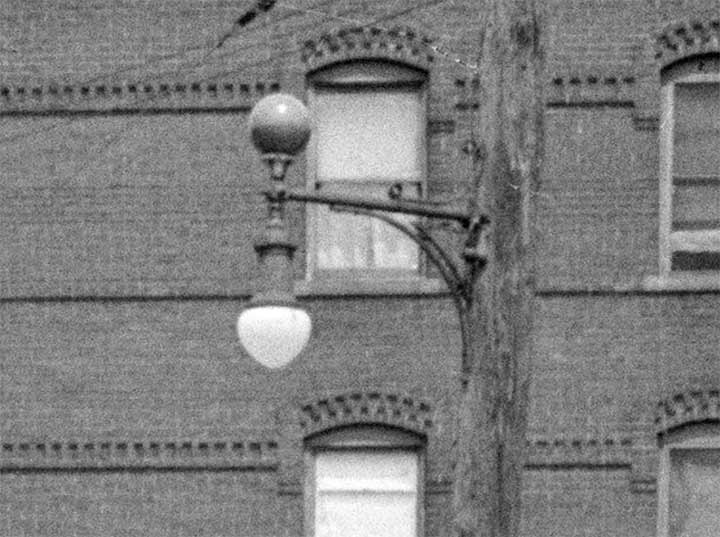

LOOKING through NYC scenes from the 1930s and 1940s available on 1940s.nyc, the Staten Island scenes occasionally exhibit lamppost varieties quite different from those seen in other boroughs, such as this one on Richmond Terrace, a telephone pole with a mastarm different from the scrolled ones used in Brooklyn, Bronx and Queens (Manhattan had mostly standalone lampposts without telephone poles, which were phased out after the Blizzard of 1888). The iron is wrought in a much different style. None of these mastarms have survived even in the island’s hidden backwaters. One item that is the same is the fire alarm indicator globe mounted above the acorn incandescent light, as was the practice until the 1960s.
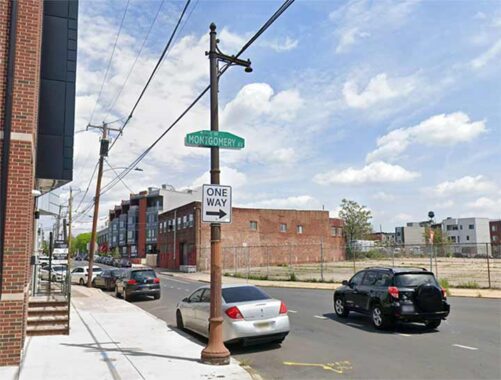
Then I remembered I had seen an old rusted lamp I found on Street View in North Philly, North 5th and West Montgomery, in a factory district. This is probably the last old iron lamppost still surviving in Philly and it’s used now for sign installations.
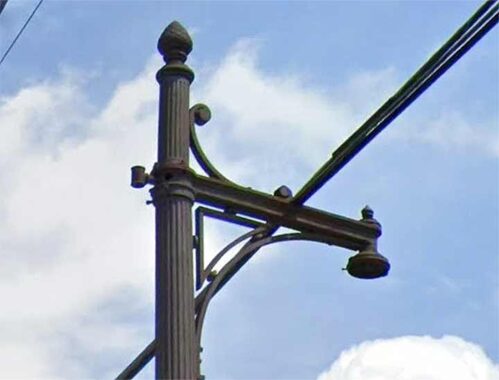
Now look at the mastarm. It’s a duplicate of those long ago mastarms in Staten Island; the difference being, this is a standalone lamp, and Staten Island had mastams attached to telephone poles.
My guess is that the same manufacturer made both…
Check out the ForgottenBook, take a look at the gift shop. As always, “comment…as you see fit.” I earn a small payment when you click on any ad on the site.
3/17/26
1 comment
Originally, street lights in NYC ( and most places in the USA) were installed and maintained by the local electric utility. The Consolidated Gas Company owned the electric utilities in The Bronx, Brooklyn, Queens and Manhattan by the early 1920’s.
Street lighting equipment for those boroughs would be similar according to the practices of the Consolidated Gas Company.
Staten Island Edison was a separate utility with their own practices and equipment. This would account for the differences in street lighting between Staten Island and the rest of the City. Staten Island Edison was sold to Consolidated Edison in 1950,
and cables under New York Bay linked Brooklyn and Staten Island in 1952.
Most of the street lighting equipment was leased by NYC from the utility companies. NYC began purchasing the street light equipment in 1936. That was also the year that IBEW Local 3 “J” division came about to maintain the City owned equipment.
A NYT article from 1947 concerning the City’s 10 year street light improvement plan noted that 200,000 pieces of equipment were still being leased from the utilities. There was a separate payment for poles, arms, fixtures, time switches ,etc.
Another article in American City Magazine noted that 2,000 miles of the City’s 5,600 miles of streets and highways were lit by overhead constant current series street light circuits. Many of these circuits were removed during the 1950’s when the City installed steel poles fed by underground 120 volt circuits. But quite a few series circuits persisted until the early 1960’s when the mercury vapor relighting program eliminated them. The series circuits would have been maintained by Con Edison because they were inherently high voltage circuits, possibly up to 3,000 volts.
To show how different Staten Island was, I was an electrician for 34 years, and it was the only place in the City that I encountered
electrical service with a “stinger” leg.