


THE blocks around Grand Central Terminal are the most ideal workplaces in the city for their connections to transit. In the last century before airplanes became the dominant form of intercity travel, most train stations had hotels next to them. In honor of New York Central Railroad founder Cornelius Vanderbilt, this terminal stood between two grand hotel towers named in his honor: the Commodore and the Biltmore. The former was bought by Donald Trump in 1976, redesigned and reopened as a Hyatt. It is presently slated for demolition in favor of a skyscraper.
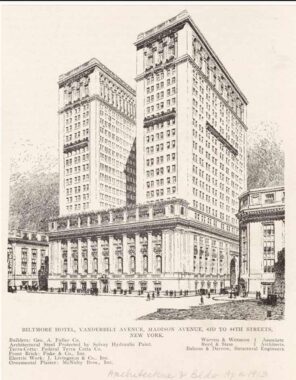
The design of both hotels resembled the beaux arts style of the train terminal, creating a unified sense of place. The Biltmore has its own history that ended in 1981 when brothers Paul and Seymour Milstein redeveloped it into an office tower with Bank of America as its anchor tenant. If one knows where to look, there are remnants of the beaux arts hotel to be seen. Like Donald Trump’s 1980 transformation of Bonwit Teller into the Trump Tower, the Milsteins promised to retain certain historic elements but then reneged.
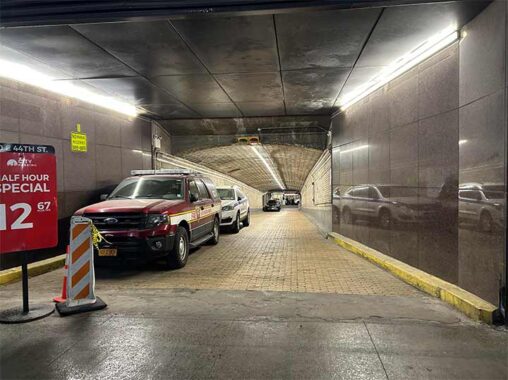
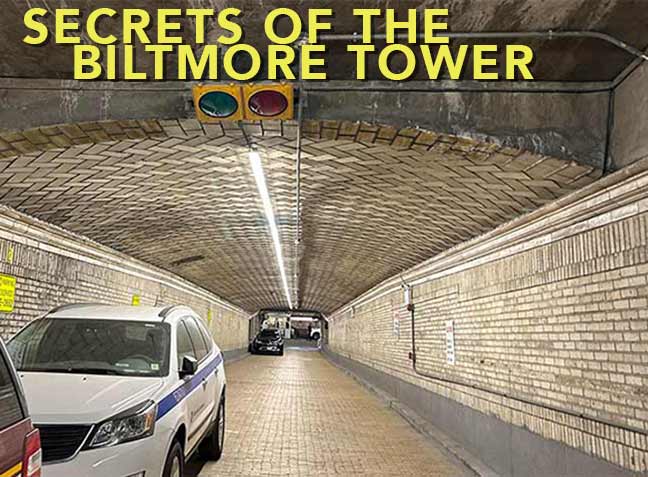
On East 44th Street between Madison and Vanderbilt Avenues is an underground garage that contrasts with the Milsteins’ modernist exterior. Cars descend on yellow bricks underneath Guastavino tiles. The narrow road is one way in each direction, requiring a traffic light at each end.
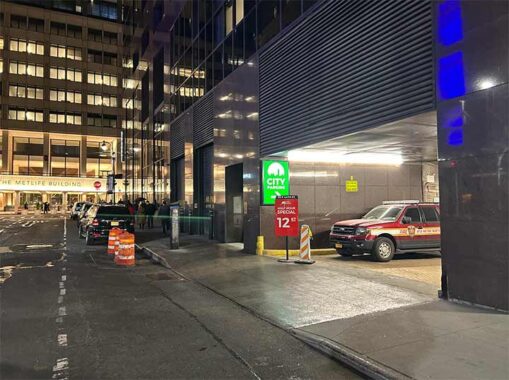
From a distance, the tunnel is not visible. You can only see its distinctive tiles when standing in front of it. It has the look of a secret roadway that leads into the past.
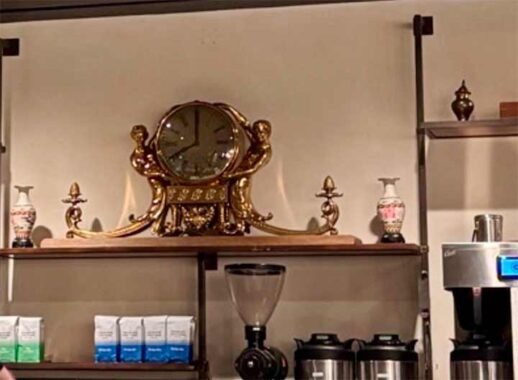
Another element of the old hotel at 335 Madison Avenue (also addressed as 22 Vanderbilt Avenue) is The Clock Coffeeshop which has the hotel’s clock behind the counter. Prior to the building’s transformation, this clock was atop a gilded arch inside the hotel’s palm court. After the Bank of America relocated its headquarters from this building to its new tower at Bryant Park in 2010, the Milsteins redesigned its interior in 2018 as a tech startup hub. Amenities here include a rooftop terrace, gym, and the Palm Court, a name evoking the old hotel’s popular meeting spot, where F. Scott Fitzgerald danced with his wife Zelda during the Roaring Twenties.
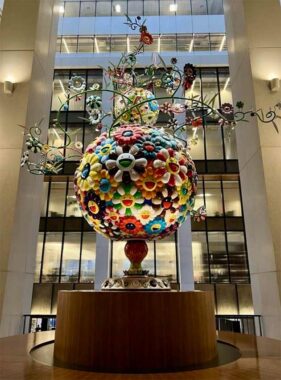
In the atrium of the office building, the most visible artwork today is a copy of “Flower Matango” by Takashi Murakami. The original sculpture was appraised by Sotheby’s to the tune of $1M to $1.5M.
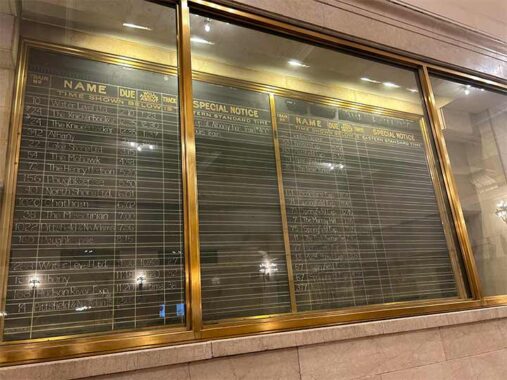
The space underneath this building retains the name Biltmore Room, which has a chalkboard schedule from the years when intercity trains had names. This room extends beneath Vanderbilt Avenue, connecting with the Grand Central Terminal building.
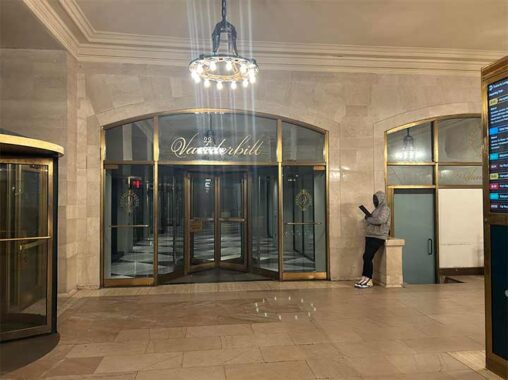
The doors connecting the Biltmore room led into the hotel but now on the other side is a modernist office building lobby. The logo of 22 Vanderbilt is almost identical to the old hotel, replacing the B with the V.
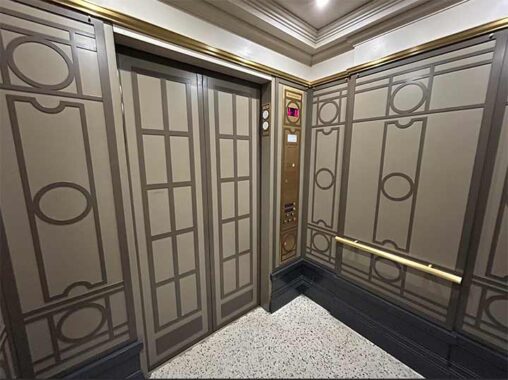
Advertisements for the hotel noted the direct elevator connection to the terminal. Today’s elevator in the Biltmore room has a historically-inspired design, but it now descends deep down to the Long Island Rail Road, which took me home.
Sergey Kadinsky is the author of Hidden Waters of New York City: A History and Guide to 101 Forgotten Lakes, Ponds, Creeks, and Streams in the Five Boroughs (2016, Countryman Press), adjunct history professor at Touro University and the webmaster of Hidden Waters Blog.
Check out the ForgottenBook, take a look at the gift shop. As always, “comment…as you see fit.” I earn a small payment when you click on any ad on the site.
5/8/26