

By PATRICK O’CONNOR
Forgotten NY guest post
FROM late February through the end of March, I had a few occasions that necessitated riding the J train, during midday periods from Sutphin Boulevard/Archer Avenue to the Myrtle Avenue/Broadway Station. There were more occurrences of riding the J train in those few weeks than in my entire life, previously. I was pleasantly surprised with the things I found riding the first time and recognized that it would a few passes to get good pictures of all the interesting sights. Cleanliness of the windows and the speed of the train were highly variable, so each shot was challenging, with different zoom settings applied. The best of them are included here…
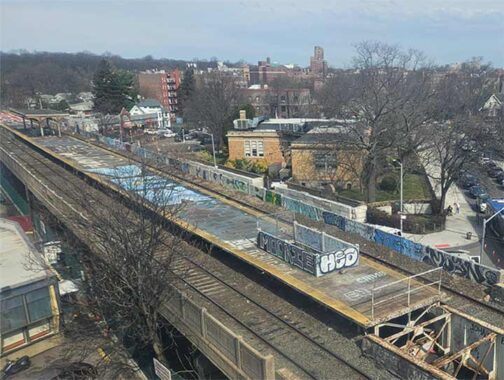
The J train rises from the Archer Avenue tunnel and swings onto Jamaica Avenue at about 130th Street in Richmond Hill. Soon, we find the remnants of the LIRR Richmond Hill Station. This line, known as the Lower Montauk Branch, provided direct service between Jamaica and Hunters Point Long Island City until 1998 when passenger service was canceled due to low ridership. Richmond Hill was one of five stations, the others being Glendale, Fresh Pond, Haberman Penny Bridge. Behind the station, you can see the roof and tan brick façade of the Richmond Hill Branch of the Queens Public Library, one of the Andrew Carnegie funded libraries, constructed in 1905.
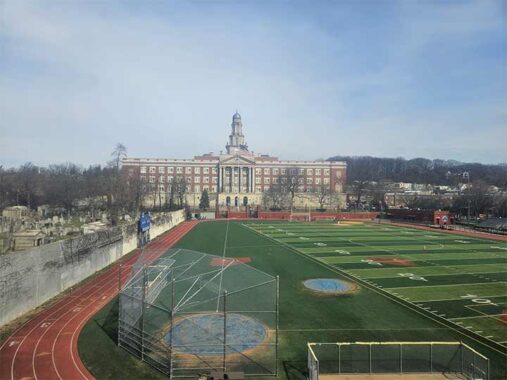
Farther along, west of 75th Street Station, we come to Franklin K. Lane High School, honoring Franklin Knight Lane (1864-1921). Lane was born in Prince Edward Island, Canada in 1864 and moved to Oakland, California in 1876 where he became a lawyer and later City and County of San Francisco Attorney. He reached national notoriety as Commissioner of the Interstate Commerce Commission under President Theodore Roosevelt and Secretary of the Interior under President Woodrow Wilson. An interesting note about the school is that the boys’ gym is named for William “Red” Holzman, former coach of the Knicks, an alumni class of 1938.
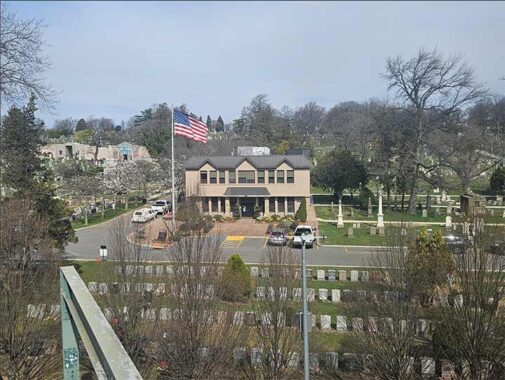
At the turn from Jamaica Avenue onto Crescent Street, we catch the administration building for Cypress Hills Cemetery with the National Cemetery in the background. Cypress Hills Cemetery dates to 1851, is the resting place for baseball great Jackie Robinson as well as old time actress and singer Mae West. The National Cemetery is resting place for approximately 4,000 Civil War veterans, mostly union soldiers and some Confederate POWs, with some having been reinterred from the Hart Island burial ground.
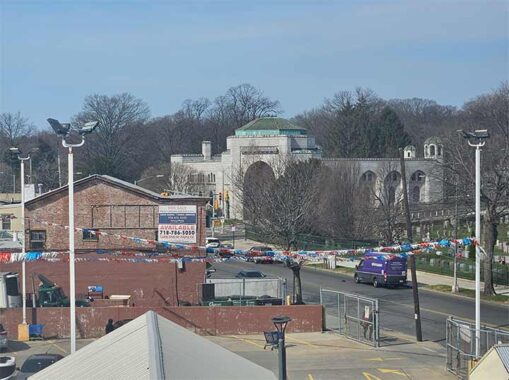
At the same turn, we can see the entrance to the Salem Fields Cemetery, located at the northwest corner of Jamaica Avenue and Cypress Hills Street. Salem Fields is a Jewish cemetery dating back to 1852. Notable burials include several members of the Guggenheim family as well as William Fox, founder of Fox Film Studios.
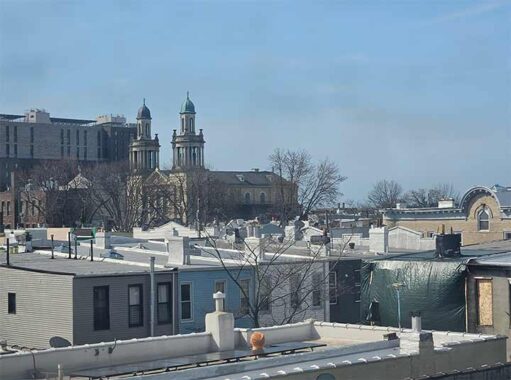
Blessed Sacrament Church at 198 Euclid Avenue dates back to 1891 and was a little difficult to capture from the elevated line but the best view comes from Crescent Street between the turns at Jamaica Avenue and Fulton Street.
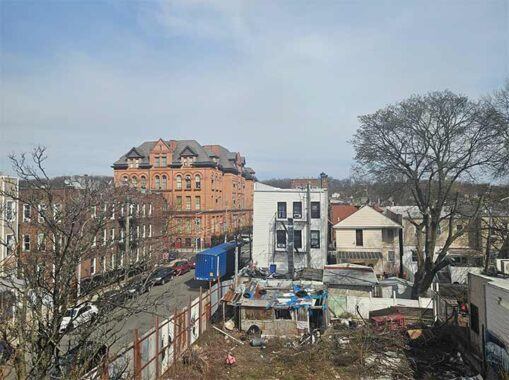
Passing between Norwood Avenue and Cleveland Street Stations, we find PS 108 at 200 Linwood Street. This stately building was constructed in 1895 in the Romanesque Revival style and is included in the National Register of Historic Places. It was named the Sal Abbraciamento School, after the restaurateur and alumni led a group that saved the school from closure in the 1960s.
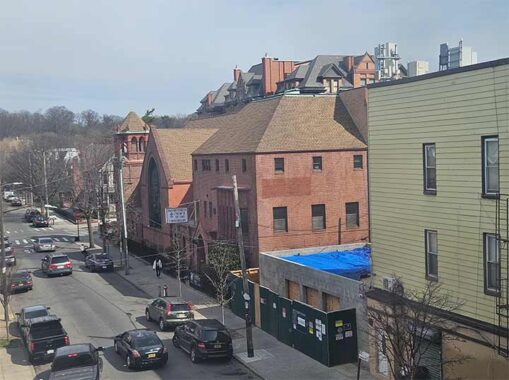
On the next block, we find The Presbyterian Church of the Crossroads at 266 Arlington Avenue. Built as the Arlington Avenue Presbyterian Church in 1905-1906 in the Romanesque Revival Style, the church also serves as a food distribution center. You can see the top of PS 108 towering above.
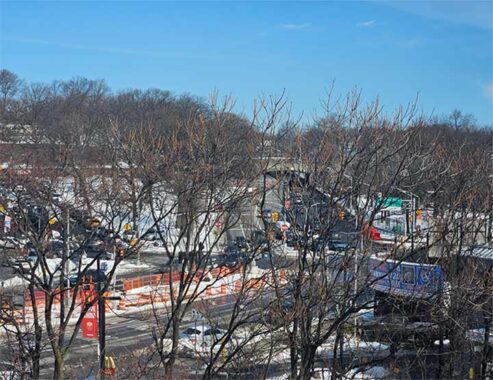
As we approach Alabama Avenue, we find the foot of the Jackie Robinson Parkway and its interchange with Bushwick, Jamaica and Pennsylvania Avenues. In the background is the Cemetery of the Evergreens, the resting place of William Howard, an 18th Century tavern owner. During the Battle of Long Island, Howard and his son were forced by British General William Howe to lead the British troops to a road named the Rockaway Foot Path in order to encircle and trap Revolutionary War soldiers who had taken up position on the terminal moraine.
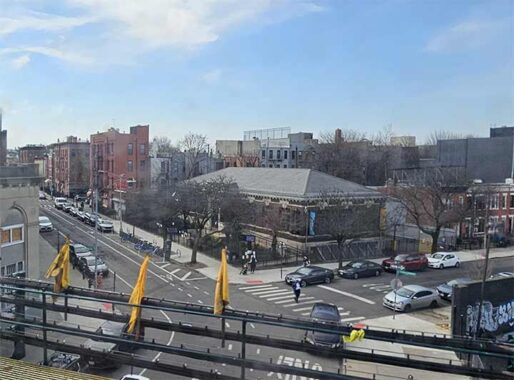
Between Chauncey Street and Halsey Street Stations, we find the Saratoga Branch of the Brooklyn Public Library, located at the end of Thomas S. Boyland Street, just off Broadway. This is another Andrew Carnegie- funded library that opened in 1908. Thomas S. Boyland was a New York State Assembly member from 1977 until his passing in 1982.
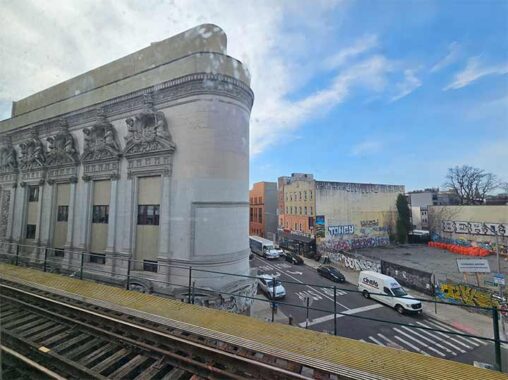
Now, here’s a gem, the Brooklyn High School for Law and Technology, located at 1396 Broadway. This building was originally the RKO Bushwick Vaudeville Theater dating to 1911. Built in a combination of Greek Revival and Beaux-Arts styles it seated 2,500 people until its closure in 1969. In 1970 it became a church and then home to the Acorn High School for Social Justice in 2003, whose name changed to Brooklyn High School for Law and Technology in 2010.
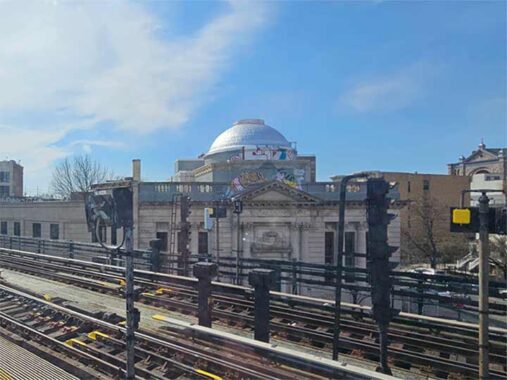
Lastly, as we approach Myrtle Avenue and Broadway Station, we find the former Prudential Savings Bank Building, constructed in 1908. The bank closed in the 1970s and it served as the Urban Sports and Cultural Center for a period.
Also: Last Days of the Myrtle Avenue El
Patrick O’Connor is a lifelong resident of Queens, retired with 40 years of service for City of New York Department of Environmental Protection and is a licensed sightseeing guide in New York City.
Check out the ForgottenBook, take a look at the gift shop. As always, “comment…as you see fit.” I earn a small payment when you click on any ad on the site.
5/13/26
14 comments
Bravo ! Nice shots.
I used to love riding the J in the very early 80’s when Bushwick and ENY looked like the South Bronx! Growing up,I had neighbors on Long Island who had come from that area and had to abandon their homes when it went to hell; plus, as a Honeymooners fan from childhood, I was familiar with so many of the street names….so it was like being an urban archeologist, imaging what those places used to be like and how they went south (Answer: Section 8 rentals and housing projects). There was a beauty to it though- like a snapshot of a society that used to be, but that had been annihilated in a nuclear war or something (That’s what it looked like). A place in the midst of the busy city that time passed by; where relics of the past were still extant but in ruins; where the streets were barren of traffic and pedestrians (But not drug dealers and muggers, of course)- a look at what happens when a city is no longer functional. It was fascinating.
I wished that SNL from the ’80s to early ’90s would’ve done a Honeymooners skit about the Kramdens and Nortons being holdouts after Bushwick went to hell.
Oh my goodness! That would have been amazing!!!!! (Shows view out of kitchen window, revealing rubble-strewn lots and burnt-out buildings).
Good posting and great photos. Thanks for sharing.
A very minor correction: the LIRR Lower Montauk Branch did not provide service to Hunterspoint Avenue Station (note corrected spelling also) – its few trains only served the Long Island City Station. That’s because the Montauk Branch cannot access Hunterspoint Avenue, which is only accessible to and from the LIRR Main Line. Today, a handful of rush hour trains to and from the diesel branches serve Hunterspoint and LI City, but all travel via the Main Line.
More important, should note the J train west (operationally southbound) of Crescent Street up to Marcy Avenue is the oldest part of the NYC rail transit system, still daily use after over 130 years! That elevated stretch dates from 1885-1893 and was originally part of Brooklyn Rapid Transit (BRT) steam-powered elevated train network. The line was electrified around 1900 and was extended over the Williamsburg Bridge to Manhattan in 1908. The BRT morphed into the BMT in 1923, which in turn became part of the NYC Board of Transportation in 1940 when NYC took over the BMT and IRT, ending private ownership of NYC’s subways and elevateds.
Yeah, should have caught that. Put the page together just before bed.
I took a bunch of photos from that subway train back in the early 1980s. I would love to pass them along . They include picture of that bank. It was proof to me that civilization is very fragile.
Send via wetransfer to me at kevinjudewalsh@gmail.com!
Oh! Oh! John, any way you could post them all somewhere, or share them with me? I’d LOVE to see them! Views of that time period are quite rare.
Coincidentally, if you drive, you can actually take the Jackie Robinson Expressway to see his gravesite in the Cypress Hills Cemetery.
Wow- THat makes it easy! Conversely, which one of the hundreds of MLK Blvd.s lead to his grave?!
“Acorn High School for Social Justice”??? “Brooklyn High School for Law and Technology”??? Who makes up these stupid names? Do they think it will improve their SAT scores, or look good on their college applications? Get real!
Easy Big Guy ….
I guess you’re right, John. Not everybody could afford a prestigious Brooklyn high school like my alma mater – New Utrecht!