
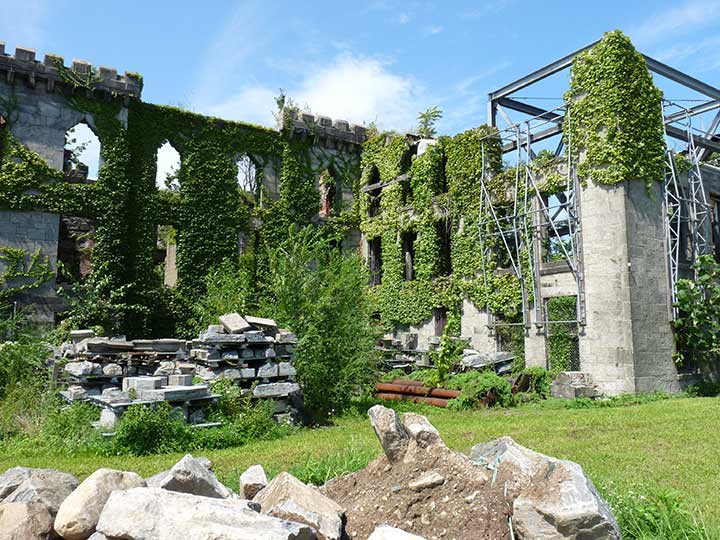

LOCATED in the East River between Manhattan and Queens, two-mile long Roosevelt Island since 1971 has been the home of a small town of about 8,300 people in the midst of a huge city. Native Americans called the island Minnehanak (“Long Island”), and the Dutch called it Varkens, or Hog Island; but it has gone under a variety of names in English: Blackwell’s Island since 1686, then Welfare Island in 1921, and finally, since 1973, Roosevelt Island; a substantial memorial to Franklin Delano Roosevelt was supposed to occupy the island’s southern tip, but the plans were stymied when the architect passed away. In recent years, Four Freedoms Park containing an FDR memorial was finally completed. In 1828 the first of the island’s lengthy succession of asylums, penitentiaries and hospitals opened; its isolation in the East River gave NYC a convenient place to stash dangerous or contagiously ill people.
By the 1920s and 1930s the Island had become a bizarre fiefdom of gangsters serving time in the neglectful tenure of Joseph McCann, who ran Blackwell Penitentiary. The mobsters were able to have all the comforts of home smuggled in and lived like kings amid the deteriorating, squalid conditions surrounding them. The penitentiary was closed and moved to Rikers Island in 1935.
By the 1930s the era of institutionalization on Welfare Island was winding down. Goldwater Memorial Hospital (not Barry, the 1964 Republican Presidential candidate, but Dr. S.S. Goldwater, Commissioner of Hospitals) opened in 1939 and Bird S. Coler Hospital in 1952. The rest of the island was in ruins by this time.
Various plans for park and residential development which would include a subway connection began to circulate in the 1960s. Finally, a plan envisioned by legendary architect Philip Johnson and John Burgee was decided upon. The Urban Development Corporation, inaugurated in 1969, hired developers and construction began. Roosevelt Island was built up with high rise developments and a promenade on the eastern and western sides of the island. No dogs were allowed on the island at first, and cars were discouraged (they were allowed only in the parking garage near the bridge; buses transported people up and down Main Street, the one of two named streets in the development).
Though it is technically a part of Manhattan, until 1976 the only way to get there by motorized vehicle was by a bridge at 36th Avenue and Vernon Blvd. in Astoria, Queens that is still the only way to get there by car or bus. Since 1976, the only tramway in NYC has run from Second Avenue and 60th Street and, since 1989, subways tunnel to one of the deepest stations in the system here.
Ruins of the Smallpox Hospital, built in 1856 by James Renwick Jr. on the southern tip of the island, have recently been made more accessible to public view, though the ruin remains fenced off. Visitors can view it from the outside, but the interior has yet to be made safe for the public. Unusually, it is well-lit at night and its ghostly outline can be readily seen from Manhattan Island after dark.
In the 1850s smallpox was a dangerously transmittable illness and its sufferers were quarantined here. In the late 1800s North Brother Island became NYC’s quarantine center, and the hospital became a nurses’ residence. It has been gradually deteriorating here since the 1950s. Fortunately smallpox has been mostly contained by vaccinations in today’s world, but the mostly fatal illness still crops up in various locations from time to time.
Check out the ForgottenBook, take a look at the gift shop. As always, “comment…as you see fit.” I earn a small payment when you click on any ad on the site.
5/28/26
8 comments
The island’s name was changed because it simply will not do to
have rich people living in a place called ‘Welfare’
The Gift Shop link is broken.
Apparently on a phone connection. It does work on my desktop.
If I remember correctly from my younger years there was a traffic light on the Queensboro Bridge above the island where an elevator would lower vehicles to the island. It was built into a building adjacent to the bridge. I’m sure it was just for ambulances, contractors, vendors, etc. Anyone out there who can verify or condemn my memory?
You’re correct. It is no longer extant, and the tram docks at roughly the site that elevator would have been. Apparently the eagle eyed can spot some of the metalwork remnants on the bridge. I live on the island and haven’t seen any such remnants, although a “sidewalk to nowhere” and oddly placed lamppost suggest at the previous use.
Access had also once been available from the Queensboro Bridge. In mid-span, to the north, there was a building that housed an elevator that ran from the lower level of the bridge down to the island. It serviced both people and vehicles. The people had access from the trolleies which ran on the outer roadways, but are now vehicle-free. The elevateor was not very gib, so only smaller trucks could fit. My uncle was an FDNY member back in the 1950’s and recounted a story told to him by folks who were FDNY veretans back then. The firetrucks which would routinely respond to calls on Welfare Island had fitted the front and rear bumpers of their trucks with bolts that could be quickly removed so as to leave the bumpers in the firehouse, or the truck would not fit in the elevator.
I grew up near Carl Schurz Park and would see the island all the
time.Nothing seemed to move there.Never any people Not a creature
was stirring.One of our gang of kids said he went there and was attacked
by a group of orphans.How he knew they were orphans I don’t know
Smallpox has been more than contained; it has been eradicated completely. The only place it exists is in laboratories which are hopefully better at containment than Wuhan. It does NOT “crop up in various locations from time to time”.