
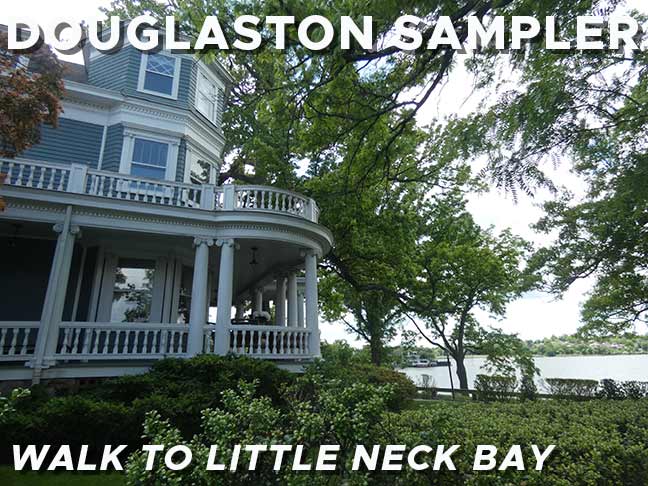

WHILE working on a longform piece I realized I wouldn’t be done by the weekend, and while I wait for some kind of employment, the weekdays are available for walks — so I thought I would strike out from my home in Little Neck up the Road With Three Names into Douglaston. I realize I have written about Douglaston from time to time. However my most frequent visits to Douglaston have been on a bicycle. When the bike path to Fort Totten along the Cross Island Expressway was closed for repairs in 2018-2019, I repeatedly bicycled to the tip of the Douglaston peninsula and back to Little Neck, a picturesque ride along Little Neck Bay along Shore Road. But you have to plan a route carefully to avoid the worst of Douglaston’s steep hills.
That plan, though, did not take me along the hilliest east-west streets and assaying them is better on foot in any case, so this is something I will do more of, hopefully. Today’s route went west along Arleigh Road to Shore Road, then south along West Drive and Douglaston Parkway to Northern Blvd. and then back home, a walk of about 3 miles.
Though I can’t afford any of them, Douglaston contains some of Queens’ finest homes along with locations like Jamaica Estates, Forest Hills Gardens and Addisleigh Park. The area was developed in the early 1900s, a time when surrounding areas of northern Long Island were farms and fields, with a railroad and a few dirt roads running through them.
Major Thomas Wickes, a patriot originally from Huntington, owned the entire Douglaston peninsula jutting into Little Neck Bay after the Revolutionary War, and subsequently sold it to Wynant Van Zandt in the 1810s. Scotsman George Douglas purchased the peninsula from Van Zandt in 1835. The region was later developed as a suburban resort and exclusive enclave, and enjoys pleasant views of Little Neck Bay and Long Island Sound. Streets were laid out in 1906 by the Rickert-Finlay realty company, who had purchased the property from William Douglas, George’s son, and eclectic, individualistic homes were built in the area, which has always been among Queens’ most affluent. The streets have retained their original names and have ignored the Queens mania for giving every street a number. The Douglas name was appended to the area in 1876, after William Douglas had donated a Long Island Rail Road stop. Today, mansions in Douglas Manor can sell for $4 million or more.
By 1636 Europeans had driven the Matinecock Indians, the area’s original settlers, out of the area along the North Shore east of Little Neck Bay called Madnan’s Neck after an Indian word meaning “place of fish.” Madnan’s Neck was subdivided into Little and Great Neck, after their relative sizes. Little Neck developed as a fishing village after the famed “Little Neck” clams were discovered in Little Neck Bay in the 1830s. But the bay was overfished and polluted after a few decades, though Little Neck Bay still has a lively recreational boating scene.


Though most Douglaston homes do not use the hyphenated Queens house numbering system and most streets indeed are not numbered (with a couple of exceptions) Open Street Map adheres to the Queens system. However, the Landmarks Preservation Commission Historic District report gives both house numbers. I’ll try to use the convention favored by Douglaston residents.
#361 Arleigh Road, northwest corner of Douglas Road, is an English cottage constructed around 1940 according to the report. That’s why I believe the hitching post at the curb is a latterday addition. It does have a bluestone that allows carriage (today, auto) drivers to not soil shoes on wet turf.
Most east-west streets in Douglaston bear British place names. Arleigh is an exception, as it is a given name that, as a form of Harley, means “hare meadow” or “rock clearing.”
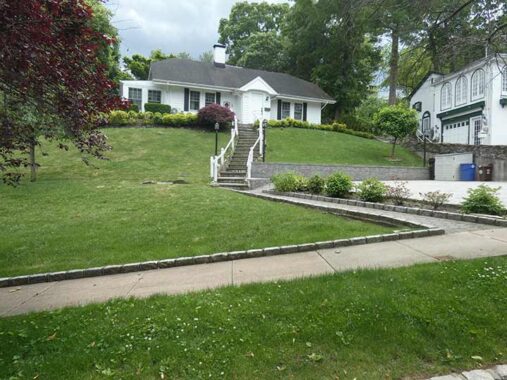
Set way back from the street and up a hill, the Colonial Revival #342 Arleigh Road was designed and built in 1920 by architect Fred D. Gardner. Lawn care here is likely expensive.
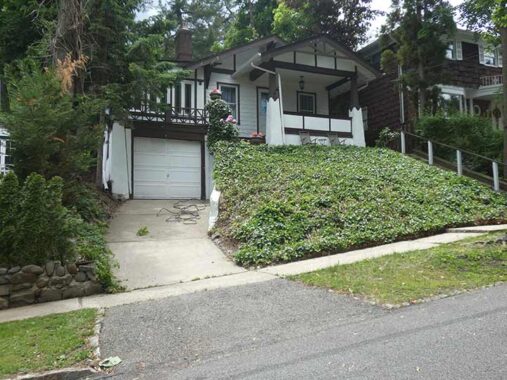
#330 Arleigh is an Arts and Crafts cottage built in 1920 and designed by architect Harry Thomas, Jr. and features a massive front porch with tapered columns on masonry posts. Its side garage was added early on, in 1921.
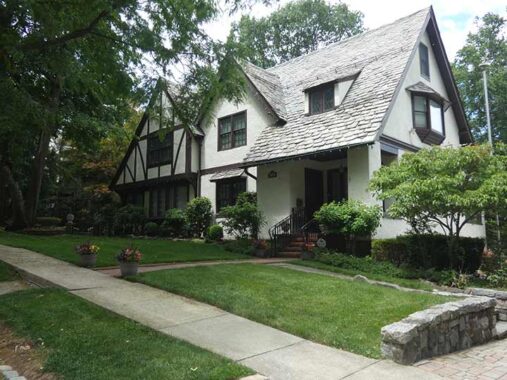
It’s a Tudor wonderland at #315 Arleigh, built in 1912 and designed by architect Alfred Busselle.
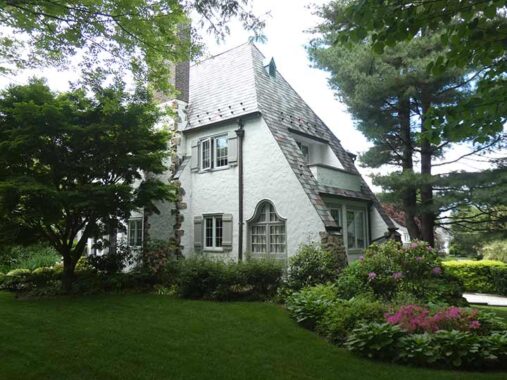
#259 Arleigh Road at East Drive is a combination English Cottage and Tudor Revival marked by its steeply pitched frame. It was designed by John C.W. Cadoo and built in 1926. Note the multi-colored slate tiles and stuccoed outside walls.
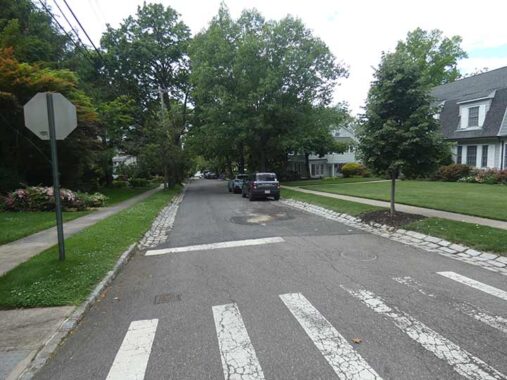
Note the Belgian blocked depressed gutters on Arleigh Road, a feature on many Douglaston streets.


I ducked over to Park Lane and Center Drive for a look at #141 Park Lane, with its massive round corner tower with conical roof and wrap-around, stucco-covered porch with round columns on posts. Edward Brown designed it, and it was built in 1909.
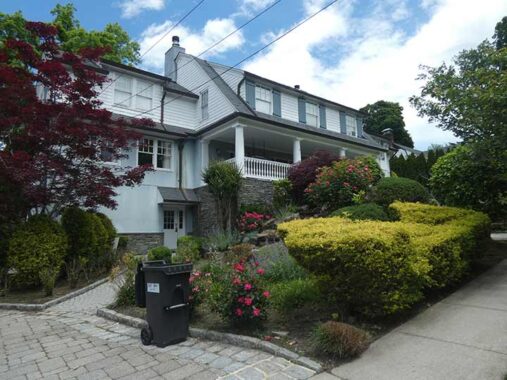
#235-15 Park Lane, a Colonial Revival bungalow, was designed by Norman McGlashan and built in 1914. Built on one of Douglaston’s many hills, its features include a gambrel roof, stucco-covered chimney and three-bay shed dormer.


Given its location facing Little Neck Bay, and its wraparound porch perfect for sipping ice tea or something stronger on hot days, I have considered the Colonial Revival #28 Shore Road among Douglaston’s finest. It was constructed in 1909, architect Carl P. Johnson.
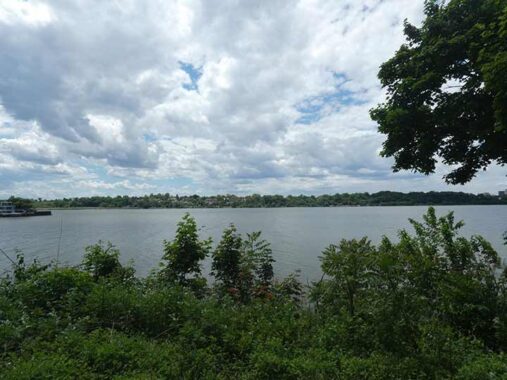
Little Neck Bay is an inlet of Long Island Sound, originating just east of the Throgs Neck Bridge. The Douglaston peninsula splits it in two and the western section narrows into Alley Creek and the east section narrows to Gabler’s Creek.
During the last quarter of the 1800’s Little Neck Bay was a haven for the likes of J.P. Morgan, J.G. Bennett, Thomas Lipton and their yachts. They formed the Douglaston Yacht Club and had a palatial floating clubhouse which was towed out to the Long Island Sound and anchored. From their vantage point on the porches of the floating clubhouse, members could enjoy watching the races in grand style. Late in the 1890’s a nor’easter ripped through Little Neck Bay and tore the clubhouse from its moorings. The next day it was found across the bay near Crocheron Lake with the club piano standing amidst the wreckage of the clubhouse. [Douglaston Club]
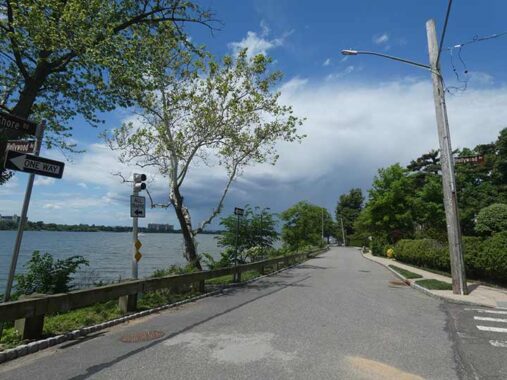
Shore Road along Little Neck Bay, looking north. While there were sunny intervals, I walked through three separate rain showers, one of which is on the way here.


Douglaston street nomenclature has long been in flux. Or has it? The 1909 map shown here, with its British street names, is more accurate than the mid-century 1949 map that gives them numbers, which is apparently what the city at one time intended to do. My question is, were the numbers ever implemented or were the original names kept all this time? My guess is the latter since hyphenated Queens house numbering isn’t used in Douglaston.
By contrast, Douglaston Hills either side of the railroad had its original names reinstated about 20 years ago after several numbered years.


I liked the intersecting gables at #202 Shore Road at Hollywood Avenue, constructed in 1919 (Werner & Windolph, arch.) with alterations in 1994 so much, I shot it from two angles.


The Wynant Van Zandt residence at West Drive and Beverly Road was built in 1819. It was William Douglas’ residence for many years, as well, so it has been occupied by the two men most responsible for the settling and development of the peninsula. The Douglas Manor Company purchased the house and grounds in 1906 and founded the Douglaston Country Club, which became the Douglaston Club in 1918. Along with the Douglaston Manor Association, the Club holds fairs, dinner dances, meetings and socials as well as weddings and celebrations. I have never been inside, though I know friends who have attended affairs here. Yelp has a few indoor shots. Is that a huge Connect Four on the lawn?
The young John McEnroe honed his tennis game at the Club in the early 1970s. In 1977, McEnroe and fellow Douglaston resident Mary Carillo won the mixed doubles championships at the French Open; McEnroe, of course, went on to a fabulous and controversial career on and off the court.
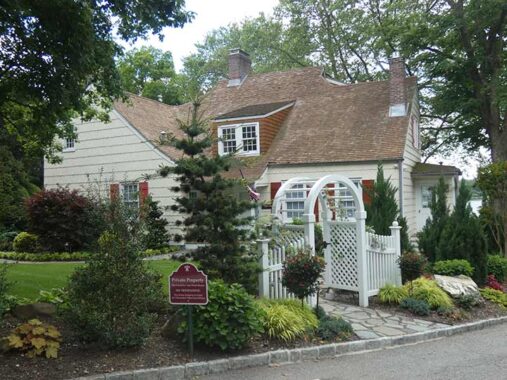
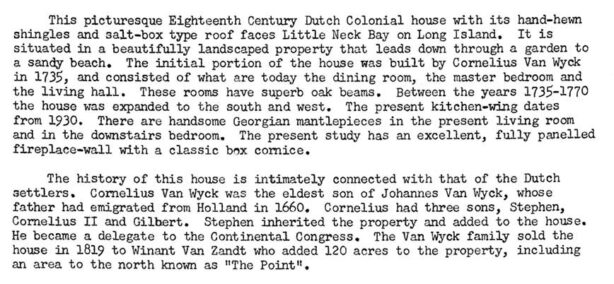
The oldest building in Douglaston dates to pre-Revolutionary days: the Cornelius Van Wyck residence at West Drive and Alston Place was built in 1735, making it one of the few remaining Queens edifices from the 18th Century.
From the 1966 Landmarks Preservation Commission report:


The Long Island Rail Road has stopped in Douglaston since about 1870, with this Queen Anne-style station constructed in 1898. It was torn down in 1962 and this ranch-style station replaced it that year. This 1916 photo is from Arrts Arrchives.


The weeping beech that stands at the Douglaston station is possibly a cutting from the original Flushing weeping beech that stood near Kingsland Homestead, home of the Queens Historical Society, from 1847 to 1998, where another cutting currently sits in the same site. Douglaston’s memorial to its World War I casualties is also here.
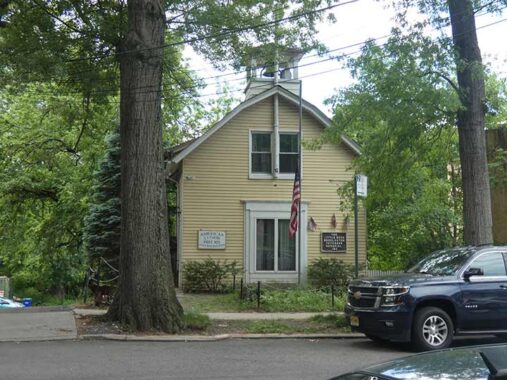
South of the railroad on 235th Street, a volunteer firehouse, still with its original bell used to call neighborhood firefighters, has become American Legion Post 103. The building was in use by the Douglaston Hose Company between 1906 and 1929, when the current FDNY firehouse was constructed on 244th Street.
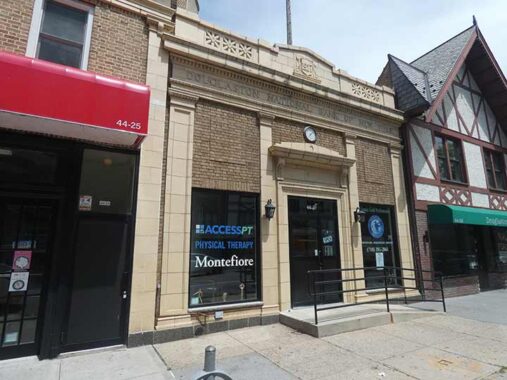
Much of the terra cotta and ironworks detailing has now been excised from the Douglaston National Bank building on D Parkway near Northern Blvd. Back in 2007, though, Forgotten NY was sure to feature it when all of it was intact.
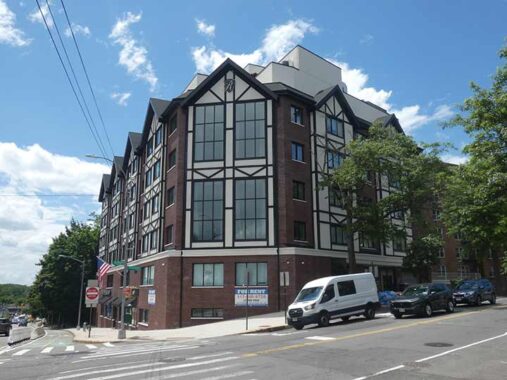
This large Tudor-ish tower was built in 2022 at the NW corner of Northern Blvd. and Douglaston Parkway, and it cleverly echoes the older Tudor buildings across the parkway. It replaced the parking lot of the now-defunct Giardino restaurant. (I ate there twice, but could not find a dish I could get attached to.) The “R” stands for Russo Luxury Apartments.
Check out the ForgottenBook, take a look at the gift shop. As always, “comment…as you see fit.” I earn a small payment when you click on any ad on the site.
5/30/26
3 comments
As I’ve previously mentioned I was the proud owner of a two bedroom apartment in the Alley Pond Co-op. In the nine years I resided there I became well acquainted with the area that included Bayside, Little Neck, & Douglaston. Alley Pond Park was such a beutiful oasis & the Bayside/Douglaston/Little Neck area was home to many terrific restaurants. I’ll always remeber the area & treasure my memories of the nine years I lived there with my wife, & my daughter. Eventually I retired & relocated to Arizona. I still read the NY Post & I’m aware of the frightening decline of urban America & this makes my memories of life in north eastern Queens even more precious. As Paul Simon once rhapodized “Oh, what a time it was…/ Preserve your memories, they’re all that’s left to you now” & as Bob Hope sang “Thanks for the memories”.
Adelaide, William Douglas’s wife, was J. P. Morgan’s mistress.
I may be wrong but I was under the assumption that the east-west streets of Douglas Manor also had their names changed to numbers, but the names were reinstated after historic district status was given such as in Douglaston Hill. Given the mid century map it would seem to support this, but again without further investigation it can’t be accurately answered. I’m sure that the Douglaston-Little Neck Historical Society would know this information or the Douglas Manor Homeowners Association.