
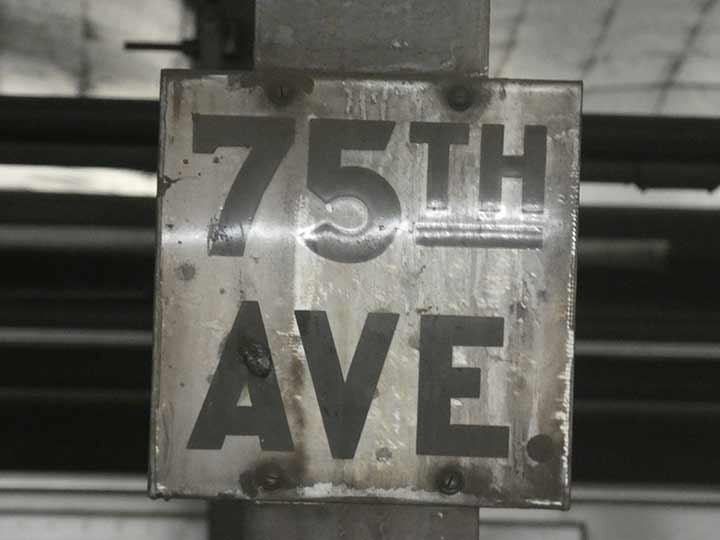

I recently walked from Briarwood to Forest Hills, mostly along Austin Street, a walk I hope to complete along its northern section soon. I have also published a couple pieces about Briarwood by other writers and intend to spend more time there soon; though if all goes well I will begin a work assignment in July and will have less time to devote to stalking around with the camera, at least during the week. We will see. On that aforementioned trip I decided to call it an afternoon and catch a Queens Blvd express at 75th Avenue. Right off the bat, I noticed that its old station ID signs on the center columns between tracks were still there.
I’m fascinated by the square signs that were employed on subway columns. Most of these, before the 1980s, were white enamel signs with black lettering in a font designed specifically for the Transit Authority (I have not seen it elsewhere).
Most of these signs were replaced by black signs with white lettering, first in the Standard font, then in Helvetica. The most prominent feature of these signs was that speace considerations required abbreviation, sometimes with apostrophes or hyphens, sometimes not.
Many of these signs were made by the Baltimore Enamel and Novelty Company, in business from 1898 to 1943, which produced products like municipal signs and license plates. Occasionally signs like these pop up for sale online. I do not know if the company produced Manhattan’s distinctive navy and white humpback street signs.
The last enamel signs of this type in service were on the BMT Times Square station which remained in place into the 1990s. In some stations, you’ll find them in columns located between uptown and downtown tracks, such as at the West 4th Street IND station. They’re pretty dust and crud-encased by now, though.
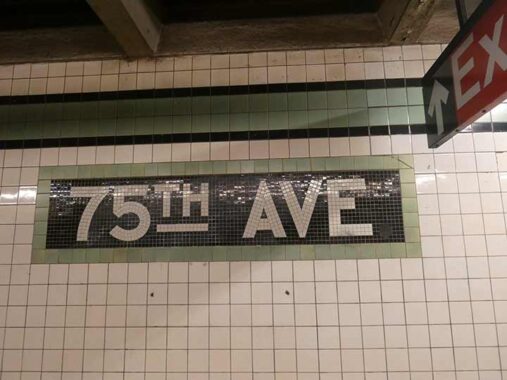
I also noticed the now 90+ year old tiled signage that is emblematic of Independent Subway stations built mostly in the 1930s. Many readers are now in the dark about the era when three separate companies ran NYC subways until 1940: Interborough Rapid Transit, founded in 1904, now consists of the numbered lines; Brooklyn-Manhattan Transit, initiated as part of the “Dual Contracts” founded to build subway and elevated lines in Brooklyn, Bronx and Queens in 1911; and the Independent Subway, founded in 1925 by New York City itself mainly to compete with the elevated lines (and succeeded in outcompeting many of them). The three “branches” were unified under one aegis in 1940, though it took some years for them to knit together and permit free transfers. To this day, because of track width differences, differing car widths, Interborough trains can’t run on BMT or IND trackage.
Subway station designer Squire Vickers, taking note of the Art Deco and Moderne art trends that largely eschewed ornamentation, devised the signage seen here for IND lines, and the signs are so timeless most of the originals remain in place today. The lettering is the same, but the tile colors change: all local statins between express stations are the same color, which changes at the next express stop. The reason for this is unclear but the best story I have heard is that the colors change to accommodate: 1) people hard of hearing, so they know what general area they are in, and B) non-English readers, for the same reason. In any case, the changing colors of the station tiles make the IND (or what we once called the IND) visually interesting.
Check out the ForgottenBook, take a look at the gift shop. As always, “comment…as you see fit.” I earn a small payment when you click on any ad on the site.
6/9/26
8 comments
The classic cobalt blue and white porcelain humpbacks were most notable documented as being manufactured by the Nelke Sign Company. The L.D. Nelke Sign Company was a prominent manufacturer of tin, metal, and porcelain-enameled advertising and subway signs based in New York City. Operating from the early 1900s through circa 1950, they are highly collectible today—especially their cobalt-blue and white NYC Subway signs
I should add that the humpbacks in the Bronx and Manhattan are different from the ones in Brooklyn. The fonts on the Brooklyn humpbacks are sans-serifs while the ones in Manhattan and the Bronx all have serifs. Which leads me to believe that two different manufacturers were used. Not sure who used the ones from the Nelke Sign Company.
Good posting and great photo of the 75th Ave. wall sign, However, should be noted that it’s not a true statement that “because of track width differences, Interborough trains can’t run on BMT or IND trackage.”
The track width, or gauge, is the same on all three historical subway divisions – 56 ½ inches, also the standard gauge for all North American railroads. The differences refer to the car widths. IND and BMT subway cars (today’s B Division) are ten feet wide and mostly 60 feet long (some cars are 75 feet long). IRT cars, today’s A Division, are 51 feet long and 8½ feet wide, and many routes have sharper curves than on the B Division. A Division cars can and do run on B Division routes for yard and shop moves, but never in passenger revenue service, because there is gap of about 12 inches between the cars and platforms because of the narrower A Division cars. Conversely, a B Division car attempted to run on the A Division it would strike the next platform and knock over signal masts – because B cars are 18 inches wider.
Amended…
The amendment helps to correct that both A Division (IRT) and B Division (BMT and IND) have the same track gauge, but have different car widths (loading gauge). The sentence still isn’t fully correct though. It’s just that the former BMT and IND trains (B Division) cannot run on the former A Division (IRT) trackage, since B Division trains are wider then the A Division trains and would strike platforms and signaling as Andy already mentioned. Vice versa does work, the IRT trains can run on BMT and IND trackage, there’s just a larger gap between the car body and platform.
Although, the BMT stations at 8th Avenue/14th Street, Broad Street on the Nassau Loop and Fulton Street also on that loop were originally built with IND-style signage. Though the BMT was a separate entity in the 1930’s, they apparently didn’t mind their new stations looking like the IND at two transfer stations
More specifically, these 3 BMT stations were the last Dual Contracts stations built and were constructed by NYC Board of Transportation. Dual Contracts refers to a vast expansion of the IRT and BMT networks built between 1913 and 1931 that was financed by NYC. These stations received IND style station signage because the IND was under construction at the time and most likely the same contractor was used to finish these 3 BMT stations. Two of them, Fulton Street and 8th Ave.-14th St., also connect directly to IND stations that are adjacent.
NYC Hagstrom subway maps of the late 40s and early 50 showed the 75th Ave. Queens Blvd. station with the name “75th Ave.-Puritan Ave.” No longer used or shown on the station walls, but Puritan
Ave. still exists south of the LIRR right of way in Forest Hills Gardens.