

By PATRICK O’CONNOR
FNY Contributor
It always amazes me how many times I find things while fishing around for something else. I was recently poking around on the 1924 aerial photos on NYC Office of Technology and Innovation’s “Now and Then” Application, in the area near Flushing Memorial Fields Park and found something odd.
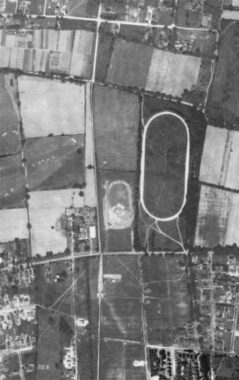
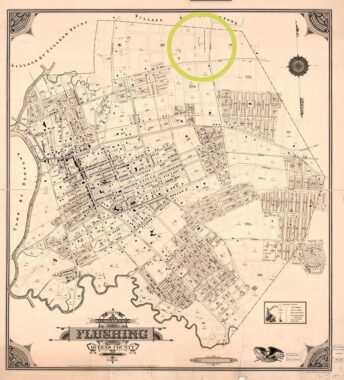
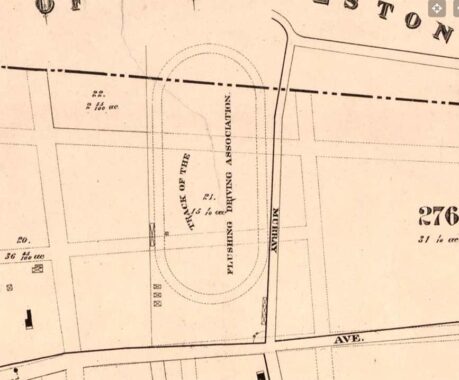
Aerial photography from 1924 shows what appears to be a racetrack north of Bayside Avenue at about where Murray Lane is today. Googling got me as far as the Library of Congress website and a G.A. Roullier map of The Village of Flushing dated 1894. The site is identified on the map as “Track of the Flushing Driving Association”. “Driving” in this case is a reference to trotters or harness type horse racing. An interesting note is that the map shows the track extending slightly outside of the Village of Flushing into the Village of Whitestone. The significance of this becomes apparent when reading about the track’s downfall.
A trip to the Queens Public Library Archive in Jamaica resulted in finding a couple of news articles regarding the creation of the track and a recap of the uproarious event that led to the demise. Neither article included printed dates or name of the publication but one had a handwritten date of November 14, 1937, and recounted events that unfolded, some 50 years earlier.
Here is my summary of the articles: The site of the track was originally a tree nursery, with a red octagonal barn called the Red Barracks and was purchased for $20,000 in 1880 by a group of prominent men, some of whom may be familiar to Forgotten NY fans. They were known as The Flushing Driving Association: David L. Van Nostrand, G. Howland Leavitt, George Mickle, William H. Salt, Colonel Fred N. Lawrence, George Barker, Fred Bowne, Joseph Dykes and James A. Renwick. A half mile track was constructed and both thoroughbred and harness racing occurred over the period from 1880 to 1887.
Of course, gambling was part of the scene and in those years, bets could only be placed for races at the site. The New York County District Attorney, named Randolph B. Martine had been cracking down on “pool rooms” and “horse rooms” that were hotbeds of illegal gambling. As a result, the New York gambling syndicate moved to Flushing and adopted the name Flushing Jockey Club. This group leased the Flushing Driving Track for a 30-day event in 1888. A large tent was set up to support the operation and the first day drew an estimated at 4,000 people, the largest crowd ever seen at the track.
Organizers ran races but the real gambling occurred on races at other tracks with results coming in by telegraph ticker. When the local leaders caught on, the Flushing Jockey Association moved their equipment to be on the Whitestone side, out of the jurisdiction of the Flushing people but eventually met with similar resistance from the Whitestone side. Back and forth disputes continued for about six weeks until order was restored by Queens County District Attorney, John Fleming, who stepped in to make arrests. After the incident, the track was deserted for decades until the rise in popularity of bicycling, and the track was then used for bicycle meets. One article ended by stating: “Such was Flushing’s brief but lurid contribution to Long Island’s racing traditions…”
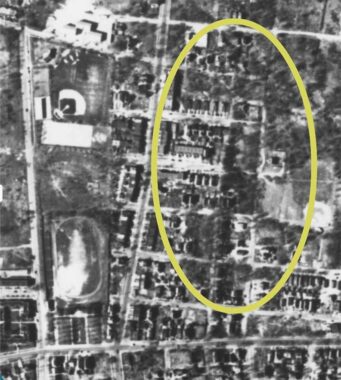
Neither article included information regarding the sale of the property, but the site of the former track was developed in the 1940s and the 1951 aerial shows the approximate location today. Sadly no remnants remain of its equestrian past.


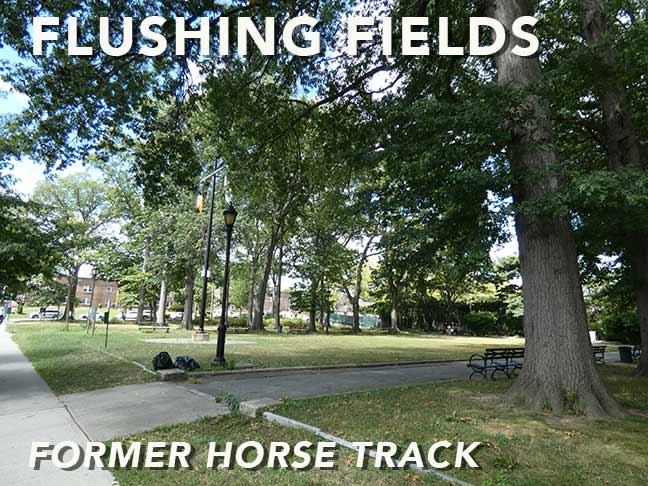
The Memorial Field of Flushing, bordered by Bayside Avenue, 25th Avenue, 149th Street and a right of way west of 150th Street, is Murray Hill’s other large field of green, and differs from Bowne Park with its playing fields home to local high school teams. Older maps from the early 20th Century show it as Flushing Driving Park, as explained above. Flushing Fields, which has a public sitting area at its southern end at Bayside Avenue, shown here, is also the home field for Flushing High School’s softball, soccer, football and track teams.


An Art Moderne memorial to local World War I casualties, dedicated in 1935, is located at the park’s southern end on Bayside Avenue. The granite stele carries a bronze plaque inscribed with 70 names and a quote from the Gospel of John 15:13. “Greater love hath no man than this that a man lay down his life for his friends.” Unusually foir the period it was dedicated, it honors both male and female casualties.
Special thanks to the folks at the Archive for their insights into where to look.
Patrick O’Connor is a lifelong resident of Queens, retired with 40 years of service for City of New York Department of Environmental Protection, a licensed sightseeing guide in New York City.
6/29/26
6 comments
With yesterday’s end of racing at Aqueduct there is no horse racing in the city since well back in the 1800’s.
Being that we will celebrate the 250th anniversary of the Country this coming Saturday it should be mentioned that in 1783, when the Brit’s were leaving NYC and Queens, they journeyed east on Bayside Avenue to Little Neck Bay to board ships taking them to Canada or England. They stopped along the way to water their horses at the pond in Bowne Park. It is a shame that today the pond is being suffocated by algae and scum, and the Parks Department does nothing to clear up this awful situation.
Interesting article. Especially to me since, from approximately 1964 when it opened through High School, I lived in a Mitchell-Lama housing cooperative in South Jamaica, Queens – Rochdale Village – that was built on the site of the Jamaica Race Course.
I’ve looked on and off for years for photos, historical documents, etc. on the race course and/or the transitional period as it became Rochdale Village, but except for a few old turn of the century (the last, last century) picture postcards, without any real success.
Maybe one of you Forgotten New York sleuths could apply your superior investigative skills to this subject and unearth some neat stuff…? I’ve never seen Jamaica Race Course or Rochdale depicted in these pages 🙁
Have you seen this essay on Rochdale Village ?
I never had! Don’t know how I missed it. Thank you!
Flushing Memorial Field is not in Murray Hill; it is actually in Linden Hill, which extends east to 154th St. I also read in a classified Real Estate Section, that referred to the Flushing Driving Park neighborhood back at the turn of the 19th Century. I’m not sure if that was just an informal name, or a legally filed subdivision or addition such as Ingleside and Waldheim were as some of the earliest additions/subdivisions to/of Flushing.