
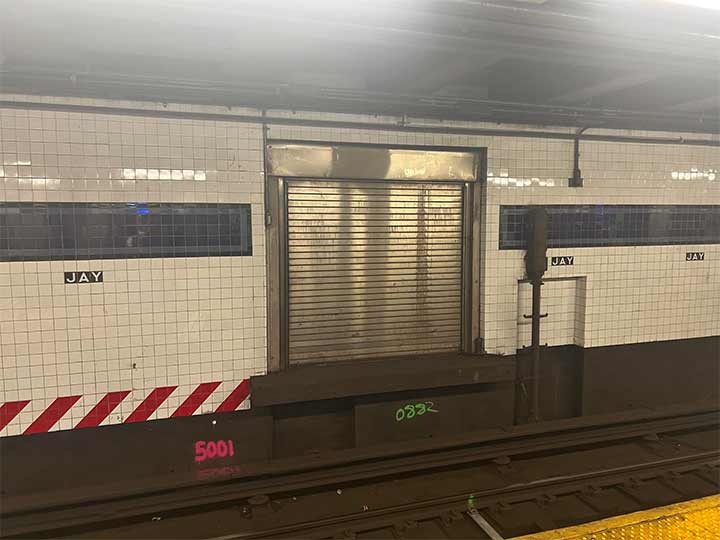


On the Manhattan-bound A, C, and F trains, Jay Street-Metrotech appears as simply another 1930s IND station with its bathroom tiles and concrete platforms. But for those boarding and working here, this express station has its quirks, the result of its location beneath the former subway administration building.
On the Brooklyn-bound platform track is the door where the money train stopped to drop off tokens and currency to be counted at 370 Jay Street. The last time this door opened was in 2006, as tokens were being replaced with Metrocards and the MTA opted to have its cash collected by armored trucks rather than the money train. In 2012, the MTA gave up the building above this station to New York University, which acquired downtown Brooklyn’s Polytechnic Institute in 2008. Metrotech’s name was inspired by that school and the nearby CUNY City Tech, in an effort to transform a sleepy downtown into a technology and business hub by pedestrianizing its streets, attracting government agencies, finance firms, schools, and the sizable Marriott on Adams Street, the first large hotel built in Brooklyn in 60 years.
Because of its location beneath 370 Jay Street, this station was the first to introduce brightly-painted platform edges with raised discs, token vending machines, and the Metrocard.
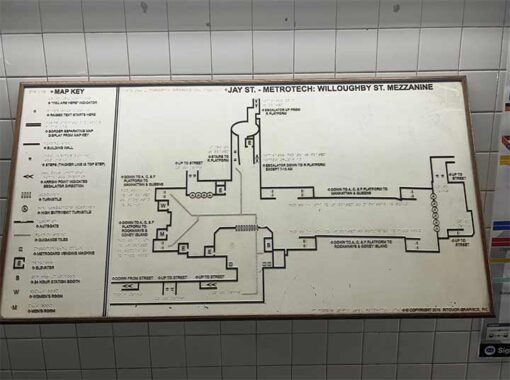
On the platform are lines indicating directions to specific trains and in the mezzanine is a Braille map of the station. The signage was installed in 2019 when the MTA declared Jay Street-Metrotech as a demonstration station for people with disabilities.
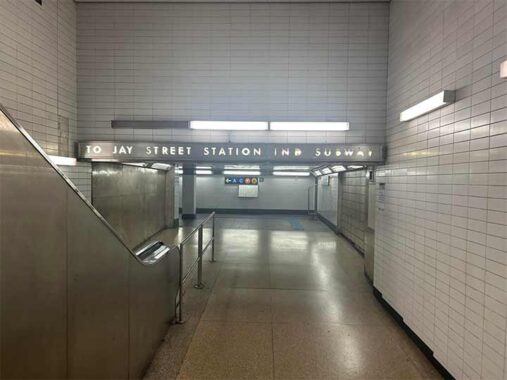
Another unique item in this station is the IND signage noting this station as part of the Independent subway system, a transit service created by the city in 1932 to compete with the privately-owned Interborough Rapid Transit and Brooklyn-Manhattan Transit. The three subway services were merged by the city in 1940, but signage indicating their separate origins lingered into the 1970s.
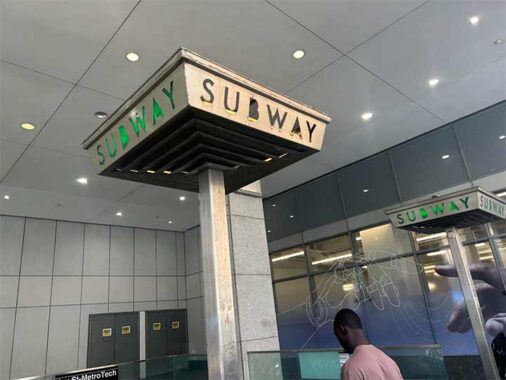
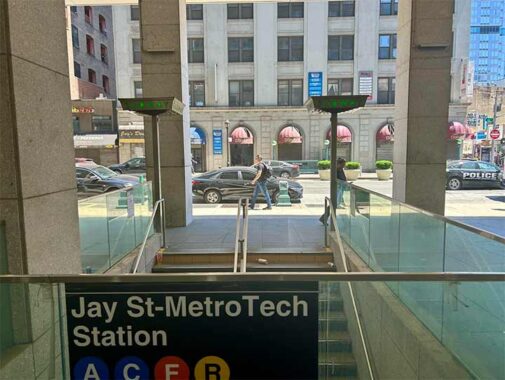
The green colors of the subway letting here were chosen to evoke the green globes in other stations to indicate an entrance that is always open. These light fixtures are unique to the Jay Street-Metrotech station, fitting with the modernist appearance of 370 Jay Street. Kevin wrote about these lights in 2016. What taxonomy name would he give to these lights?
[Signage at the Jay Street entrance is in the sanserif Futura font, invented in Germany in the 1920s. This is the only usage of Futura in the subways; signage in other stations since 1969 has been rendered in the sanserif Standard and Helvetica fonts. —Ed.]
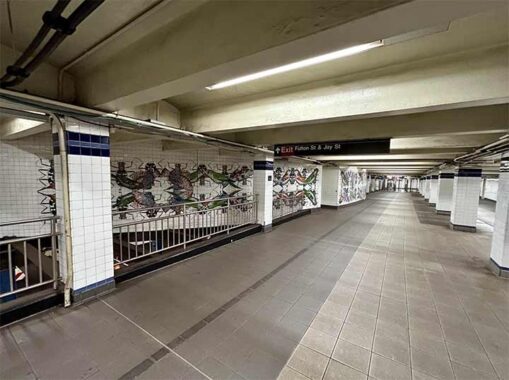
The creative element in this station was installed in 2009 by the MTA Arts & Design program. Ben Snead’s Departures and Arrivals has mosaics of migratory birds decorating the mezzanine. It was installed as part of the transfer tunnel project connecting the A, C, F Jay Street-Borough Hall station to the Lawrence Street station on the R train. The two merged stations were then renamed Jay Street-Metrotech.
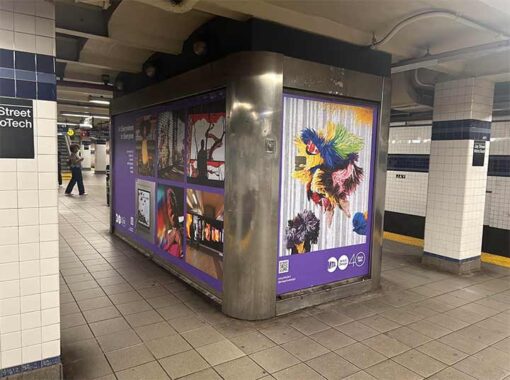
More recently, with straphangers getting their news from their phones, platform newsstands have lost their purpose. In some stations, they’ve been repurposed for art installations. On my visit, the displays celebrated 40 years of the MTA Arts & Design program, formerly known as Art for Transit.
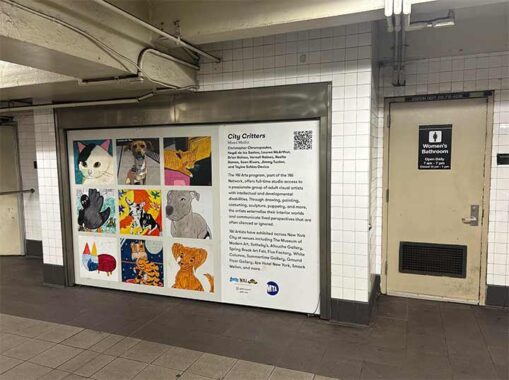
In the mezzanine, the YAI organization sponsored a poster with artworks by its clients, adults with intellectual and physical disabilities, noting that their works have been exhibited by the city’s leading art institutions. YAI rarely uses its original name, Young Adult Institute, as it now serves people of all ages across New York, New Jersey, and California.
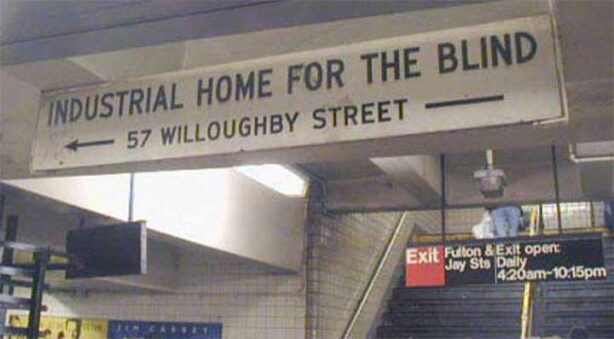
Concerning Braille, the nonprofit Helen Keller Services is located near this station at 180 Livingston Street. On his 2008 survey of Willoughby Street, Kevin Walsh noted an outdated sign at the Fulton Street entrance to the station, “Industrial Home of the Blind” for 57 Willoughby Street, indicating the old location and name of Helen Keller Services. On my visit to the station in 2026, this sign was gone.
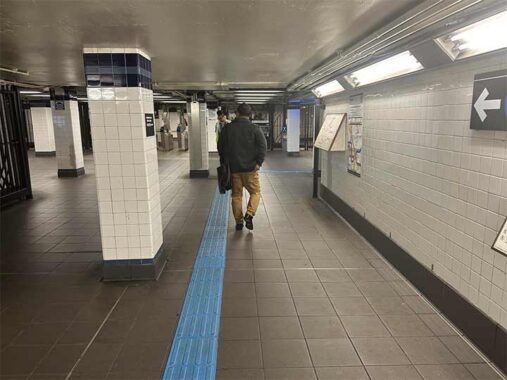
Raised pathways are designed to guide visually impaired travelers throughout this station, from entrance to the platform. Navigating a transit hub can be confusing for a first-time able-bodied traveler, now imagine yourself without the sense of sight. Known technically as tactile guideways, they were invented by Japanese engineer Seiichi Miyake in Okayama. Inspired by Braille, his creation is seen worldwide at platform edges and street corners.
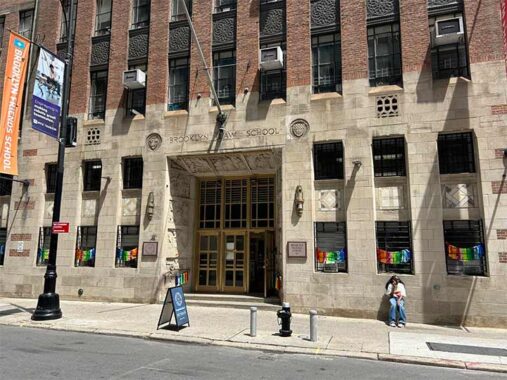
Behind the former transit headquarters is 375 Pearl Street, an ornate building designed for the Brooklyn Law School and later acquired by the Brooklyn Friends School. Constructed in 1928, its main entrance contains reliefs relating to the legal profession and the emblem of Saint Lawrence University. Between 1903 and 1943, the law school was affiliated with this university, whose main campus is near the Canadian border. The Quaker-run Brooklyn Friends School moved here in 1973, with the law school relocating a couple of blocks away to its present campus. To my surprise, this building is not landmarked.
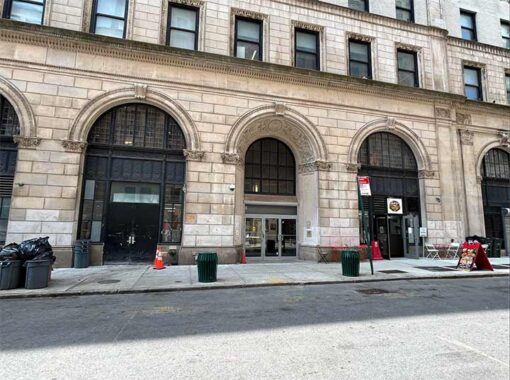
But across the street, the Brooklyn Edison Building is landmarked. After merging into Con Ed in 1943, the former Brooklyn Edison Company offices remained in use by the utility provider into the 1970s. Over the decades, lawyers, insurers, nonprofits, and government agencies moved into this Renaissance-style facility. Its namesake is an ideal fit for Metrotech, as a pioneer in the electrification of Brooklyn, with its main office across the street from the borough’s political center.
As Kevin documented in 2019, downtown Brooklyn had a tight grid of streets that ran their full length, but in the second half of the last century, the Brooklyn-Queens Expressway, urban renewal and pedestrianization reduced and broke up some of the streets here. Pearl Street has two segments, here and in DUMBO where it runs to the East River. Back in 1922, the Jay Street station wasn’t yet built but there was plenty of transit with elevated lines converging on this downtown. The last one here was demolished in 1969, exposing Myrtle Avenue to sunlight.
Having recently taken a new job that involves lecture halls and screens, I took the train to this station to see my optometrist. The Braille lettering here fits with the theme of my visit to downtown Brooklyn on that day.
Sergey Kadinsky is the author of Hidden Waters of New York City: A History and Guide to 101 Forgotten Lakes, Ponds, Creeks, and Streams in the Five Boroughs (2016, Countryman Press), adjunct history professor at Touro University and the webmaster of Hidden Waters Blog.
Check out the ForgottenBook. As always, “comment…as you see fit.” I earn a small payment when you click on any ad on the site.
6/20/26
2 comments
It should also be noted that Brooklyn Law School currently stands on the former location of the Kings County Courthouse, a large, domed ornate structure. That building was demolished when the new courthouse was built across the street, at 360 Adams Street, as part of the Civic Center. Before 1940, the area looked very different, with the Fulton Street elevated running right through the area and a row of shabby stores and apartment buildings standing where the Supreme Court building is now.
As a Brooklyn Law School grad, vaguely recall we had been told in the ancient beginnings BLS was affiliated with a different upstate Catholic college, St. Bonaventure College. Have no idea. Either way such affiliation was long over by the time I got there in the 1980s.