

AFTER Greenpoint’s grid street system was laid out by Neziah Bliss in the early 1800s, east-west cross streets were named simply, A through Q Streets from north to south. Greenpoint Avenue was a plank road that was bridged over Newtown Creek, entering the Queens township that gave the creek its name, but it later became National Street and later, simply L Street. The story goes that by the early 1850s Greenpoint residents were dissatisfied with the bland lettered street names, and thenceforth they acquired names. Interestingly there’s a pattern to those: the ones in the north, Ash, Box, Clay, DuPont — seem to honor the industry and manufacturing along Newtown Creek, though some historians believe Clay Street was named for Henry Clay, the “Great Compromiser” of the US Senate in the early to mid 1800s.
Further south, Huron, India and Java Streets hark to the shipyards found on the East River side, where vessels from the world over unloaded their cargoes. L became Lincoln in honor of the 16th President, while Milton and Noble honor Williamsburg political luminaries. There may have been many Oak trees in the area, while Quay (properly pronounced “key”) is a fancy word for “dock.” There had never been a “P” name, since P Street became Calyer for an early Greenpoint patriarch.
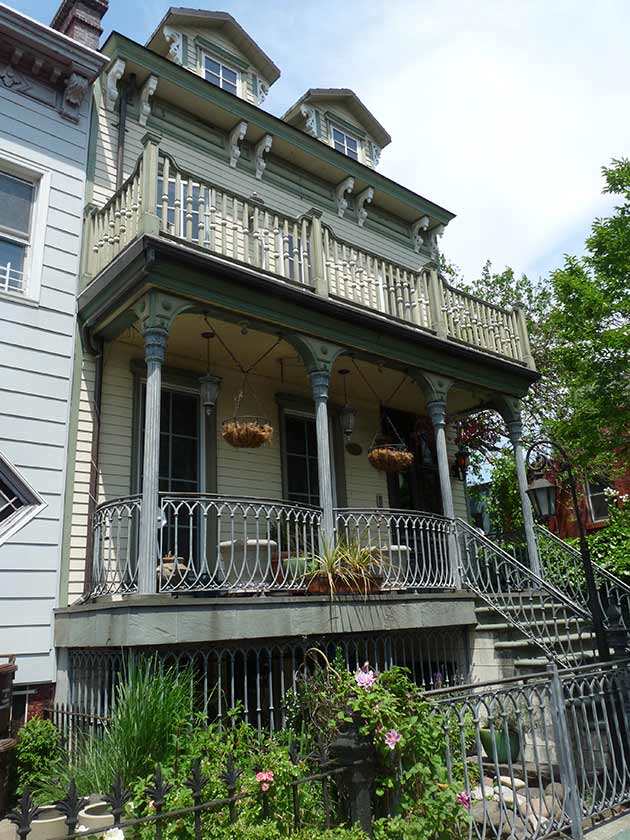
#141 Java Street, west of Manhattan Avenue, is a singularly interesting Italianate-style building, likely constructed around 1860. It’s undergone several changes over the years.


The black and white 1940 tax photo image via 1940s.nyc shows it close to its original appearance. By 1980 however it had fallen on hard times with cheap asphalt siding replacing the original. (1940s.nyc thumbnails don’t disappear when you mouse off them, unfortunately, obscuring some of the photos). By 2005, though, a complete restoration had taken place complete with two new dormers, which didn’t feature on the original construction. Two varieties of railings and extra ornamentation had been added, all new to the classic building.
Suzanne Spellen has much more in Brownstoner.
Check out the ForgottenBook. As always, “comment…as you see fit.” I earn a small payment when you click on any ad on the site.
7/22/26
6 comments
It’s funny that the renovation makes the house look more 19th Century than the original. Dormer windows? Cast iron porches and gates ala New Orleans?
Red Hook used to have a street with the beautiful name of
India Wharf but it got wiped out when they widened the entrance
to the Brooklyn Battery tunnel
You’re wasting time and effort obtaining photos from 1940s.nyc. The site sucks big time. Just check for tax photos at https://nycrecords.access.preservica.com/1940s-tax-photographs/
I know: but I always found the Municipal Archives site hard to navigate and they made it a lot harder a couple of years ago.
I always find comfort in seeing an old house that has become someone’s clearly loved home.
As to the renaming of J Street to Java, as well as the other alphabetized streets in Greenpoint. The change appears to have been made shortly after the 1855 annexation of Bushwick Township to the City of Brooklyn; the renaming of the streets appears to have been mostly random, with the aim of maintaining alphabetical order. I’ve scoured newspapers of the day and have been unable to find any specific reference to an ordinance changing the names, let alone the sources. With the exception of Lincoln, Milton and Noble, it’s almost as if the municipal planners of the time opened up a dictionary and just took the first word that matched the letter designation of the street; the City took a similar random approach with the 1887 renaming of 67 streets in what had been New Lots Township. I’m sure there’s a file tucked away in some municipal office in Downtown Brooklyn, just waiting to be found by some ardent researcher.
The street grids of Greenpoint and Hunters Point when taken together (using the original designations) have a mirror image layout with numbered streets increasing north from Newtown Creek, and alphabetical ones to the south.