
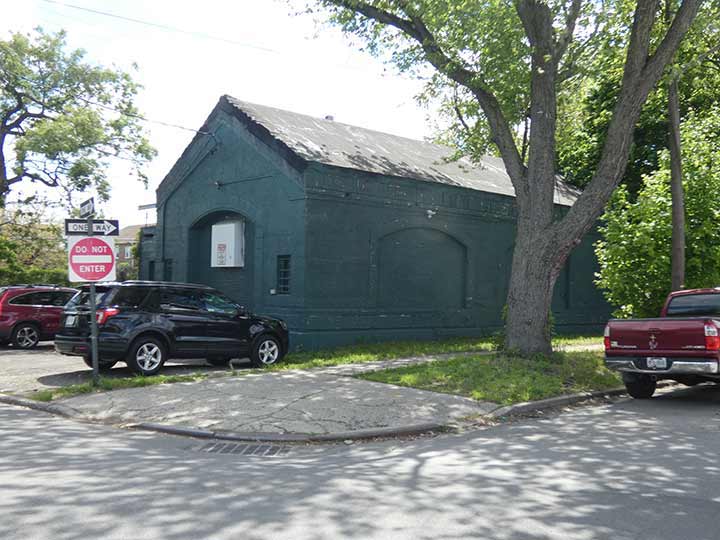

ACCORDING to NYC subway and railroad historian Joe Brennan, the New York, New Haven and Hartford Railroad made its entry to New York via the Harlem Line in 1849, but the secondary route known as the Harlem River Branch was opened in 1868 mainly to make freight connections by water with other railroads. Local passenger service was also run until 1931. The line was rebuilt in 1908-1910 to 6 tracks with complete grade separation, and all new stations. It was also electrified. Most of the branch became part of the Hell Gate Route opened in 1917, the main line from Penn Station to Boston, and so it still has intercity trains today run by Amtrak. The portion south of 142d Street is now open for freight only.
(Footnote: From 1876 to about 1906, two passenger trains a day on a Boston-Washington run were carried by lighter (a barge with rails) between the old Harlem River terminal and the Pennsylvania Railroad at Jersey City, without a New York station stop. That unusual operation was then replaced by an inland route over the Poughkeepsie Bridge, and the trains were finally included among those using the new Hell Gate route starting in 1917.) –J.B.
Of these stations in the Bronx, Westchester Avenue, Hunts Point, Morris Park and City Island Road (now in ruins) are still standing as part of its Penn Station Access Project. Metro-North, a division of the Metropolitan Transit Authority, and Amtrak this week have come to an agreement that will allow trains on the Metro-North, specifically its New Haven line, to enter Penn Station for the first time. The New Rochelle, Larchmont, Mamaroneck, Rye, Port Chester and Harrison lines would provide service to the west side of Manhattan, making commutes there easier for passengers entering from those stations.
Interestingly, the same plan also calls for four “new” stations for local service in the Bronx, to be located in Co-op City, Morris Park, Parkchester, and Hunts Point. However, local transit historians know that this amounts to a restoration of local service to a line that last saw local railroad service in the early 1930s.
The Metro-North is the successor to a number of commuter rail services established as early as the 1830s. All had been acquired by the New York Central Railroad in the 1960s, which then became part of the Penn Central Railroad as well as Conrail. The MTA fully took over all of the Penn Central and Conrail lines in 1983, forming the Metro-North branch known today.
The New Haven Line stations and future Bronx stations that will have access to Penn station originated as the New York and New Haven Railroad in 1849. By the early 1900s the line had expanded and was known as the New York, New Haven and Hartford; it expanded to six electrified tracks, while grade crossings were eliminated, and terminated at the second Grand Central Terminal at Park Avenue and East 42nd Street that opened in 1913.
Proposed new service will run MTA’s Metro-North across the Hell Gate Bridge, which currently carries Amtrak across the East River, and then via Sunnyside Yards and the East River tunnels into Penn Station. Though groundbreaking occurred in 2022, service is not expected to begin until 2030 (realistically, add five to ten years to that date).
While it is likely that four completely new Bronx station houses with modern appointments such as handicapped access will be built from scratch, the NY & NH opened several stations in the Bronx, some of which are still standing and in ruins, all of which were active from approximately 1906 through 1931; they were designed by renowned architect Cass Gilbert.
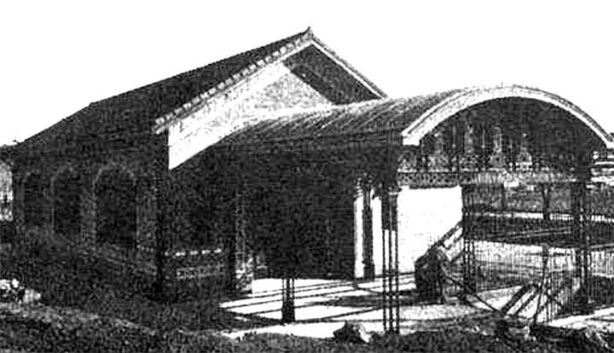
A view of the old Morris Park stationhouse, opened in 1908 or 1912 (research reveals various dates) at #1010 Sacket and Colden Avenues, on the westbound tracks. Naturally, there was also a platform and/or a crossover to the eastbound end, but no trace of it remains. The entrance canopy was removed several decades ago.
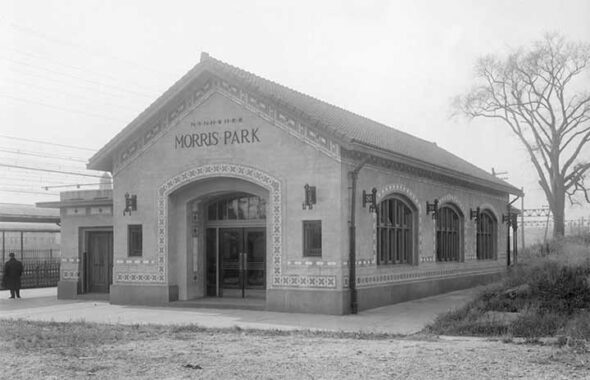
A later view, sans canopy.
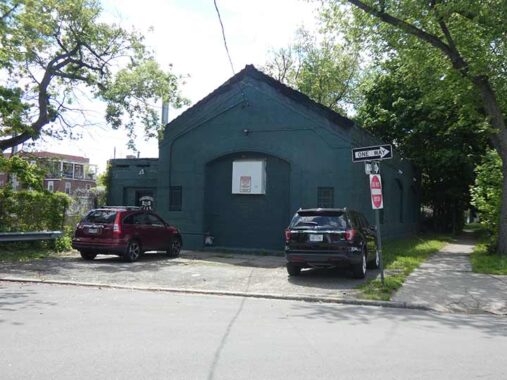
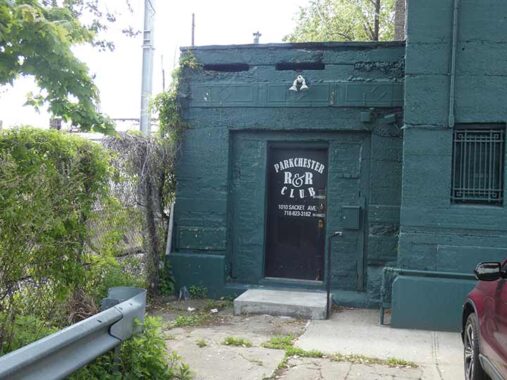
Though I detected no sign of activity when I passed by on Sunday, 5/3/2026, I noted the sign on the door for Parkchester R & R (Rifle and Revolver) Club, which formerly painted the station in an American flag motif.
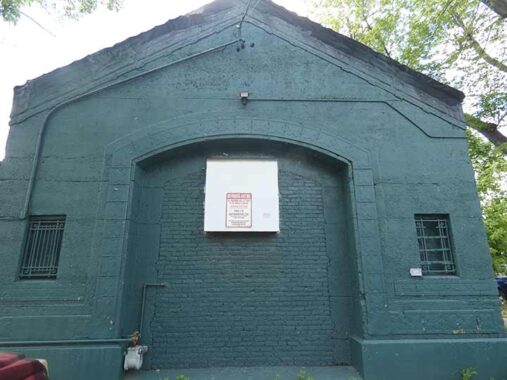
The arched entrance is still detectable, but little of its old glory remains.
Check out the ForgottenBook. As always, “comment…as you see fit.” I earn a small payment when you click on any ad on the site.
7/21/26
1 comment
SWITCH TO NEW STATION ON METRO NORTH RAILROAD STATION ON NORTHEAST CORRIDOR USED BY AMTRAK TRAIN AND GREYHOUND RAILBUS AFTER CLOSING ON 1925